The Pope blesses Pedro Sánchez's migration policy
The pontiff's plane breaks down and King Felipe lends him his 'Falcon' so he can return to Rome

-
CAT -
CAST
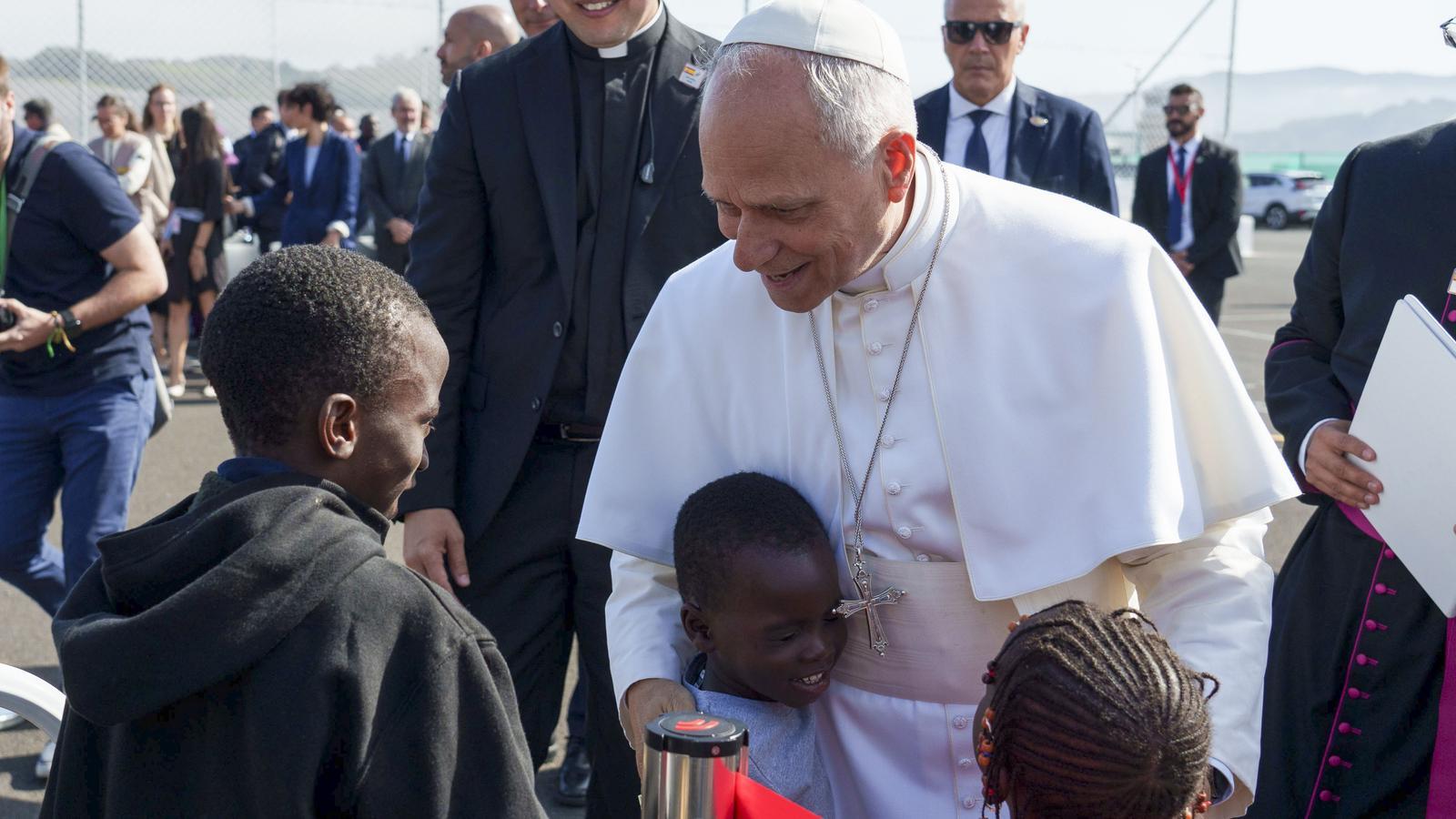
Special envoy to the Canary Islands (La Laguna, Tenerife)The Spanish Prime Minister, Pedro Sánchez, is playing the immigration card to counter the right, coinciding with the moral battle waged by Leo XIV on the same issue. This Friday, the state executive received the blessing of the head of the Catholic Church for its humanitarian work with newcomers. From the Las Raíces immigrant reception center in La Laguna, Tenerife, which houses 700 arrivals from the Canary coast, the Holy Father was clear: "I appreciate the collaboration of the government, various institutions, and so many men and women of good will who make this humanitarian aid possible," he emphasized, in a speech in French so that the 250 people who could witness it would understand.
The Pope's last day in Spain ended with technical problems. The plane that was supposed to take him to Rome had issues before takeoff and, to return to Rome, the pontiff accepted the offer made by the King of Spain. Felipe VI lent him the Falcon, with which he was to return to Madrid, so that he could complete his return to the Vatican. The rest of the papal entourage, including the bishops and the press who followed the pontiff to the Canary Islands, had to wait at the airport for the delays caused by the breakdown to be resolved.

The gratitude towards the Spanish executive is not futile for a PSOE that this very Thursday asked the PP and Vox to listen to the Pope. Christian humanism has been the link that the socialists have clung to with homilies by Leo XIV that they have made their own. On this occasion, it was not the Spanish president who was able to applaud him from the front row of the authorities – he did accompany him yesterday to Arguineguín – but the Minister of Inclusion, Social Security and Migration, Elma Saiz.
In the same vein as what he has done since he arrived in the State, Leo XIV has issued a warning: "We are all, in some way, migrants" because humans are "pilgrims on their way to the heavenly homeland." The pontiff has argued that we must leave behind "a civilization of love and where migrations have an important word to say because they can be an occasion for meeting and mutual enrichment between peoples," in line with what he laid down in black and white in his first encyclical, Magnifica humanitas.
Faced with mostly Muslim newcomers, Leo XIV recalled that the "universality of love" defended by Jesus set the example of "the act of service of a man from another people and another religion who took pity on the injured and mistreated." Minister Saiz also championed "Spain's commitment to a profoundly human vision" of immigration. "We are all new somewhere at some point in life," she said, before citing Saint Paul's first letter to the Corinthians, praising "loving service" and railing against "hate speech" and migrant mafias.
Life stories
The migrant center, although it belongs to the State, is managed by Accem and is responsible for arrivals in the "first reception phase". These people are then distributed to foreign centers of the Ministry of the Interior in the archipelago or the peninsula, as Francisco Navarro, head of Accem Canarias, tells ARA. More than 70,000 people have already been welcomed in recent years, although the maritime tragedy has left many dead.
Boussa Diouf is one of the few women present among the migrants, but she addressed the pontiff: "You look at immigrants with respect, we appreciate your close heart," she said. And after thanking the Church, she defended in rudimentary Spanish "that borders do not become walls of indifference" and that they are not seen as immigrants, and she emphasized humanity.
Among those present, several migrants have told ARA their stories: Fammara is seventeen years old and arrived in El Hierro two months ago. "I was studying science and I would like to continue, I would like to be a scientist," assures this Gambian in English. He came to the Canary Islands due to the extreme difficulties in his country and after having lost his father. Ismaela, 28 years old, drives the point home and states that he wanted to go "anywhere in Europe to work," despite the dangerous seven-day journey. "I really appreciate that the Pope is coming because he is a good person. The image of migrants will change 100% thanks to the Pope, we will be treated better, he can help us get documents. That's what we hope for," he says, hopefully.
And the reason he fled is misery, as other colleagues assure: "Salaries in Africa are very low, that's why I came, to help my family and to be able to return someday. Things are very difficult there." Muhammad Lamine, 36 years old, shares part of the name of the Barça star, but with a laugh assures that he is from Madrid and admires Florentino Pérez: "I want to work and stay in Spain. I think the Pope will help us, he is a good man," he says about the pontiff – whom he had only seen on TikTok. He has left his wife and children and wants to help them from here by working.
Muhammad is Muslim, like all the other witnesses, but feels gratitude for Leo XIV and advocates for a message of unity between Muslims and Christians: "We all believe in one God." Sekou and Souleiman, at twenty years old, left Senegal with some friends to find a better future. Like the others, they hope for a return.
