Podemos: the left of the left that will also make the PSOE its target in the campaign
Irene Montero heads a personalist candidacy that marks distance from the Spanish government and boasts of the alliance with Gabriel Rufián

-
CAT -
CAST
MadridFor the second time in history, Podemos is running in a general election alone in a large part of Spain. The hypothetical alliance to the left of the PSOE dominated the news in the days following the early election call, but the timid contacts between the 'morados' and the new Broad Front –which started with few options of succeeding– ended up failing. This has led Podemos not only to focus its messages against a hypothetical PP and Vox government, but also to insistently distance itself from the role that Sumar has played during the legislature. Irene Montero's initial demand was to choose the head of the list in open primaries to confront the two models, but she ended up acknowledging that the dissonance was much deeper: “We have had serious political disagreements with Sumar for years, we are very critical of its proximity to the PSOE”, she lamented.
And this is being one of the axes of their speeches. The distance between the two alternative lefts has been growing in the last three years. Podemos broke with Sumar a few days after Pedro Sánchez's investiture to have free hands and has taken advantage of the entire legislature to mark its own profile and set itself up as a critical voice against the socialists. It has become an uncomfortable and demanding partner –it overturned two decrees, derailed the delegation of immigration powers in Catalonia and stretched the rope to the limit in other votes– and now aspires to continue pressuring the PSOE.

One of the strengths of the Podemos campaign is the alliance it has articulated with Gabriel Rufián, who has been and will continue to be one of the assets of the purple party, which sells the collaboration as a "tandem". It is rather an asymmetric symbiosis. The leader of ERC in Madrid shows off a collaboration with the left—in his power struggle with the Comuns in Catalonia—and Podemos squeezes the political capital of Rufián, which generates sympathy and support across the state. He and Montero have held events in Barcelona and Madrid, where they will return during the campaign, and they will also go to the Valencian Community and Mallorca.
However, the left is running united only in three communities—in the Valencian Community, in the Balearic Islands, and in the Canary Islands—, where the Broad Front and Podemos will indeed share a ballot. In the five general elections in which the purple party has run, they only went solo in most of the State in the first ones. That was in December 2015. In the other three elections, it erected the formula of United Podemos with United Left—and other regional parties—and in 2023 it joined—dragging its feet—Yolanda Díaz's Sumar. Later they broke up.
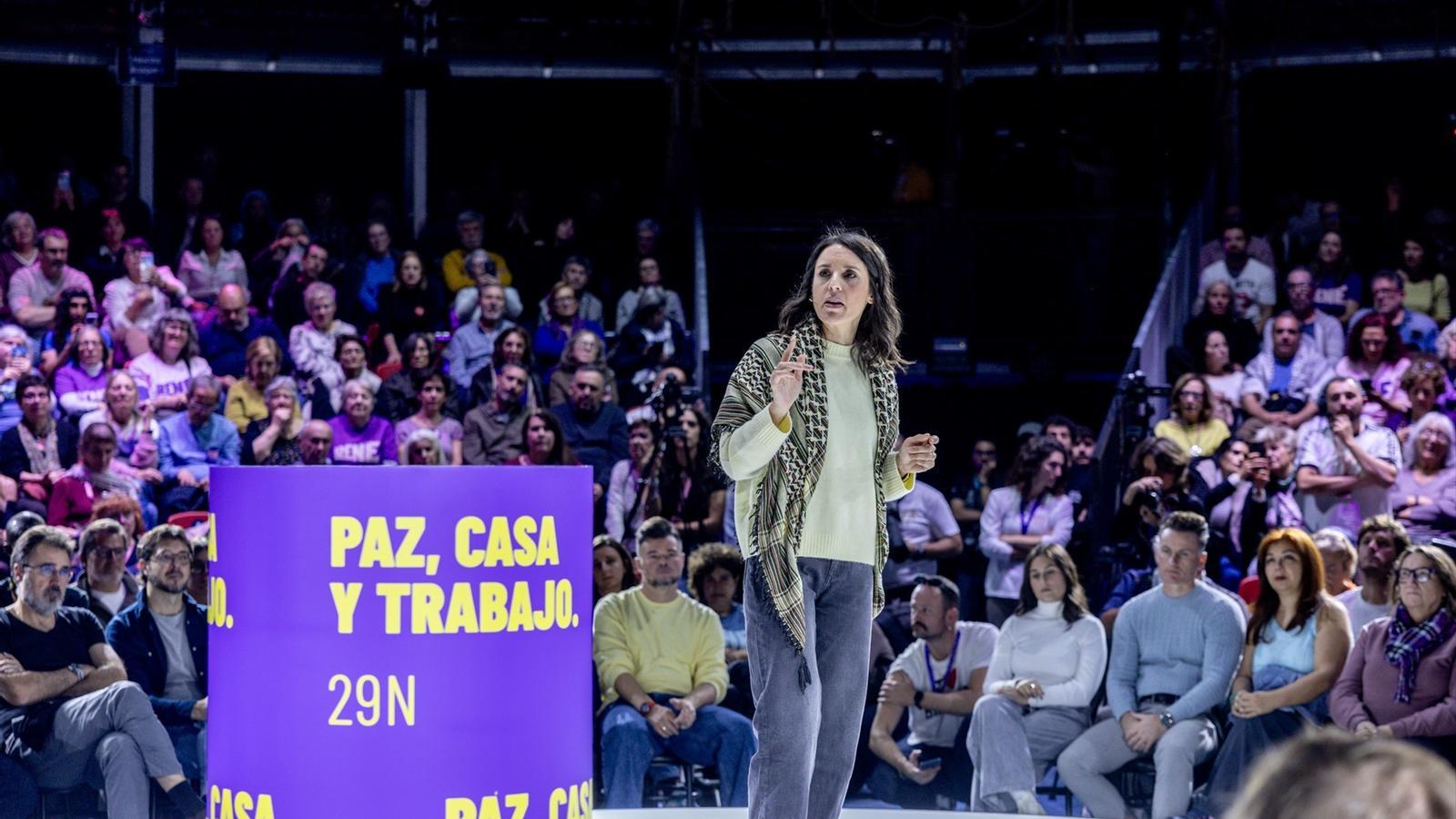
For now, Podemos has set three conditions to renew a pact with the PSOE: "Lower the price of rent, prohibit speculation, and cap the prices of food". Two of the issues it has placed in the crosshairs have been spending on armaments—with an alternative proposal on where to allocate the money—and the concentration of wealth. The campaign image hides the party's logo and the traditional purple color and bets on a personalist message centered on the candidate and with three omnipresent words: peace, home and work.
Where could it win seats?
To a large extent, Podemos's chances of obtaining seats have to do with territorial alliances. One of the deputies they could obtain is Alejandra Sandoval, a councilwoman at the Sabadell City Council and number six on the ERC list in Barcelona. Another deputy who could make the leap to Congress is Mari Tere, the leader of Podemos in the Valencian Country and head of the list in Alicante for the Valencian Front.
However, evidently the jewel in the crown is Irene Montero, who is number one for Madrid. The polls place the purple party at the limit. They would have to obtain more than 3% of the votes –in the 2024 European elections it exceeded 4%– and that the distribution according to the D'Hondt law would smile upon them.
