Government and Commons agree on 2.5 billion for housing and rethink the R-Airport
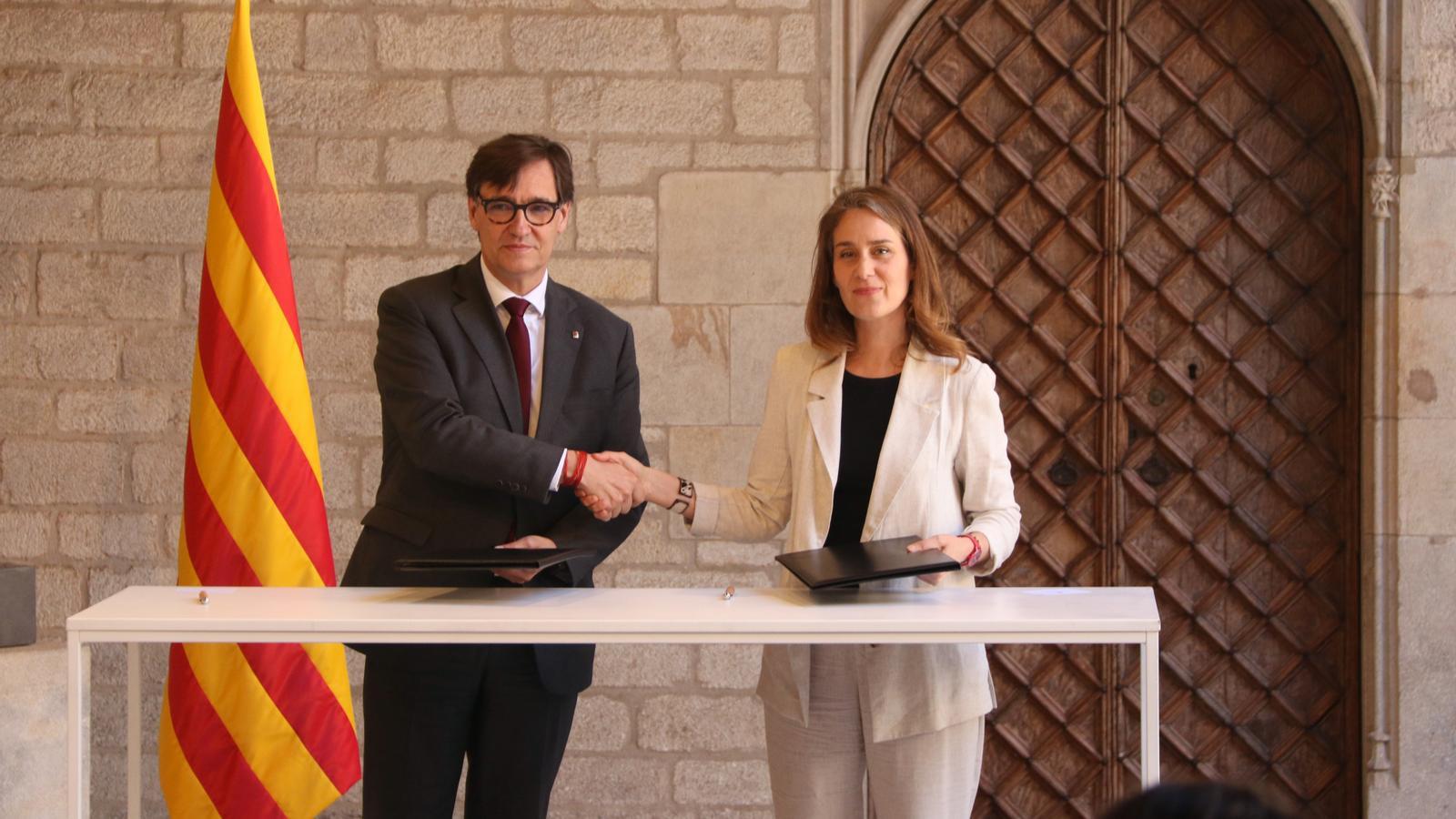
Illa and Albiach seal the definitive pact for the budgets, which could see the light at the beginning of July
-
CAT -
CAST
BarcelonaThe Government already has all the support to approve the budgets for 2026. After this week's agreement with ERC, validated this Wednesday by the Spanish government, the executive and Comuns have signed their definitive pact for the accounts this Thursday morning, which includes 2.5 billion for housing and rethinking the R-Aeroport, among others. Salvador Illa and Jéssica Albiach have sealed the understanding at the Palau de la Generalitat and this Friday the Government will approve the numbers in an executive council, with the aim that Parliament definitively validates them in the first fortnight of July.
The agreement with Comuns is an update of what the two parties closed in February and which already included measures on housing and mobility. Three months ago, the housing item was set at 1.95 billion, which included, among others, about 300 million to expand the public housing stock and 300 more to finance rent subsidies. In addition, it also contemplated allocating 150 million euros to housing rehabilitation and 600 more through the Catalan Institute of Finance (ICF). Now these amounts are increasing: the Generalitat's own resources allocated to housing grow to 1,500, while the ICF will finance 1 billion.
Furthermore, Comuns has also agreed to create a General Directorate of Housing Discipline, responsible for inspecting and fining non-compliance with the law in matters such as the rent price cap. In a press conference, Albiach explained that the "regulatory changes" must now be made – they will be incorporated into the accompanying budget law – so that this new directorate is ready in August. The agreement also provides for a new law to convert empty offices and commercial premises into official protection housing (HPO).
the claims of user and expert platformsMobility and energy poverty
Regarding mobility, the two parties have agreed to study whether the R-Aeroport can be reconverted into another Rodalies line by 2030, one of the demands of user platforms and experts in the rail sector. "By 2030, what we have agreed is to reconvert it into an extension, let's say, of the R4. That is to say, that this R-Aeroport ends up being another line in the Rodalies network," said Albiach in an interview on TV3. In the agreed document, however, there is talk of "commissioning a study" to incorporate the "transformation" of the line into the Government Plan and "maximize the benefit for the entire railway system." "It cannot be that with the situation of Rodalies, the Government only thinks about trains for tourists," added the leader of Comuns in Parliament.
Furthermore, the Government has committed to promoting the Solidarity Support Fund before the summer of 2026, which will serve to rescue families in situations of energy poverty. The fund must respond to the termination of the agreement with electricity companies to forgive the debt of vulnerable families, which ended on December 31, 2025. In fact, Comuns has incorporated this issue after the Government rejected one of its requests: the Zucman tax, which taxes 2% of assets over 100 million euros. "The Government of the Generalitat did not see it clearly," admitted Albiach. Now Comuns will introduce a bill in Parliament to defend this tax, but it will need the support, at least from the PSC, for it to move forward. However, the Catalan chamber would only be the first stop, as this tax must go through Congress.
Regarding health, the executive has also agreed to develop a plan to increase the number of midwives and to retain those being trained in Catalonia. In addition, they have also agreed to create the General Commission for the Prevention and Reporting of Male Violence during the next year.
The unknown factor now hanging over the budgets is whether they will incorporate the demands of the education sector, up in arms to achieve labor and resource improvements for schools. The last meeting between the unions and the department ended without agreement but with a new timetable for negotiations which, for the moment, will be extended this Thursday afternoon, Friday, and Tuesday of next week. Regarding this, Romero clarified at a press conference that both the Government and ERC and Comuns are willing to review their respective agreements if there is an understanding between teachers and the Generalitat and if "more resources" are needed for the Education budgets. Albiach reaffirmed that they are open to "reprogramming" their agreements.
Calendar: approval, at the beginning of July
This very afternoon, at 5 p.m., President Illa will sign another agreement related to the budgets with the Social Third Sector. And all this, after in the last few hours the pact with ERC has been endorsed both by the State, through the Bilateral Commission with the Generalitat, and by the ranks of Jovent Republicà, the youth wing of ERC.
Once the Government approves the accounts this Friday, the processing in Parliament will take about six weeks, so they could see the light in the first fortnight of July. The calendar could be cut short, however, if any party requests a ruling on the numbers from the Council of Statutory Guarantees, which would have to rule within a month, during which time the budgetary processing would be halted. Be that as it may, Romero has celebrated that finally the budgets – the first of Illa's presidency – have a guaranteed parliamentary majority and considers that they demonstrate the "stability" of the investiture majority.

