
Before the Constitutional Court's decision was known, it was learned that Madrid's investigative court number 35 has admitted for processing a complaint from the ultra-conservative group Hazte Oír against Sofía Puente: they will investigate her because they believe the facts “present characteristics that suggest the possible existence of the crime of administrative prevarication.” She is the sister of Minister Óscar Puente and was the Director General of Legal Security and Public Faith who signed the instruction that complemented the Democratic Memory Law and which the Supreme Court has called into question. The Public Prosecutor's Office had requested the dismissal of the lawsuit, arguing that in 2022, the Association for Reconciliation and Historical Truth had filed one that was “coincident” with this one and which was archived.
The Constitutional Court maintains the ban on voting for those naturalized under the 'grandchild law'
The court of guarantees overturns the appeal of the Ombudsman against the decision of the Supreme Court

-
CAT -
CAST
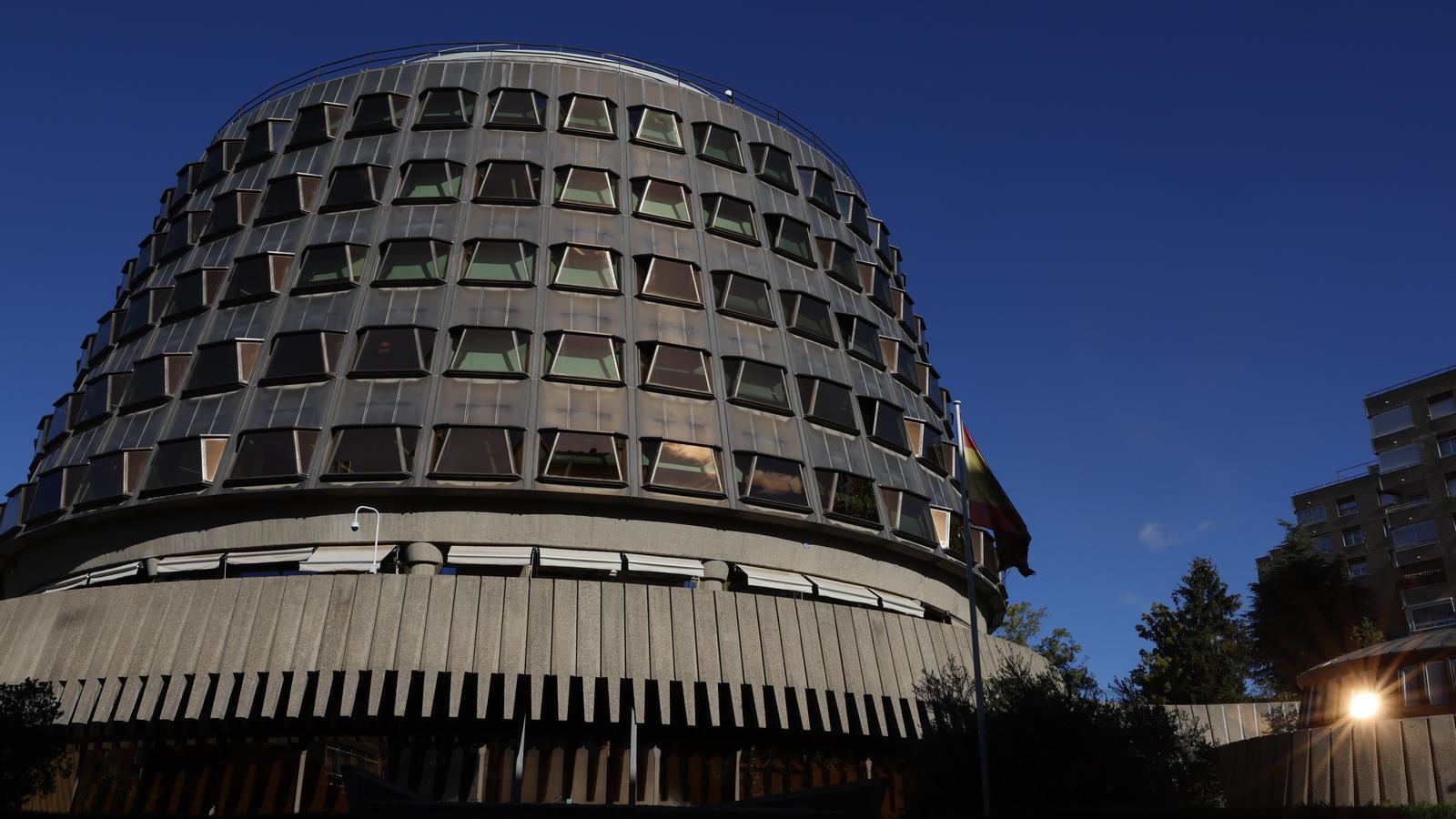
MadridThe Constitutional Court does not, for the moment, authorize the vote for people nationalized under the Democratic Memory Law. The high court has halted the appeal for protection filed by the Ombudsman against the Supreme Court's decision to suspend the right to vote for all those who have not proven that they are descendants of exiles. Therefore, there will be 163,000 people with Spanish nationality – 0.41% of the census – who will not be able to vote in the general elections of November 29 if they do not prove that they meet the requirements. Ángel Gabilondo denounced that the Supreme Court's decision violates the rights to equality, to participation in public affairs, and to effective judicial protection. However, the court of guarantees considers that it is “premature” to study the appeal because the Supreme Court opened a period for allegations that has not yet ended. Once it has ruled again, after studying the complaints of those affected, the Constitutional Court could indeed agree to study an appeal for protection.
The Ombudsman warned that maintaining the voting ban would be an “irreparable injury” because citizens will not be able to vote retroactively, but the appeal for protection did not even pass the first filter and was rejected by ten votes to two. Two progressive magistrates, Juan Carlos Campo – who was Minister of Justice under Pedro Sánchez from 2020 to 2021 – and Ramon Sáez Valcárcel, have announced dissenting opinions in favor of studying the appeal.
Immediately afterwards, Spanish government sources have assured that they respect the decision for “procedural reasons,” although they trust that in the future there will be a “definitive decision” that makes it clear that “the right to vote cannot be massively suspended with a precautionary measure, without a final judgment and without a hearing for each affected person.” “There cannot be second-class citizens with different rights,” they insist from Moncloa. For its part, in a statement, the Ombudsman has expressed that it “respects” the decision, but has shown “concern” that the suspension could prevent “exercising the fundamental right to vote for Spanish citizens”.
Ángel Gabilondo urged the Constitutional Court to act quickly in the face of an "exceptional urgency" to "preserve the right to active suffrage without limitations not provided for in electoral regulations." His appeal sought for the Central Electoral Board to keep Spanish citizens residing abroad registered in the Electoral Census of Absent Residents (CERA), arguing that the precautionary measures to exclude them generate "undoubted legal uncertainty" and an "excessive intervention in the framework of the exercise of fundamental rights." Likewise, he stressed that the "link between being Spanish and the right to vote" is "indissoluble."
Subsequently, an affected citizen –an individual of Argentine origin, naturalized in 2025 and defended by the firm of former judge Baltasar Garzón– joined the appeal. The document, to which ARA has had access, maintained that the Ombudsman's request was "essential" and "the only legal path" to preserve the right to vote and argued that the Constitutional Court's ruling is the "appropriate mechanism" to "safeguard it." However, the Constitutional Court has not taken into account this document nor those presented by Iustitia Europa and Vox –the two parties that brought the issue to the Supreme Court– because the procedure was not yet formally open.
The allegations to the Supreme Court
In parallel, on Friday the deadline given by the Supreme Court to those affected to submit allegations ends. One who submitted them, for example, was the Center for Descendants of United Spaniards, which demands that the general interest prevail. As ARA has learned, the document speaks of discrimination and alleges that the Sephardic people or the international brigadists used similar paths to obtain Spanish nationality. It also regrets that those affected were not able to be part of the process until the decision had been made and denounces a clear violation of the right to vote, which it recalls is not restricted even in times of war or among prisoners.
Subsequently, the contentious-administrative chamber will rule again. And it will be after this position that someone could file a new appeal for constitutional protection (recurso de amparo). In parallel, this noon the 24-hour deadline that the Supreme Court gave to the parties to give their opinion on the decision of the Central Electoral Board to send electoral documentation to all those registered in the CERA with a “warning of the possibility” that they may have their electoral rights suspended has expired.
