The Broad Front trusts in the irruption of Ada Colau to re-edit the coalition government
The candidacy to the left of the PSOE starts with the objective of surpassing 10% of the votes to become decisive again
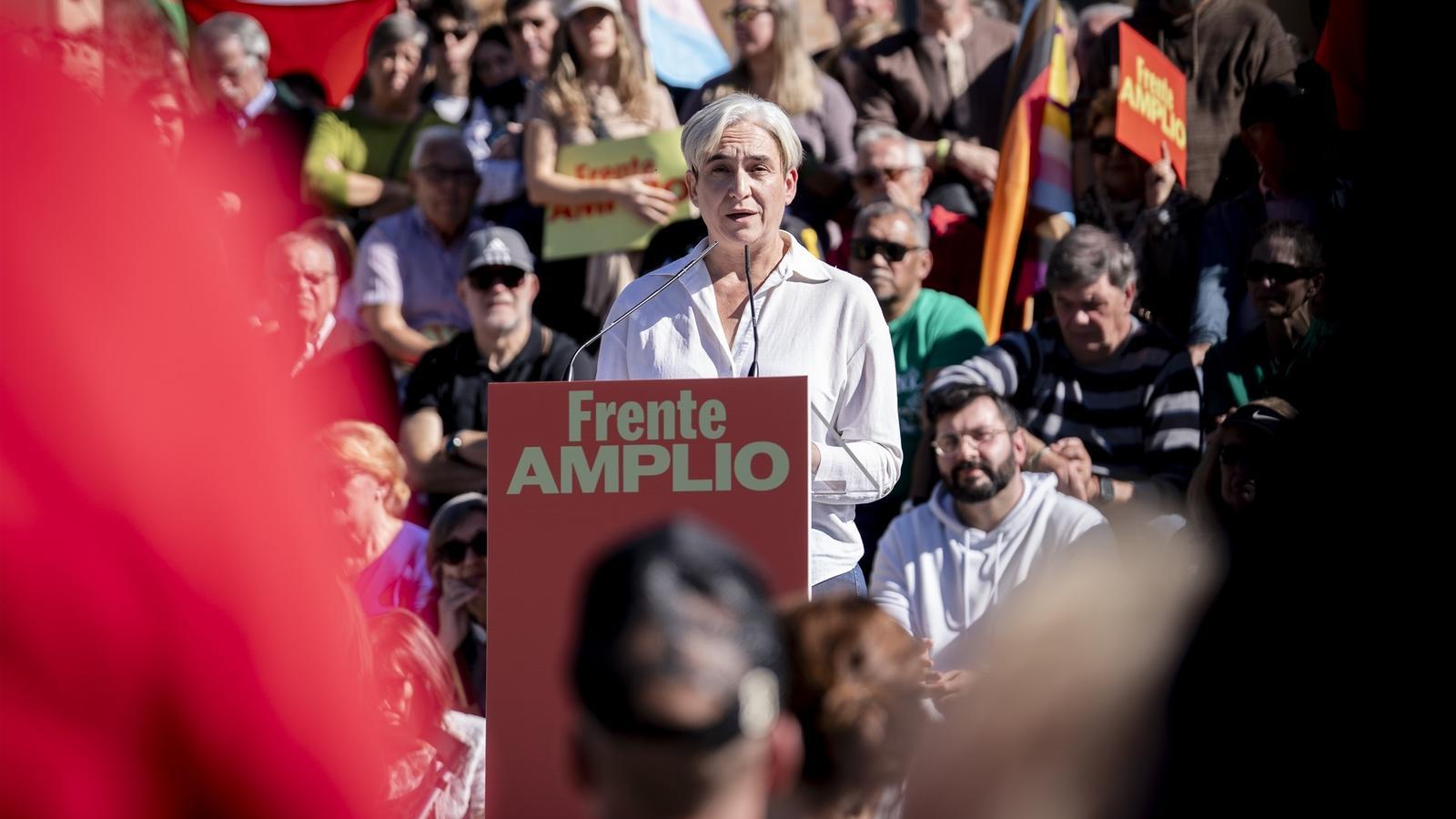

MadridTwo years after leaving Barcelona City Council railing against the “mediocre and greedy elites” of the Catalan capital, Ada Colau has decided to return to the political arena with the goal of “taxing the rich.” She does so by heading the Broad Front, the new coalition to the left of the PSOE and heir to Sumar, the platform that Yolanda Díaz promoted three and a half years ago. For months, Comuns, Moviment Sumar, Esquerra Unida, and Més Madrid had been working—slowly but surely—to articulate a new horizontal alliance, prioritizing the program and trying to avoid personalisms. But it had an Achilles' heel: leadership.
Since the public presentation in February, the speculation and rumors about who would be number one have not ceased. There were discrepancies regarding the pace, and the snap election caught the coalition without having finished its homework. The name—which was indeed finalized—was unknown, and it remained to be decided who would lead it. Minister Pablo Bustinduy ruled himself out—though he is acting as a spokesperson during the campaign—and the names of Unai Sordo—General Secretary of CCOO—or Minister Ernest Urtasun were also floated. In the end, Més Madrid took a step forward proposing Ada Colau and the former mayor of Barcelona ended up being enthroned. Initially, she had set a condition that Podemos should also be on the ballot: “If we are all here, I will be here too,” she said. However, she ended up accepting without the purple party joining, and despite some siren songs, she will end up facing them in most of the provinces of the state.
The Broad Front also has territorial variations. In the Valencian Country, the ballot was formed under the auspices of Compromís, in the Balearic Islands, the alliance with Ara Més has been re-edited, in the Canary Islands the collaboration has been with Nueva Canarias, and in Aragon, it has reached an agreement with the Chunta Aragonesista. In the first three cases, Podemos has also joined. With the start of the election campaign, one of the big unknowns is when and where Yolanda Díaz will intervene. The founder of Sumar and Minister of Labor will participate, but it is not yet known in what format. On Monday is the vote to elect the new Director-General of the International Labour Organization, the position to which she aspires.
Tax the rich
The Broad Front's roadmap vindicates the major social measures promoted by Sumar during the legislature, such as paternity leave, the dependency law, or increases in the interprofessional minimum wage, but it aspires to “overcome the resistances that have prevented going further” in a transformation they admit “remains unfinished”.
The candidacy places housing at the center of the campaign and champions the role of Ada Colau as a “benchmark for the right-to-housing movement” and as a “combination” of social mobilization through the PAH and transformation in institutions as mayor of Barcelona. Two of the first proposals she has put on the table have been a tax on large estates dubbed as tax the rich to force fortunes of over one million euros to pay 2% of their assets each year and a law to expropriate homes from vulture funds that own more than 1,000 apartments.
The goal for the coming days is clear: to overcome the 10% vote threshold. In the candidacy’s engine room, they are convinced it is essential to win the seats that are in contention in different provinces—which are being disputed with Vox—and achieve an “exponential multiplication” of deputies. Ada Colau assures that they are currently at 8% in voting intention, but predicts that by taking a leap forward they could go from 8 to 22 seats. Among the provinces they have marked in red are Barcelona and Tarragona, although the polls in Catalonia—for the moment—do not bode well for them.
