"I didn't know Pedro Sánchez had a brother": the accused deny preferential treatment
David Sánchez liquidates in 10 minutes the declaration without responding to anything about his hiring

-
CAT -
CAST
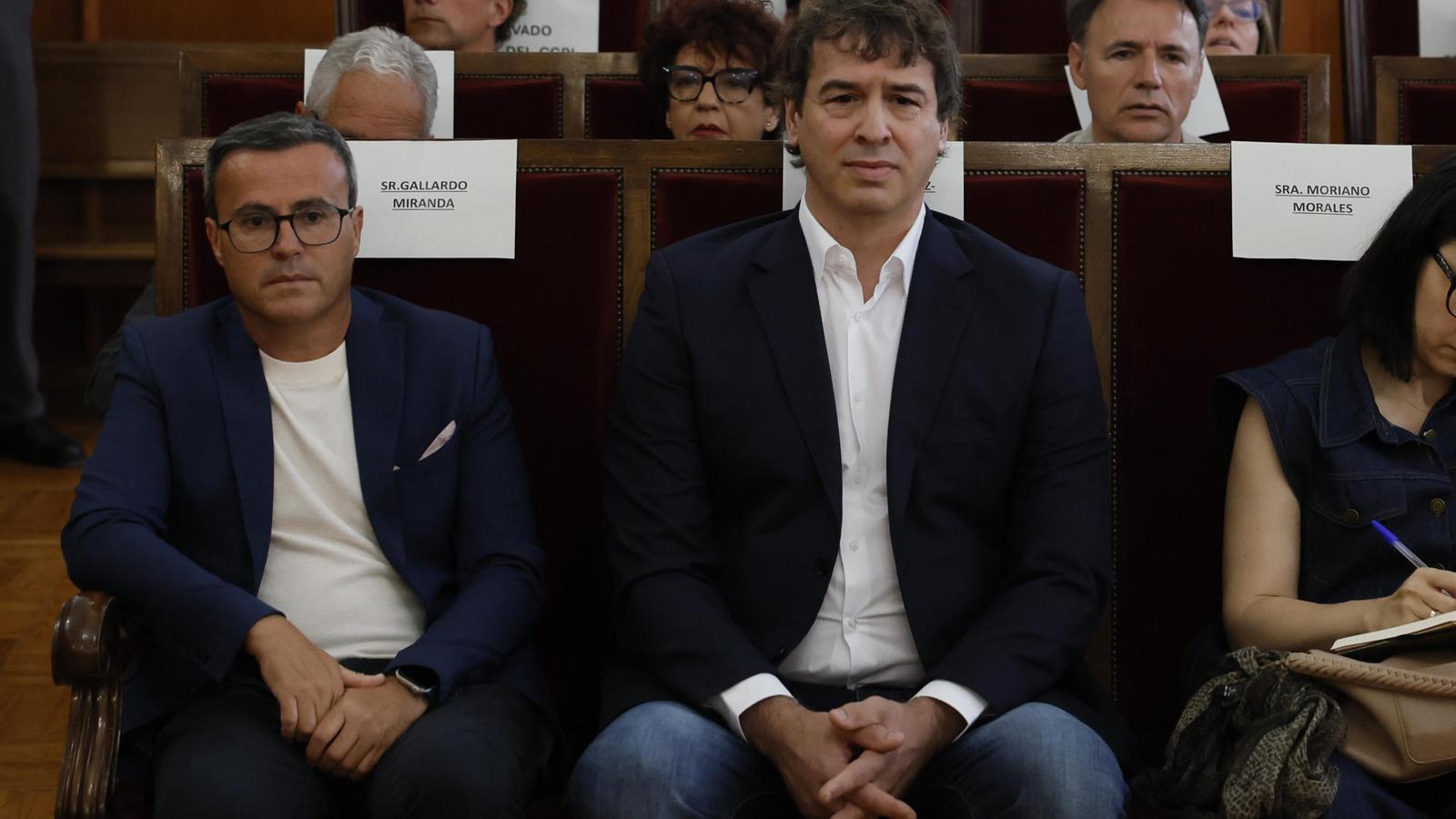
MadridDavid Sánchez's anticipated statement at the trial over his hiring at the Badajoz Provincial Council lasted 10 minutes and 20 seconds. He was only questioned by his lawyer, Emilio Cortés, who asked him 25 questions about his office, the change in his job title, and the hiring of a friend who helped him. Sánchez, however, made no mention of how he obtained the job in 2017. He also did not allude at any time to his brother and the President of the Spanish government. In fact, in the statements of the rest of the accused and witnesses of the day, there was a common element: no one knew - according to what they said - that Pedro Sánchez had a brother.
The lawyer began the interrogation by asking about the office David Sánchez used, because during the investigation a cut video had circulated that made it seem like he didn't know where he worked. He wanted to address the rumors. What was the Office of Performing Arts that he directed? "It was not understood as a physical office with a counter or a physical building," he said. That is to say, it was not a building, but an administrative category.
David Sánchez began as coordinator of the conservatories' activities, and later, his position's designation changed, which the accusers find suspicious. However, the accused has completely distanced himself from it. He said he found out "when it had already been done," stressed that he continued to receive the same salary, and justified the reasons: "It occurred due to the natural evolution of the activities." And his lawyer reinforced the explanation: "There was an increase in the volume of subsidies and a certain geographical expansion related to the initial mandate."
Emilio Cortés pointed out that the popular accusers – made up of regular players in the judicial siege of the PSOE, such as Manos Limpias, Hazte Oír, the PP, Vox, Iustitia Europa, and Liberum – say that the name change was a "kind of disguise" to adapt the workplace to his "personal preferences," as if it were a "whim" of his. And he also denied it: "All activities were framed within the institutional activity of the Provincial Council. They were advertised with logos, there were files and controls."

The other leg of the accusation is the hiring of Luis Carrero, a friend of his who previously worked at Moncloa and who also sits on the defendant's bench. Previously, he helped him to "better draft" his ideas in an "uninterested" manner because he was a "person very interested in cultural projects". David Sánchez has denied influencing anyone to hire him, said he did not speak to anyone, and assured that he had no privileged information about the procedure. His lawyer alluded to an email from October 2023 between the two that suggests the position was awarded 23 days in advance, and he wanted to provide context: "He tells me that the position was already there. I confused that the position was awarded with the publication of the position. Luis corrects me and tells me that he has no news or calendar," he stated. And he made it clear that he had no influence: "I have neither the capacity to say anything nor administrative information about the status of the procedure".
Regarding Carrero's functions, he acknowledged that he was a "very capable" person, but pointed out that the work he was supposed to do required technical training that he has and Carrero does not: "He is a very talented person, but he cannot do my job." Carrero later corroborated this: "I could occasionally collaborate with him, but in no case did I do his work because I am incapable of doing it." Carrero admitted that he had a friendship with David Sánchez since 2008 and that he informed him that the Culture area would be strengthened: "He told me that a position would come out and that I should keep an eye on it if I was interested," he explained, although he had doubts about changing jobs.
A necessary position
Miguel Ángel Gallardo, president of the Diputación and leader of the PSOE of Extremadura at the time of the events, has pointed out that Pedro Sánchez was neither president of the Spanish government nor secretary general of the PSOE at that time and has denied that he made any request to him about his brother: "I did not have a fluid relationship with him and not even at that time was I aware that he had brothers". He also denied that the position was intended for David Sánchez: "I did not say or suggest who should be appointed for that position, I thought 'May the best win'", he made clear. Regarding the modification of David Sánchez's job position, he assured that he did not intervene: "I had no participation, it was a technical matter".
The former director of the Culture area of the Badajoz Provincial Council, Elisa Moriano, said that she never met with anyone to create David Sánchez's job. “My profile was merely technical - she added -. I did not modify the requirements for this job and the applicants received equal treatment and the most suitable candidate was finally chosen,” she added. For her part, the former deputy delegate for Culture of Badajoz, Cristina Núñez, said that it was not “the only position that was created” in her department that legislature and that she also did not know who David Sánchez was when he applied. “The position was processed quickly because we wanted it to be operational before the next academic year,” she pointed out. Regarding whether David Sánchez carried out his activities, she said yes, and gave different activities as an example. “No one told me that he was not working,” she concluded.
Juana Cintas, former director of human resources for the Badajoz Provincial Council, said she did not know the functions Sánchez performed because it was not her responsibility. “No one informed me of what he did or did not do,” she summarized. In any case, she explained that she had no knowledge “of any non-compliance or complaint” from Sánchez's brother on the part of any employee or superior. Manuel Candalija, general director of Culture, defended Sánchez's selection because the other candidates did not merit more than him to obtain the position.
