Junqueras: "I went to jail for Catalonia, not because Colau is a deputy on an ERC list"
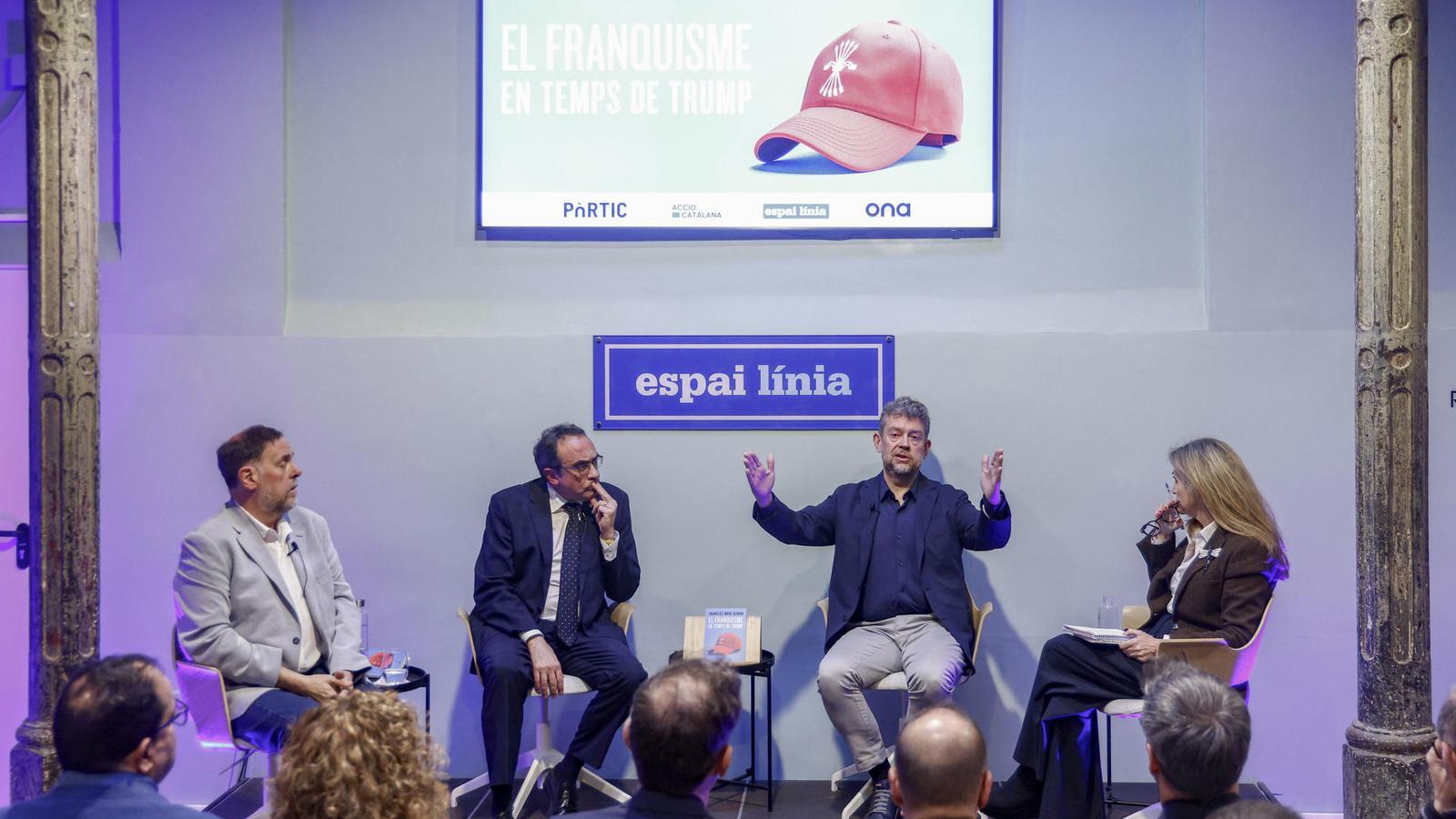

BarcelonaThe ERC deputy in Congress Francesc-Marc Álvaro presented the book, but it was another republican in Madrid who took the party president's message. "I went to jail for Catalunya, not because Colau is a deputy on an Esquerra list." Oriol Junqueras has cut short the unitary list of the left promoted for weeks by Gabriel Rufián with the collaboration of his former colleague in the lower house, Joan Tardà. In fact, a few days ago Tardà himself suggested in an interview in Público that Colau be number 2 on a list headed by Rufián and that David Fernàndez (CUP) also be in third position.
In Calabria street, Tardà's and Rufián's moves are not liked, and whenever they can, they insist that ERC will run under its own banner and avoid experiments to save the Spanish left. In this case, Junqueras took advantage of a question from the director of ARA, Esther Vera – who was moderating the book presentation – to throw a dart at Rufián, who on April 9 will star alongside Irene Montero, one of the leaders of Podemos, in an event at the Universitat Pompeu Fabra.
The president of ERC, then, has taken one of the headlines of the night, even though at this afternoon's event he was one of the supporting actors, alongside the president of the Parliament, Josep Rull, both initially destined to accompany Francesc-Marc Álvaro. This was the case for much of the presentation, in which the journalist from Vilanova has shown that his time in politics has not diminished his analytical capacity, which made him one of the most incisive pens in recent Catalan journalism. In his book, Francoism in the Age of Trump (Pòrtic), he takes the opportunity to break down what we could define as the theory of xarneguismo against Trump. Álvaro explains that his paternal grandfather came from Torre Pacheco, a Murcian town sadly famous for the racist riots sponsored by Vox, and that in Catalonia he found a home where he could prosper and a nation with an inclusive concept of identity that he opposes to Trumpism and its franchise in Catalonia, Aliança Catalana and Sílvia Orriols. "We are all xarnegos," he exclaimed.
The book is about Vox, but the debate moderator asks the participants to engage in an act of political introspection to discern what lies behind the emergence of a far-right with a distinctly Catalan matrix. The event is a small miracle (or should we say mirage?) of Catalan politics. Sitting side-by-side, Rull and Junqueras share diagnoses and exchange pleasantries. So much so that at one point Junqueras exclaims "I am a Rullista!", to general laughter. Among the audience, the miracle is also repeated: people from ERC like Isaac Albert, Esther Capella and Joan Ignasi Elena share space with former convergent councilors like Boi Ruiz and Lluís Recoder or Junts members like Josep Maria Argimon. "Here we have an alliance of democrats and Catalanists," emphasizes Álvaro, who then recalls other examples of Catalanist ecumenism, such as Catalan Solidarity of the early 20th century, anti-Francoism, the Benet-Pujol relationship or the Procés. And as the presenter of the event, another example of a transversal Catalanist like Carles Campuzano, on behalf of Acció Catalana.
Battle for Civilization
The fight against the far-right is, according to him, a "battle for Western civilization", and specifically its two most valuable fruits, democracy and the welfare state. That is why he calls for the weaving of broad consensuses and broad agreements. And with no one should it be easier to reach an agreement than with Josep Rull, who calls for an aggiornamento of how Catalan identity is understood to be as inclusive as possible. Rull appeals to the spirit of October 3, 2017, the moment when Catalanism was closest to heaven.
Things, however, did not go entirely as expected. Junqueras and Rull shared prison and a police van. "The Spanish judiciary has Francoist tics," recalls Álvaro, who concludes with another sentence that makes the audience nod: "The best way to be anti-fascist is to be Catalanist".
