The traditional chocolate tasting that Jordi Pujol had institutionalized during his term has returned to the Palau de la Generalitat. Salvador Illa wanted his second Sant Jordi as President of the Generalitat to revive a breakfast that was discontinued in 2011. This was after his institutional message (where he defended Catalan) and after participating in the Sant Jordi mass officiated by Archbishop Joan Josep Omella, which was also attended by ministers Albert Dalmau, Núria Parlon, Sílvia Paneque, Jaume Duch, Núria Montserrat, Berni Álvarez, and Miquel Sàmper, in addition to Illa. Illa acted as host at an event attended by institutional representatives and most of the Catalan parliamentary spectrum. Former Presidents of the Generalitat José Montilla and Artur Mas were also present, for example. The breakfast featured quite relaxed scenes, such as the one between the Minister of Economy, Alícia Romero, and the deputy to the presidency of Junts, Albert Batet. Both were discussing the current political situation before various journalists, including some barbs. Romero reproached Batet for Junts' role in the Parliament – "You need to regain your judgment" – she prescribed. Shortly after, the spokesperson for ERC in the Parliament, Ester Capella, arrived and asked Batet if they would endorse the investment consortium in Madrid. In fact, Romero and Capella presented a united front here. The conversation also turned to the "Dragon Khan" of the governments that Junts and ERC shared, until Illa joined the conversation and brought it to a close. "The chocolate is very good," Batet told Illa.
From Vox's "neither strip nor 'fronjo'" to Illa's stroll among books: politicians' Sant Jordi
The parties take to the streets to claim a Diada that does unite left and right

-
CAT -
CAST
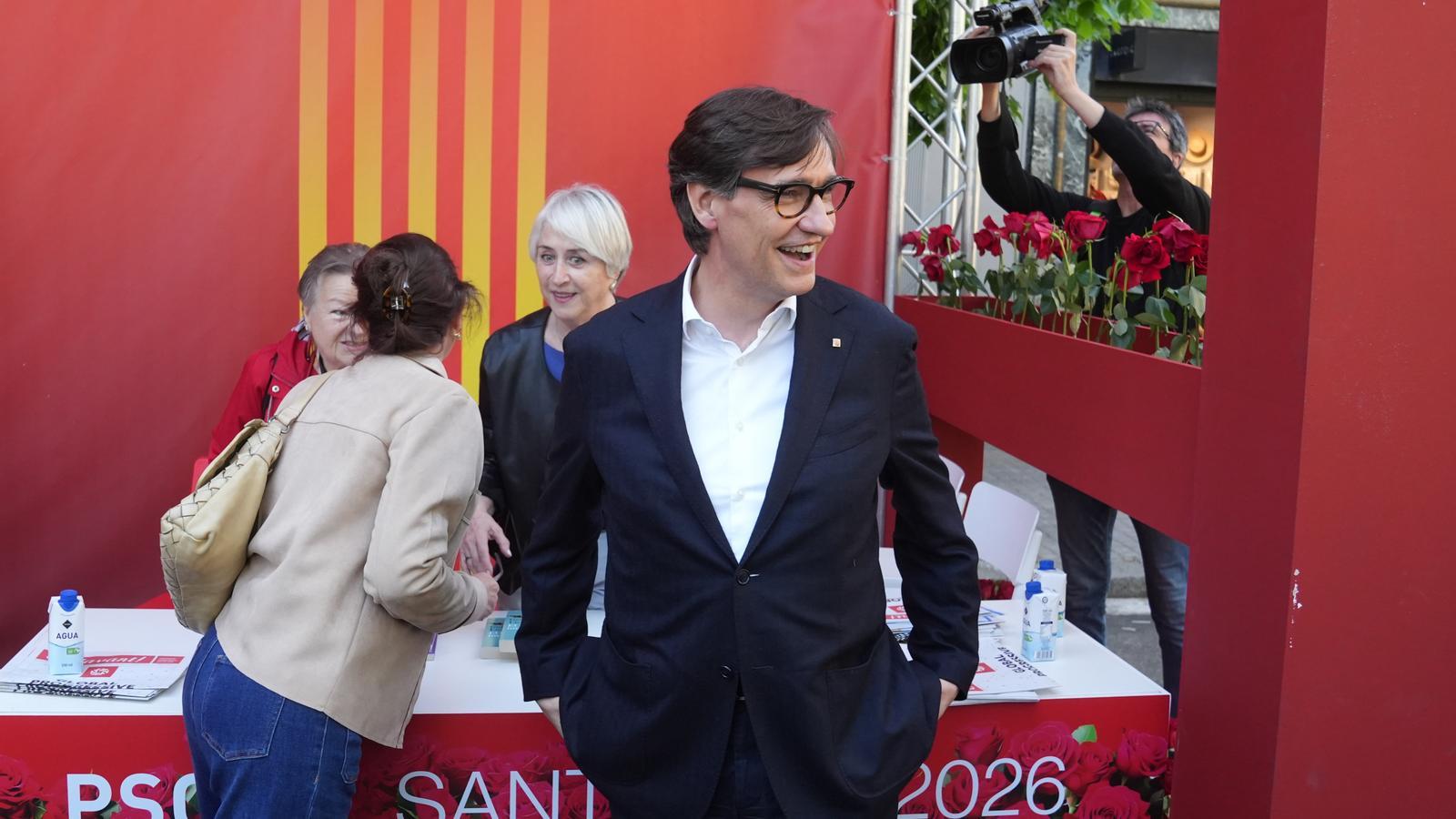
BarcelonaPresident Salvador Illa is known for being a punctual person. And this Sant Jordi day, he even arrived a quarter of an hour early. The head of the executive arrived at quarter past four at the PSC stall when journalists had been summoned for half past four and made a lightning tour of the intersection of Rambla Catalunya with Diputació street. There, Illa took the first photos with some supporters and exchanged a few words with the second vice-president of the Parliament's board, David Pérez, and also with the Minister of Justice, Ramon Espadaler.
It was the first stop on the approximately one-hour walk he then took along Passeig de Gràcia with his wife, Marta Estruch, and also with the Minister of Culture, Sònia Hernández. Amidst the dust from the plane trees and the crowd, Illa lets himself be recommended some books and buys two: La filla del rei d'Hongria i altres contes truculents de l'Edat Mitjana, to give to his daughter, and the novel L'hereu Noradell, by Carles Bosch, for himself to read. Later, he also buys two copies of Un Aladí i dues llànties, by Jeanette Winterson, which he gives to his wife and the minister.
On a day marked by the controversial presence for the first time of a National Police stall, as denounced by the CUP, who were banned from having a space in the city center, the Mossos were not present, but they did carry out preventive surveillance in some areas. As at the junction of Rambla Catalunya and Provença. There, a Catalan police van and dozens of agents positioned themselves in front of the Junts stall. They were not expecting the return of former president Carles Puigdemont, who justice still keeps in exile despite the approval of the amnesty law. They were there because opposite the Junts stall was the tent of the Jewish Community of Barcelona, which received boos from some passers-by, without any major incident.

Without Puigdemont as a draw, the spokesperson in Congress, Míriam Nogueras, has established herself as the most sought-after representative of Junts. Numerous supporters have asked her to take a photo with her. Between selfie and selfie, she avoided answering el ARA if the Spanish president, Pedro Sánchez, is the dragon, after Wednesday's charge in Congress, where she demanded that he call elections now. With a broad smile, she didn't commit and resorted to one of her classics in the lower house: "What you can say is that the closest thing to a right-wing Spaniard is a left-wing Spaniard".
At the Esquerra stand, located further up, the entire leadership was present, with President Oriol Junqueras at the forefront, cheered by some young people, who did not hide their disappointment because the spokesperson in Congress, Gabriel Rufián, one of the politicians with the most followers on social media, was not there. "Rufián isn't here," a teenager said resignedly to a friend.

After attending to the media, Junqueras did indeed stroll for a good while through the most emblematic streets of the Catalan capital while chatting with people who stopped him. The ERC leader also approached the stalls of Comuns, PSC, and Junts, where he greeted the party's secretary general, Jordi Turull, and the former Minister of the Interior, Joaquim Forn, all three imprisoned for the organization of the 1-O referendum.
Vox, as Ciudadanos did in its day, has called for Sant Jordi to be converted into the Diada de Catalunya, and to replace September Eleventh, which it has labeled as "civil war-mongering", in front of the party's stall, without a single sad senyera, but indeed adorned with Spanish flags. After its party agreed in the investiture agreement with the PP in Aragon to eliminate Catalan, Garriga reiterated that "Catalan is defended by speaking", despite eliminating the few measures to protect it in the Franja de Ponent. "Neither Franja, nor fronjo", he concluded in an attempt to close the debate and prevent journalists from asking him more questions.
