The Ruffian Quagmire

1. In February, the Goya Awards for Spanish cinema were presented in Barcelona. In March, Cornellà hosted a Spain-Egypt football match that went around the world because of the massive chant of “Muslim, he who doesn't jump”. In April, on the eve of Sant Jordi, AENA invents a literary prize for published works with one million euros for the winner. Maurici Lucena's intention is to re-stitch Ibero-American literature through a literary air bridge, a prize that excludes novels written in Catalan, Basque, or Galician if they are not translated into Spanish. Shall we continue? What are they preparing for May? The agenda for the Hispanization of Catalonia seems set and strategically prepared. It is, almost, a post-war plan, made with more subtlety and elegance because with culture and leisure, everything goes down better. After severing the Procés, after beheading its leaders, and once they have the troops demoralized, enraged, or resigned, the plan to dilute residual independentism is systematic.
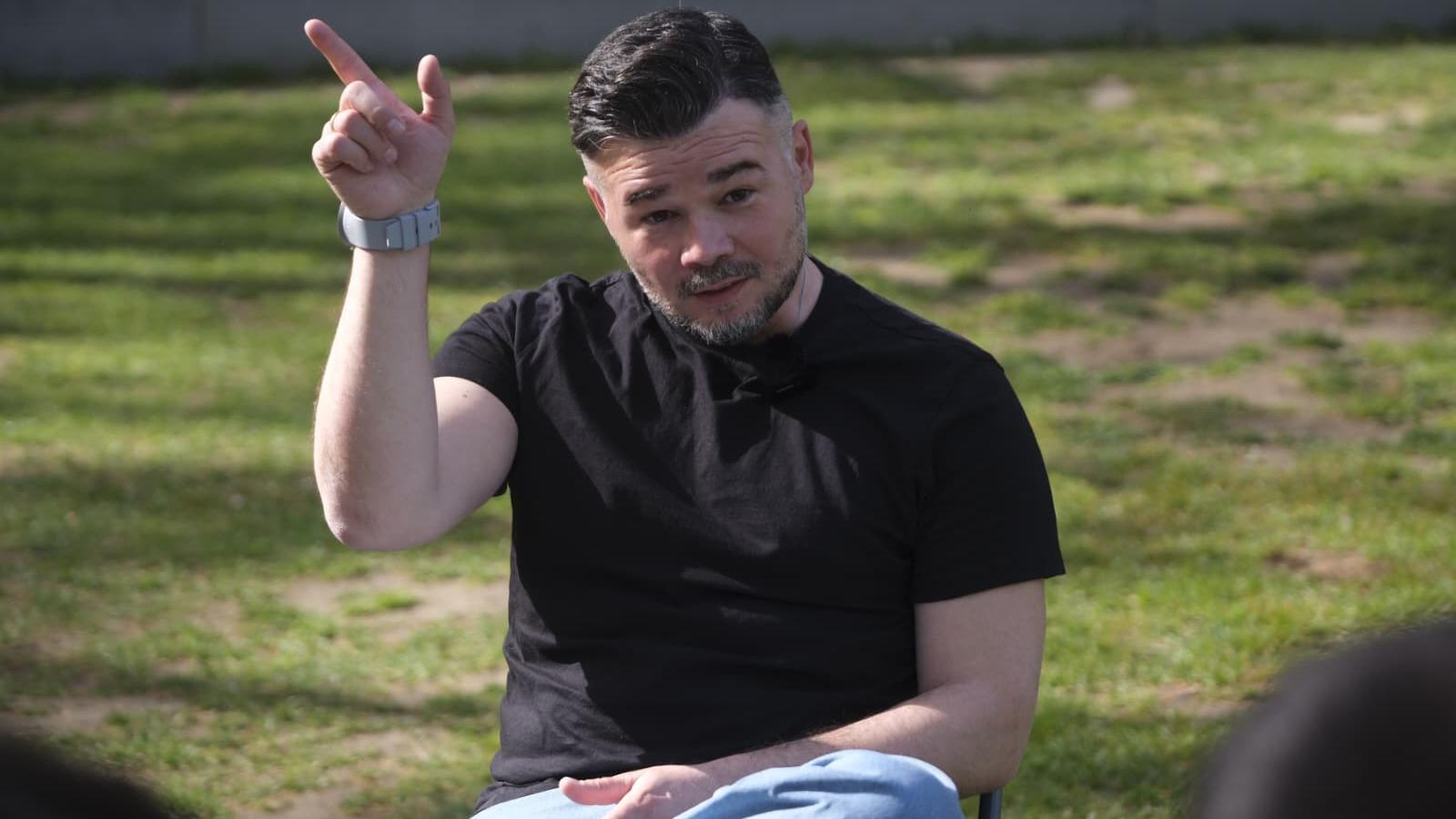
2. Politically, Gabriel Rufián has had an idea for weeks. He calls for the unity of the left, beyond the PSOE, to be able to democratically halt what seems unstoppable at the polls: the advent of the right and far-right to the government of Spain. Last week, accompanied by former minister Irene Montero, Rufián presented in Barcelona what he had already explained in Madrid. The hall of the Pompeu Fabra University did not fill up, but, in media terms, the event was covered as a major occurrence. Of the two-hour talk, three headlines stood out. “Without unity, they will kill us separately.” “Some people think that the far-right stops at the Ebro, and that is not true.” And “I ask my party to lead this. And if my position is at stake, I’m going home.” The diagnosis seems accurate, but the treatment he proposes offers too many doubts and some contraindications. Let's take it step by step.
3.”. The diagnosis seems accurate, the treatment it proposes, however, offers too many doubts and some contraindications. Let's take it step by step.
4. “The far-right does not stop at the Ebro”. The phrase warns us that, if the PP and Vox win, we can consider ourselves screwed. Nothing we didn't already know. Rufián, who is the best-rated political leader in Spain according to the poll published yesterday by La Vanguardia, insisted that his proposal tries to protect Catalonia. His good faith is not questioned, but the starting point of this hypothetical coalition would already be with a shot in the wing. It is not an exciting project to go and win, but to go and lose by the smallest possible margin. In Catalonia. And in Spain. Or vice versa. The order of the factors now does not seem to alter the product.
5. “If the position matters to me, I'm going home”. Rufián wants ERC to lead this process of unifying the left across Spain. Junqueras is not keen. ERC, logically, is not either. Its historical trajectory and recent past cannot lead to this "rufianada" (a trick or ploy attributed to Rufián) which could backfire. Let's remember that in 2015 Rufián arrived at Congress predicting that in “18 months” he would leave his seat “to return to the Catalan Republic”. He also announced that there was no plan B. Eleven years later, bewildered and disappointed, we are presented with an unexpected plan whose letter we no longer even know. That to stop the rise of fascism, ERC should be left within a left-wing macedonia, with too much mashed fruit, makes no sense at all.
