The finger and the Moon
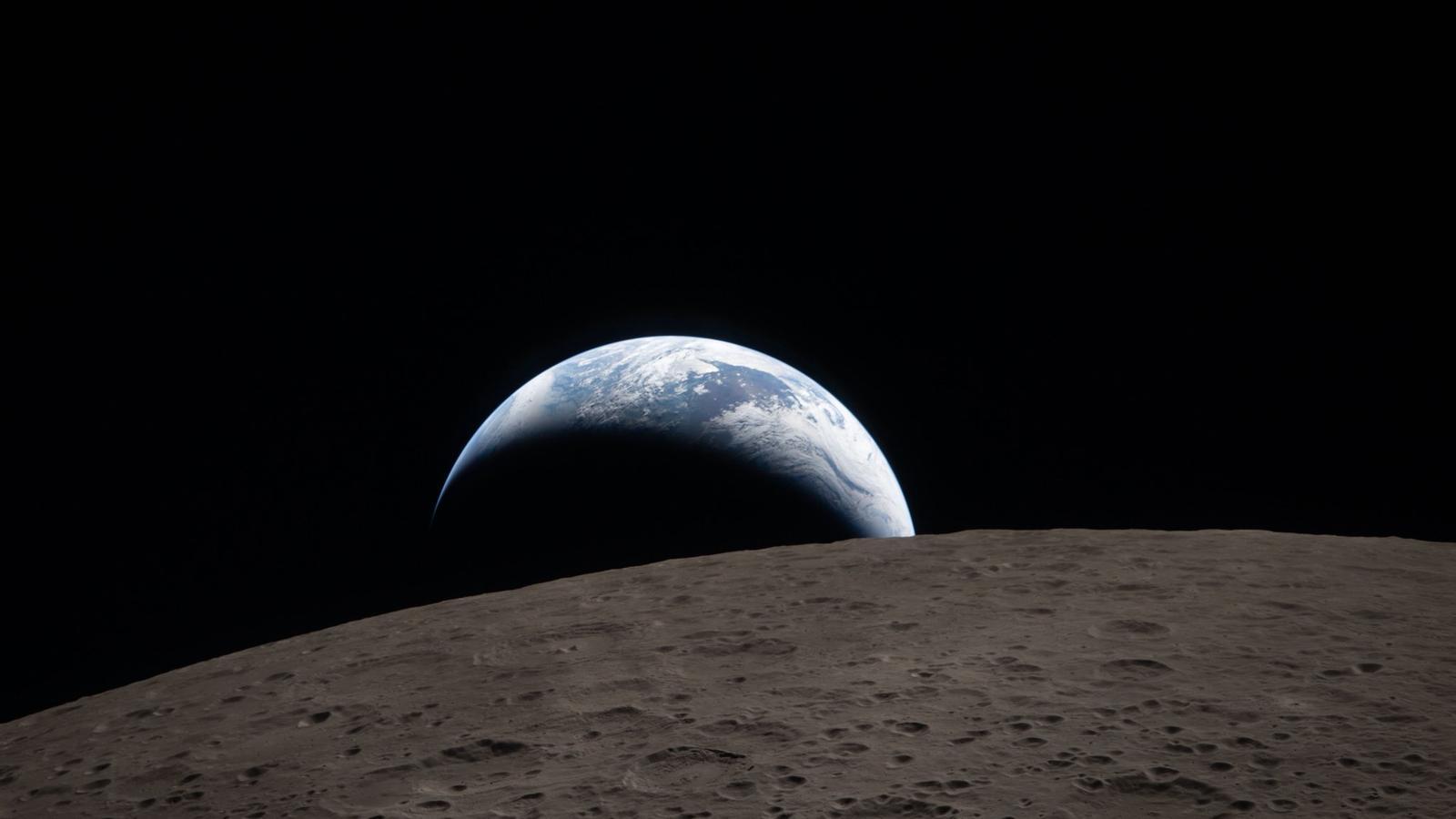

The arrival on the Moon in 1969 was a technological feat, but above all political and symbolic. It emerged in a polarized world where every scientific advance was, or wanted to appear, a demonstration of strength. In that context, the United States turned the Apollo program into a priority operation. It was necessary to demonstrate that its social, economic, and ideological model was capable of achieving what the Soviet Union could not, and to underline in the most theatrical and incontestable way possible the superiority of a political system. The pressure generated a concentration of funds and a collective will that is hard to imagine today. They were the happy sixties, yes, but what drove the joke up is disconcerting: during the peak of the Apollo program, between 1964 and 1966, NASA's budget reached between 4% and 4.5% of federal spending and approximately 0.8% of US GDP, which at that time was, and by a very large margin, the richest country in the world. It was a disproportionate amount, but even so, it met with little opposition. The technology available at the time – computers with ridiculous capacity, materials still in experimental phase, etc. – is also disconcerting, but the political and social determination was absolute. Risk was assumed as part of the project, and society accepted a dose of almost suicidal audacity, which today might not be accepted.Artemis II, on the other hand, fits into the framework of the “new world disorder”, where bloc logic has been replaced by a multiplicity of actors, interests, and often contradictory priorities. The space race is no longer a grand ideological duel, but a modest foosball match of economic competition and technological exhibition. Space agencies must justify every euro invested to fragmented public opinions, shaped by a media ecosystem that demands immediate and photogenic results. Technology is immensely superior – state-of-the-art artificial intelligence systems, ultra-sophisticated materials, simulations that anticipate thousands of scenarios – but collective will is more diffuse. Risk, which in 1969 was an exciting element inherent to the epic, is perceived very differently today. The paradox – exponentially more advanced technology, yet achievements perceived as less epic – reveals a profound shift in postmodern mentality.
In 1969, the Moon was a symbol of the future; today it is just a technical objective within a world saturated with emergencies. It is inscribed in an ecosystem of fragmented purposes without defined blocks, in a constellation of actors – states, private companies, etc. – that project diverse and unlyrical interests onto space: mining and things like that. The very idea of going to Mars is formulated in purely extractive terms: obtaining rare stones, securing industrial advantages, apart from the tourist additive related to the fantasies that science fiction has been normalizing for decades. I say the latter thinking about something that has been deliberately erased from collective memory: the monumental scam of the Mars One project, conceived by a Dutch engineer named Bas Lansdorp. Do you remember it?Mars One was presented as a visionary project to establish a human colony on Mars, but, over time, it was revealed to be a big fuss. The company promised a one-way trip financed by an Endemol reality show, but it lacked the technology, the funding, scientific support, or anything at all. Several aerospace experts denounced that the plans were unfeasible and that the announced budgets were completely unrealistic. Meanwhile, thousands upon thousands of unsuspecting aspirants from all over the world paid registration fees and participated in false selection processes. In 2019, the company went bankrupt, confirming that the project had never been more than a farce disguised as a space epic.They say that when the wise man points to the Moon, the fool looks at the finger. I believe that before looking at the finger or the Moon, what should be scrutinized with attention are the reasons why someone points to projects whose purpose is not very clear. They talk about colonizing Mars as if peeling tangerines, forgetting that human beings are the result of an evolutionary process associated with Earth's gravity. In space, they lose approximately 2% of bone mass per month and experience significant muscle atrophy in a short time. A minor detail... We'll solve it with "astronaut pills": even though they didn't exist, when I was little, they were very popular.
