The enemy factory
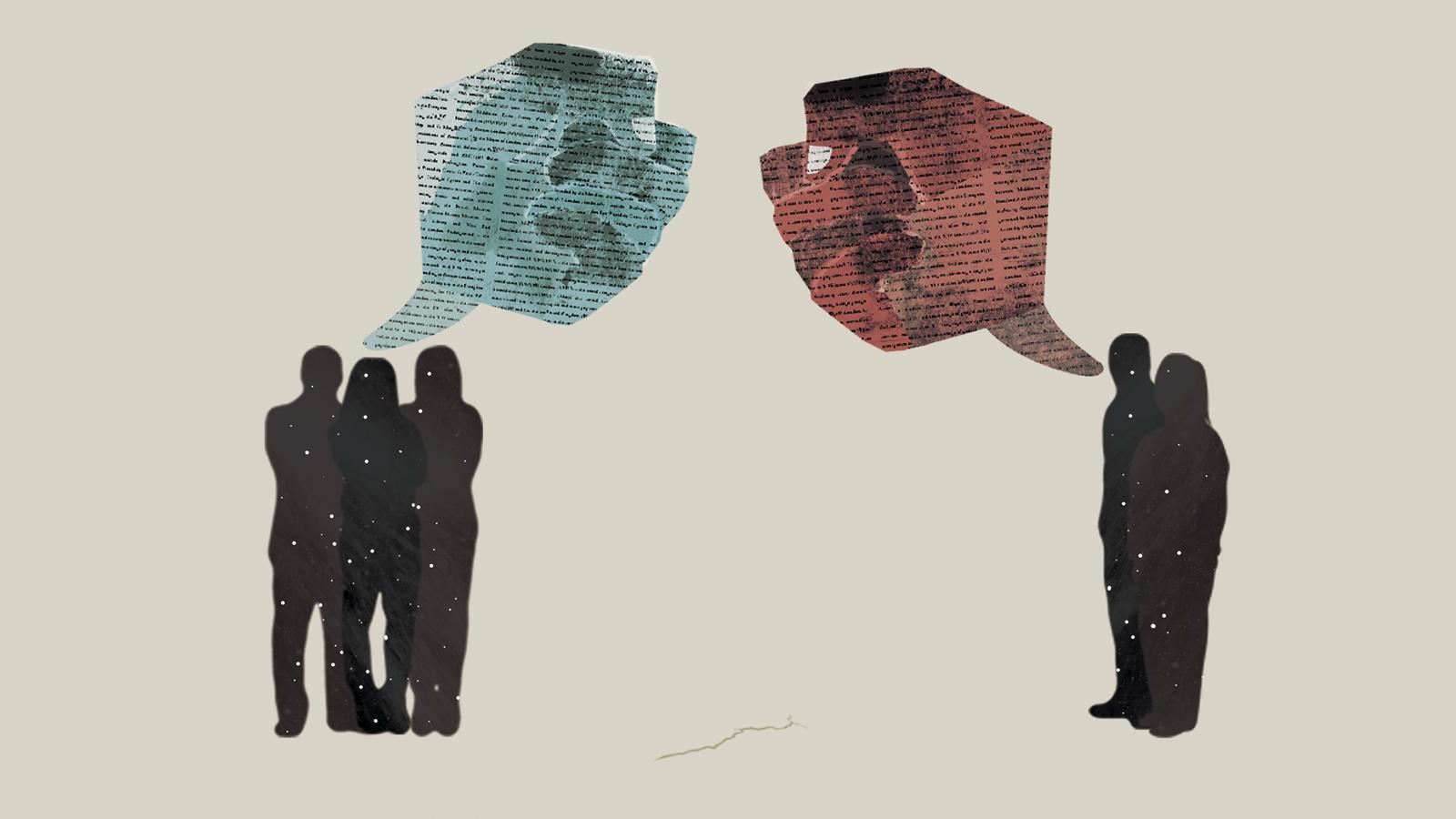

There are times when a society stops discussing policies to start discussing meanings. Words become weapons; symbols, battlefields. It is not a new metaphor, but it is a persistent one: the idea of cultural war as the central axis of public life. The term, popularized by James Davison Hunter, described a struggle between incompatible moral visions. Three decades later, the struggle not only continues but has accelerated, amplified by technology, exploited by a way of doing politics, and normalized as a permanent state of opinion.
To understand the nature of this battle, we must go back to Antonio Gramsci, who observed that power is maintained not only by coercion but by consensus. What he called cultural hegemony is the ability of a class or group to present its values as universal, as common sense.
This idea has been reinterpreted and simplified by political actors across the ideological spectrum. If culture is the decisive battlefield, then school, media, university, even entertainment, become a front.
The result is an expansion of the conflict: everything is political, but in a reduced sense, and the debate no longer revolves around public policies but around symbols. The flag, language, school curriculum, or an advertising campaign are interpreted as signs of an offensive or a resistance.
The mutation of public debate
Unlike classic disputes over economics or governance, cultural war operates in the realm of feelings. It's not about how much tax to pay but about what is fair; it's not about which immigration policy is most efficient, but about who has the right to belong.
This shift has structural consequences. Positions become less negotiable because they are rooted in identities. In this context, compromise is not seen as a solution, but as a surrender.
The philosopher Hannah Arendt warned that politics needs a shared world of facts to function. When this world fragments and each side operates with exclusionary narratives, debate becomes unviable. Cultural war, in its most extreme form, is not just a disagreement about values, but a divergence about reality itself.
If this dynamic has acquired particular intensity in recent decades, it is largely due to the transformation of the information ecosystem and media. Digital platforms are not neutral: they amplify content that generates strong reactions such as indignation, fear, and identity reaffirmation.
The result is an attention economy based on conflict. The most extreme narratives not only circulate faster, but are rewarded with visibility. Some media, also purportedly serious, have economic incentives to radicalize or vulgarize discourse.
In this environment, political figures like Donald Trump and the European far-right have demonstrated a singular ability to turn provocation into political capital. Their style is not an accident, but an adaptation to a system that rewards transgression and simplification. Constant conflict is not a byproduct of their leadership; it is their fuel.
The instrumentalization of conflict
The cultural war, thus, ceases to be a reflection of social tensions to become a deliberate strategy. Political actors identify issues with high mobilizing potential such as gender, immigration, and religion, and amplify them until they become central axes of debate.
This instrumentalization has various effects. On the one hand, it displaces other complex issues and problems such as inequality or climate change, which are relegated because they do not generate the same emotional immediacy. On the other hand, reality is simplified: issues are presented in binary terms, without nuances. Finally, enemies are constructed: the opponent is not considered a legitimate adversary, but a moral and emotional threat.
This last point is especially relevant because when politics becomes an existential struggle, democratic logic, based on coexistence and disagreement, erodes. Unlike traditional conflicts, cultural war offers no clear resolutions. There is no moment of closure. Every advance is provisional, every defeat is reversible. This generates a sense of permanent struggle.
In a context of constant confrontation, language itself becomes an instrument of power. To control words is, in part, to control thought. This is manifested in disputes over terminology, over what can be said and how. These disputes are not trivial; they reflect a deeper struggle to define the limits of debate.
Pluralistic societies have always contained deep disagreements. The problem arises when these disagreements transform into a logic of victory and defeat. When every issue is perceived as a decisive battle, trust in institutions degrades. Courts, media, and universities cease to be common spaces and come to be perceived as instruments of the other side. This distrust is corrosive. Without a minimum of shared trust, democratic deliberation is unviable. Perhaps the central question is not how to win the cultural war, but how to prevent it from devouring everything. This does not imply eliminating conflict but limiting its expansion. Reclaiming spaces of non-existential disagreement. Recognizing complexity without turning it into weakness. Accepting that politics cannot be reduced to exclusive identity without losing the capacity to govern.
