Police in school?

«Police everywhere, justice nowhere»
Victor Hugo
To Maria Campuzano
I admit that when I first heard the rumor that someone wanted to introduce plainclothes police officers into classrooms, I immediately thought it was some bizarre far-right proposal. One of those that offer easy remedies to complicated problems and that inevitably become false solutions. Those so tempting and noisy ones, which last as long as a lollipop in the playground, but which in reality are gaining ground and making a national priority. I suppose that's what I wanted – what I needed – to believe. But no. With a lump in my throat, it turns out to be a governmental proposal with official backing that supposedly started Monday in thirteen educational centers. Plainclothes police officers inside our schools with a supposed preventive character: that's where we are. The unease is preventively infinite – like a solemn failure, like an undeniable defeat, like a complete renunciation–. The mere imagined image of a plainclothes officer rummaging through students' lives completely unsettles, destroys the foundations of democratic schooling, and recreates a degrading imaginary of an education subjected to police criteria of safety, surveillance, and control. Looked at from any angle, a sacrilegious absurdity. These are not times for naivety, but one believed, after a resounding general strike by teachers, as democratic as it was historical, that the response would be different, in line with the accumulated demands of the sector and following the broad social support shown in the streets by teachers from all over the country. Fewer class sizes; more pedagogical resources; better conditions; more counselors and more professionals in all areas – from integration assistants to intercultural mediators, from support staff to psychopedagogues, from speech therapists to psychologists–. Nowhere was any police presence requested – and if you pass by any public school you will see a thousand protest banners of all colors, but not a single one demanding police presence–. What is still demanded is more time dedicated to each student in training, to each life under construction, through greater community, social, and neighborhood involvement, and socially addressing the enormous difficulties in centers of high complexity. Resolving in a completely opposite direction and choosing to put police first to explain to young people how adult life works out there is, simultaneously, infantilizing adults and adulterating children. And it is discrediting the teacher, to whom we entrust the education of our daughters and sons, by exchanging moral authority for disciplinary authority. And it is also stigmatizing, center by center, social inequalities where poverty and social segregation hit hardest. And it is banishing inwards, when the war rumbles so loudly outside, the indispensable promotion of a culture of peace, disregarding the immense efforts and enormous accumulated experience in mediation, management, and transformative resolution of all conflict.At this impossible crossroads is when we must ask ourselves how on earth we have arrived here –and why and why now– and try to find out if it is all a weather balloon, a smokescreen, or a ceremony of confusion. And we don't know –it still escapes us–. It is known –form and substance– how it has been promoted: with opaque stealth and without any debate with the educational community. And we also know how we have known it: through journalistic information. Two more reasons to immediately suspend –radical defect in form– the application of the pilot plan. Unfortunately, this way of doing things fits too well with how the wet paper agreement has been signed with two majority unions that in education have been left in absolute minority and have received, in a democratic consultation, the unanimous rejection of general amendment from those they claim to represent.
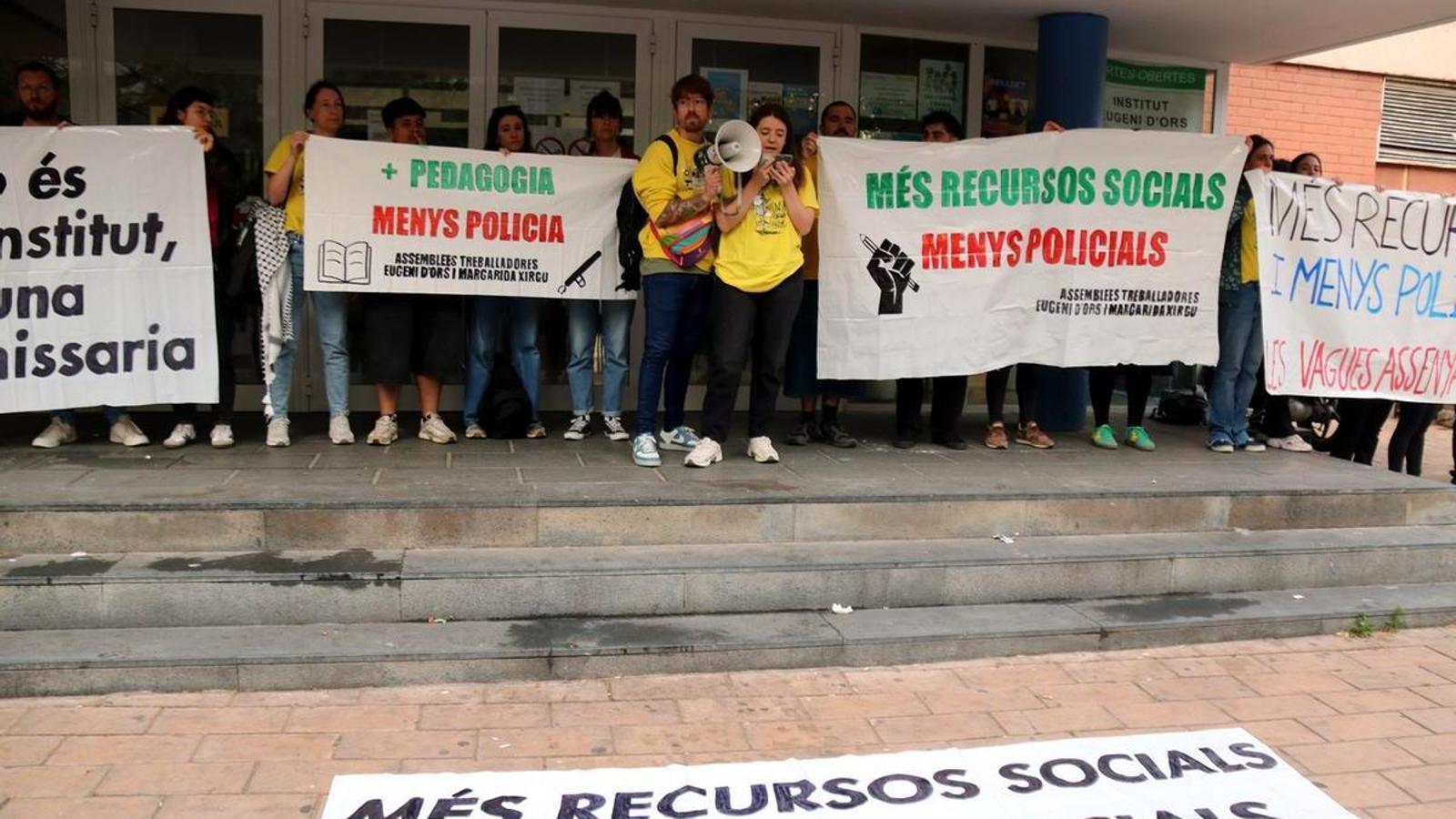
Because now that we talk so much about how the complexity of each social fact is handled, nothing seems simpler than pretending that the police solve every tension, every difficulty, every conflict, every disagreement. Even in the schoolyard, even in the middle of a classroom. The subtext and the context incite to think also about a questioning, ridicule, and belittling of the work of teachers –and that’s why they send the police there, go figure–. Unfortunately, it is as if the general global trend had reached education in the worst way and someone intended to Americanize our school life: the unstoppable advance of the punitive penal state that is replacing the gradual and planned dissolution of the welfare state and the easy recourse to the police because we have already denied, refused, and renounced all democratic possibility. Fortunately for everyone, even for the promoters of the politicization of schools themselves, we will have to be grateful for the immediate reaction of the educational community itself and a large part of the country, for the campaign Desmilitarize Education –integrated by 100 entities–, for the Council for the Promotion of Peace and for the teachers against evictions grouped in the platform Docents080. Or for the protests that last Monday unfolded in front of the affected institutes, such as in L’Hospitalet de Llobregat. All of them have already forged and drawn, self-protection and antidote, how difficult the application of this singular Plan Kampai Escolar will be.When there is a fire in a school, the firefighters are called in a hurry; when there is a medical emergency, an ambulance immediately; when there is a serious unmanageable incident, the Mossos – because that is the coordination of public services. But in a democracy, whoever educates and will educate is and should always be the school – and not the Penal Code or the police forces. The day we forget this, we will have drunk oil – castor oil–. It could be added, without sarcasm, that the last time the police went to schools to pursue adults, to try to prevent a democratic ballot box, we already know how it ended and we are still paying the dire consequences. It could be added, without crying and in the name of university autonomy, that we have been crying out to the heavens for years about the unpunished presence of undercover police in faculties, assemblies and collectives, as if we had to put up with this now. But in the end, the final paradox of complete absurdity is that if someone believes that police are needed in schools, perhaps what is needed are professors and philosophers in some police stations. With a thinking corner readily available. Urgently.
