Lamine Yamal's boots

-
CAT -
CAST
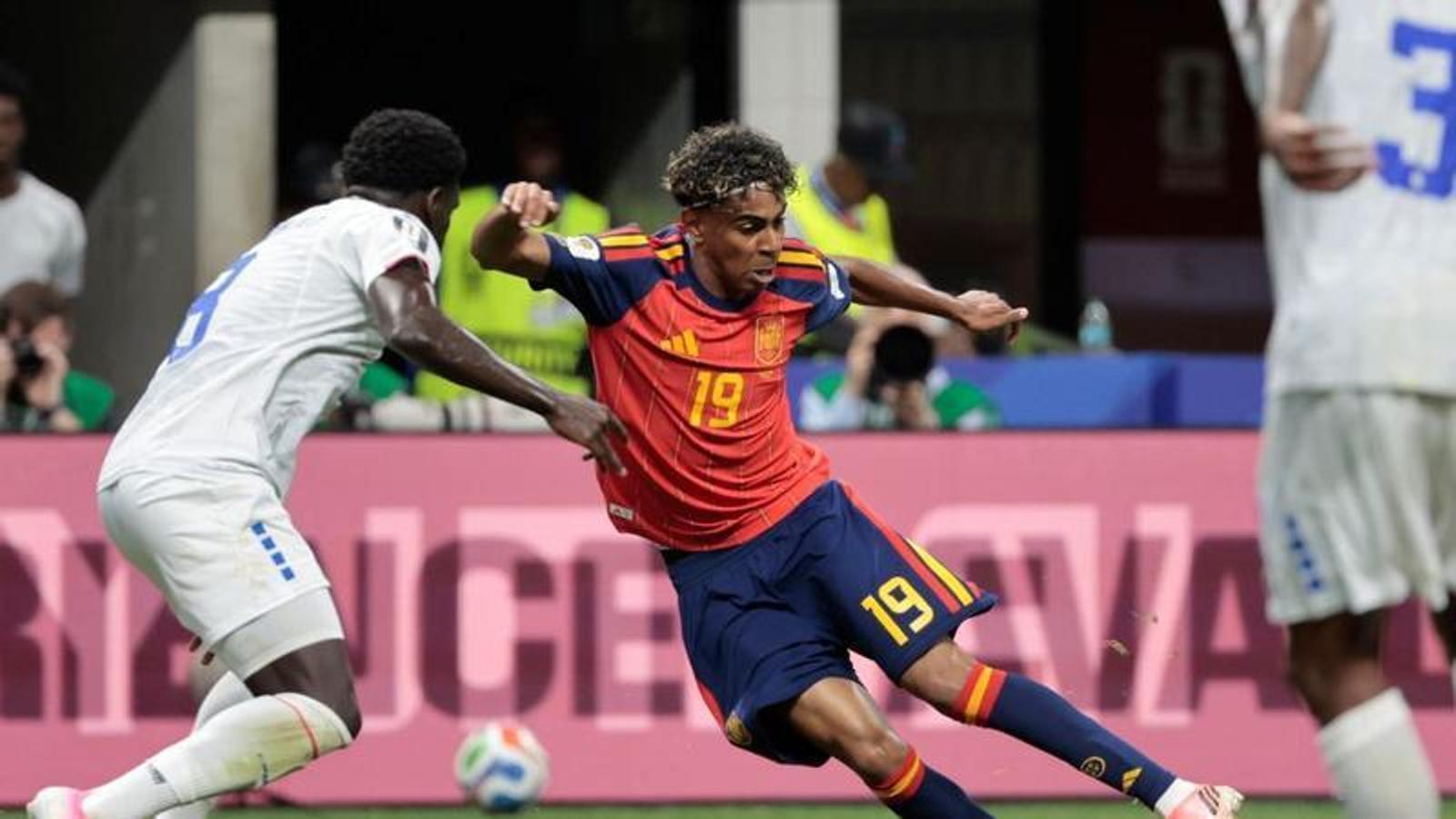
Lamine Yamal's boots explain better than many speeches what football is today. And, incidentally, what Europe is today.Lamine Yamal plays for Spain, but he has had the flags of Morocco and Equatorial Guinea, the countries of origin of his parents, printed on his boots. In a single gesture, identity, roots, and mobility coexist. And this mix, far from weakening teams, makes them stronger, more unpredictable, and more attractive.In this World Cup, many teams can no longer be understood as homogeneous national blocs. Nine of Spain's twenty-six players work for teams outside the country. The entire squad of Ivory Coast plays abroad. And only a quarter of Morocco's footballers were born in Morocco. France, probably the most feared team in the tournament, is also a product of this mix: only four players have parents born in the Hexagon.Individual cases make it even more evident. Lamine Yamal and Michael Olise could have chosen which country to represent. Olise plays with France, but was born in England and could also have played with Algeria or Nigeria. The two Williams brothers have chosen different paths: Nico plays with Spain; Iñaki, with Ghana. The admired – and loved and missed – Messi, with Spanish nationality and trained at La Masia, was about to play with la roja in 2004.Almost all the teams in this World Cup are mosaics of ethnic, national, and cultural intersections. And yet –or perhaps precisely because of this–, football lovers are witnessing the most interesting, fun, competitive, and beautiful championship to watch in recent decades.Can we get anything out of all this? Yes, and not just about football.The first lesson is that confrontation with the other is a powerful mechanism for creating the existential feeling that the anthropologist Victor Turner called communitas. Football matches are an example: fans forget all their internal differences, suspicions, and grudges, and gather unconditionally under a common cause.The set of individuals becomes a community. A single people. Differences –political, social, economic– disappear, absorbed by an irrational and dionysian spirit. Facing a well-defined adversary, human beings tend to merge with the masses to confront it. It is enough to define an enemy — this one or that other— for this popular force to go here or there.
The second learning is obvious: mobility, diversity, and variety generate excellence.And this is not something exclusive to football. It is more than proven that, in science, the more diverse research groups are, the more and better papers they generate and publish. It has also been known for years that companies with more cultural variety are more competitive and earn more money. There is conclusive research that allows us to affirm that when faced with a complex problem that needs to be solved, a group of people with different backgrounds is always more effective than a homogeneous group.The third learning is a corollary of the previous two: immigration is not something to be fought, but rather to be managed. Recently, in Switzerland, where 27% of the population does not have citizenship, nationals rejected, in a referendum, containing immigration and setting a demographic limit of ten million inhabitants. In regions with more foreigners, the results in favor of "no" were overwhelming. The Swiss believe that well-managed immigration is a first-rate political asset.And what does “well managed” mean? Seven Catalan economists have just explained it to us in the Fènix Report: the problem is not immigrants. The problem is the structure of Catalonia's economic fabric, which allows – and even favors – the growth of sectors with very low added value, financing them in the shadows, with indirectly “subsidized” wages. This perverse structure prevents productivity from increasing, GDP per capita from improving, and citizens' disposable income from increasing in real terms.This is why Lamine Yamal's boots are not a funny anecdote or an identity quirk. They are a precise metaphor for the world we already have: a world made of crossed trajectories, multiple belongings, and increasingly blurred borders. The question is not whether we like this world more or less, but whether we are capable of organizing it well. In football, mixing has made teams stronger. A country can also be made more prosperous and competitive. Provided that politics is up to the level of the talent that is already running on the field.
