From A to Z

"For you will say the right word,
you will say it at the right moment»
Vicent Andrés Estellés
"For you will say the right word,
you will say it at the right moment»
Vicent Andrés Estellés
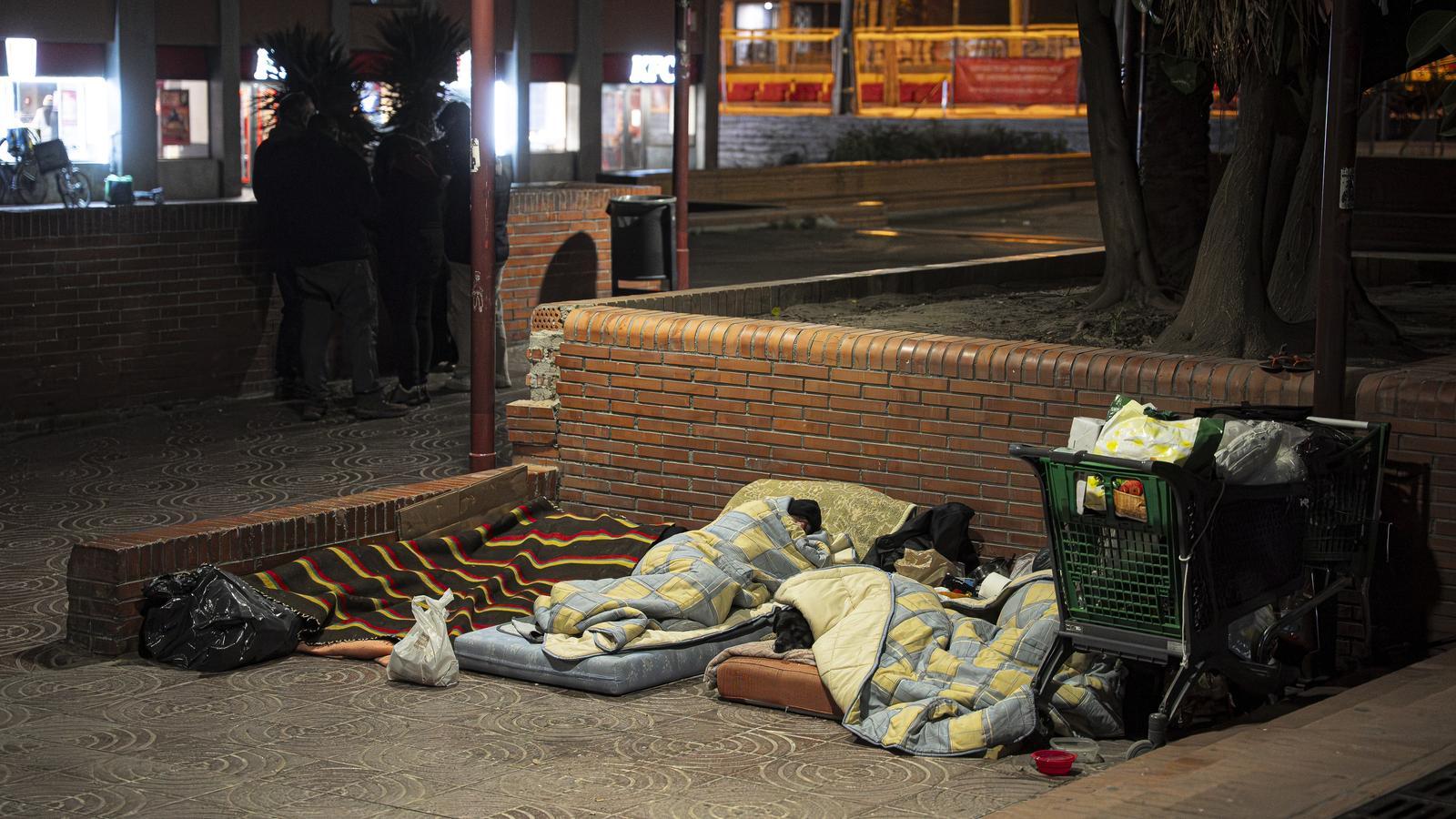
A la intempèrie, which means exposed and without anything, is the first entry, the initiatory concept, of a singular and prized dictionary that was released last week. Last Monday evening, at the Sala Sagarra of the Ateneu Barcelonès, the first Dictionary of homelessness in the Catalan language was pioneered. Driven by those who know most about precise words and accurate definitions —this common institution of Catalan which is the Termcat— and by those who know most about the reality of surviving on the street in bulk and in detail —the Arrels Foundation—. Double rigor to recover the exact name of things and to be able to Having outlined the what and how, we need to specify the when. The Catalan political cycle has meant that we have seen the dictionary printed first —which has an online version— rather than the bill on transitional and urgent measures to tackle homelessness being approved in Parliament, which we have been waiting for for so many years. The reverse order was planned, so that the dictionary would also be inspired by the spirit and letter of the law. But successive election calls have caused the parliamentary process to lapse time and again and, as we know, it’s back to square one after each election. I suppose the dictionary, prematurely and in advance, hits the nail on the head. The concept "institutional factor, well, what do you know, refers in the dictionary to the "risk factor related to policies and the functioning of public administration and its bodies in relation to tackling homelessness". And the volume, which is full of essential explanatory notes, specifies it with street clarity: "The inadequacy of public budgets, the lack of coordination of social services, the procedures and bureaucracy of public administration, or the lack of planning in deinstitutionalisation are examples of institutional factors".The socio-public linguistic cooperation in the dictionary's drafting also tells of a great team that, rejecting the fashion for Anglicisms, enriches our lexicon, sharpens Catalan, and invites uninterrupted solidarity. The team starts with Jordi Garcia—a volunteer from Arrels who had the original idea, embracing "the transformative power of inhabiting words"—and includes Guillem Fernández—one of the most lucid Catalan and European voices in the fight to eradicate homelessness—to arrive at the scalpel-like precision of Termcat's terminologists. And more: another volunteer—Marisol Alafont—always insisted on key words, asking if they had already "filed" them. For years, she has collected them on the street: frustration, despair, suffering, loneliness, fragility, hopelessness. Ultimately, the director of the Arrels Foundation, the good Bea Fernández, clarified from the outset that she was talking about a dictionary that, without needing any narrative, dissects an entire panorama "of broken lives, of failing systems, of violated rights".A dictionary, in current times, can be a lucid peaceful weapon of massive reconstruction. This one is, and perhaps there is no struggle more urgent and contemporary than the daily battle for language. A terminology against ambiguity, with conscious and consistent words, in times of reductionisms, binarisms, and polarizations. Because language has always been double-edged: it humanizes or brutalizes, transforms or reproduces, generates empathy or provokes rejection. Because words —every word we use— can lead us to simplisticness or complexity, to stigmatization or dignification, to bringing us closer or moving us apart. Not long ago, the philosopher Santiago Alba Rico recalled a recent scene on the metro, when a man entered and announced: "I will not ask you for money. I will only ask you to lift your heads from your mobile phones and say good morning to me." The philosopher remembered that it is easy to deal with abstractions, when the difficult thing is to do so when the needs of those around us become painfully concrete. Like that very concrete thing of avoiding eye contact and looking elsewhere.
Between five hundred and sixty-two words that still speak of where we are, one remained —a selective choice through Estellian stimulation— in the concept of peer support: "A person who, having lived in a situation of homelessness and acting as a volunteer collaborator or as a worker for a social entity, accompanies and supports homeless people, based on the peer relationship, empathy, respect, and participation". The event ended and the shared wish was that the dictionary would soon become obsolete —as an archive of an unjust past that we have managed to overcome collectively—. And the dictionary ends, the last word, with the concept functional zero. Coming from the inclemency with which the volume begins, the last entry is a whole social program, an invitation to active hope and a roadmap horizon. Because functional zero refers to a scenario where homelessness is no longer an endemic structural reality; it may occur, but when it does, society has emergency responses and residential resources to solve it immediately. That is, it does not exist in practice. The previous entry is, instead, absolute zero —the universal ideal of "no one sleeping on the street", where there is no longer any risk of any person spending the night outdoors in our cities—. Both zeros no longer depend solely on a dictionary or on so much solidarity organized by social entities. They depend on politics. On democracy. On an idea of a country. That is, they still depend on all of us. On the peer support that each of us can become.
