Albert Pla: "If they look for me to shit on the king, I'm not going to the talk shows anymore"
Singer and presenter

-
CAT -
CAST
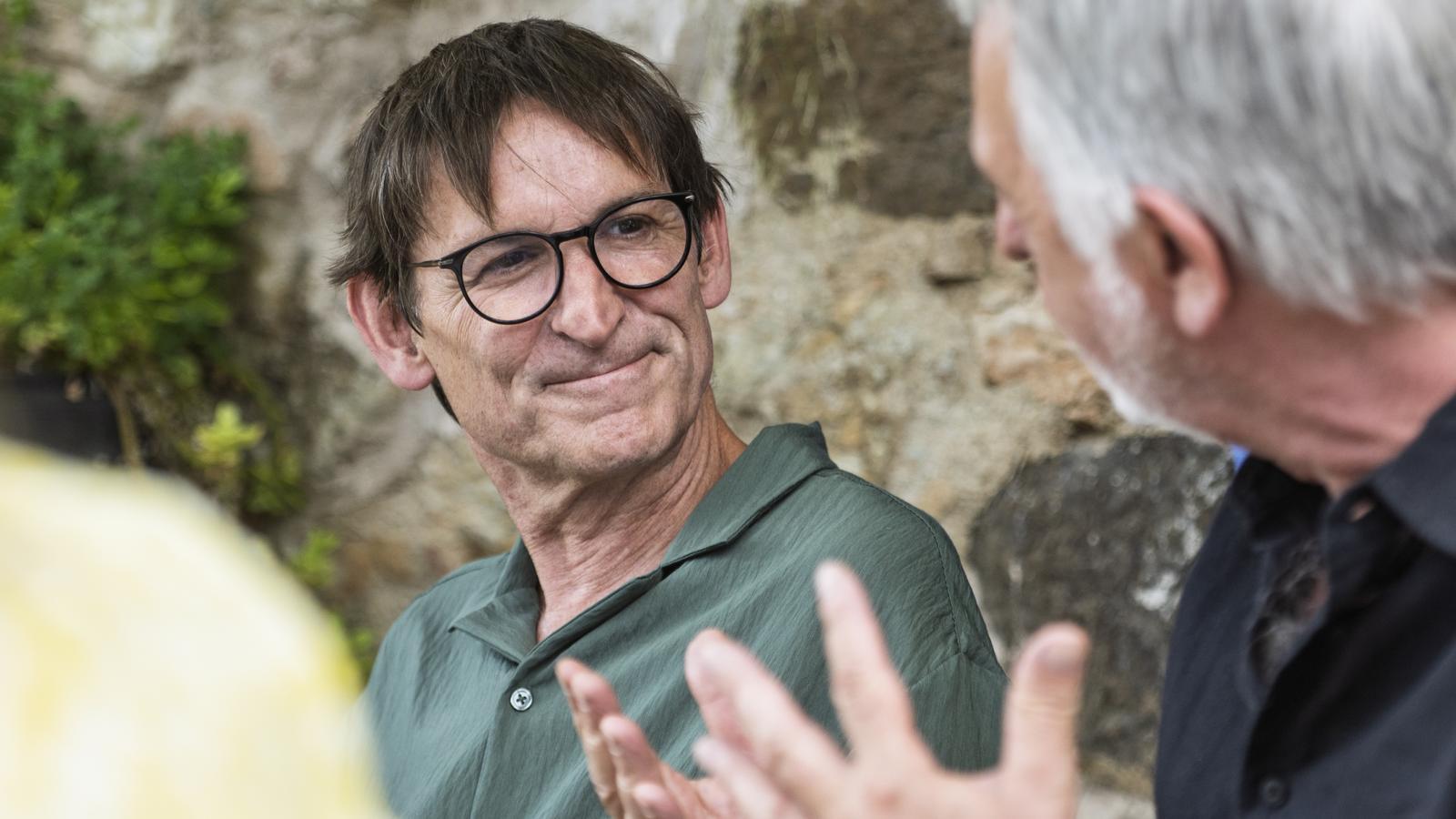
BarcelonaThe musician and creator Albert Pla (Sabadell, 1966) is now the presenter of Sala 30, a new program on Canal 33 that brings together artists who have at some point been linked to MACBA. A new 3Cat format whose objective, among other things, is to celebrate the 30 years of the Catalan museum.
On social media you joked that you had been commissioned this program "by mistake". How did it come about?
— I don't know: this is El Terrat's doing. It was their initiative. They proposed it to me and I found it interesting.
Did you know you were interested in contemporary art?
— As far as I know, no. And I really didn't understand much about contemporary art. Now I don't either, but a little more, because it was an opportunity to learn.
You looked good speaking their language with the guests, indeed.
— We were trying...!
The program celebrates MACBA's 30 years through conversations with artists, but it is not recorded in a museum, but in a farmhouse. Was it your idea to chat there listening to the little birds while eating fuet to sanctify art?
— It was also El Terrat's idea, to get him out of there. I don't know if Tarradellas sponsored it or what! [laughs]
There was salami and, also, many flies.
— Well, life in the country, you know.
Are you a big fan of going to museums?
— Not much. I had known the Macba and I have been to some of the museums, but it's not my hobby.
You pose some of the eternal questions about art to the guests. I'd like to know what you think. For example, you ask Manolo Laguillo: if there were no audience, would we still be making art? What do you answer yourself?
— At this point, I don't know anymore. When I started, I did things without an audience, out of pure vital necessity. And now... I continue to do so out of vital necessity. Over the years, I do them because I know it's my craft and because I can't help but let them come out. In fact, it's the most fun part of the whole process, more than showing it later or receiving inputs. I like this moment when you can't help but start doing something that yesterday you didn't know you would find inside your head.
After talking to about thirty artists, have they contributed anything to your way of seeing art?
— I have learned a lot and yes, I have reconciled myself a little with art.
Reconcile in what sense?
— In the world of musicals, theater, or cinema, there's a professional inertia that leads you to do more things, but, on the other hand, most artists I've met doing the program have a much more interesting point of view than any singer or actor I've met, and, on the other hand, they don't do it for money. Precariousness in the art world is like this, and almost everyone does other jobs. And they do art for the same reason as me: because they can't help it. It's the insistence on bringing out this inner world, and in the program, it's very clear that everyone has taken a very personal journey. This is what I think is interesting about art. That when someone offers an opinion, and I'm not just talking about art here, at least it gives you an interesting, surprising point of view, or one you had never considered before.
Can everyone be an artist?
— I don't know... I know good musicians, good singers, good actors... but few artists.
Do you consider yourself an artist?
— No, I'm a comedian.
Why is a comedian not an artist?
— I am a person who does silly things: I set up a circus one day in a city and then I leave.
But you have a very prominent personal vision.
— Yes, but I don't consider it art.
What would be missing for it to be art?
— Another person, who wasn't me.
And could it be that you made art without being an artist?
— I don't know. Is it worth dwelling on the word "art" or the word "culture"... Everyone understands it as they wish, you know? One of the artists I've spoken with told me: "Why talk, if others understand whatever they want?"
The guests come from many different disciplines, but are often twinned by a phobia of labels. And I would say that also connects you to that.
— I understand that journalists do it. Or myself. When I see something, I immediately give it a name, a label, but that has nothing to do with who does it, really. So, when they call me a singer-songwriter, artist, asshole, or genius... I remain very indifferent.
Is there any of these that you identify with more, because of that?
— Comedian.
You also talk to Laguillo about the martyr artist and ask if one must suffer to be an artist. What do you think?
— There are many people who have managed to make art out of their suffering. But there are also people who use love or happiness. Expiating always feels good.
With Pilar Aymerich, on the other hand, you talk about struggle. And about whether art can change the world. Can it?
— I think so, of course. It's not that I can change it, it's that he has changed it. He always changes it.
And has it changed for the better?
— Ah, I don't know that anymore: it has changed where humanity is going. Artists come before scientists. Before the scientist invents a rocket, there is always some artist, before, who thinks about going to the Moon.
In the chapters there are 'pills' that explain each creator's language, making it much easier to understand their work. But there's the danger of losing virginity in one's gaze. What do you think of this dilemma?
— As a viewer, there is a lot of ignorance within the world of contemporary art, starting with myself. If I see a chair, I see a chair. Either they explain it to me, or I know the girl who made it and her intention... or I can't help but see just a chair. However, I think this is a deficiency on my part. We have been very well educated to listen to songs and watch Netflix movies, but not in art.
With the program, have you tried to break this a little?
— No, I have no merit. If anything, El Terrat. All I have done is enjoy myself, because I had to study the artists and I tried to enter each of the worlds that were presented to me and, damn, it has been a luxury for me. A learning experience and a great luxury.
With Antoni Abad, in fact, you pose the question of how an artist looks at the world. How do you look at it?
— I do like everyone else! I think the things I think are very good and the things others think... pfff!
Don't you feel eccentric?
— Well, in the end you move in your circles and you seek the company of those to whom you don't seem eccentric. And you create a small bubble within other bubbles, just as there are thousands in the world.
Who you were seen talking very comfortably with was Joan Fontcoberta. Did you know each other?
— No, we didn't know each other, but I really like what he/she does.
Play a lot with deception. And you, as a comedian, this surely excites you.
— Yes, I really like what he does with his fakes.
In fact, before succeeding as a singer, you already managed to get into the media, slipping a prank into the Sabadell newspaper. They interviewed you because you made them believe you had been in the Ceis sect.
— I really like mockumentaries. In fact, it's one of my artistic failures: I've made five or six, but I haven't managed to get any of them through. I like to make up stories that could have been true.
How would you define your relationship with the media?
— I try to do the minimum interviews. I know that, sometimes, a sentence said in an interview takes up much more space than a song. You can play 80 concerts without anyone saying anything and then you say a silly sentence and you are forever remembered as the one who said that sentence. And the truth is, with these sentences, I prefer to choose them myself, although I've already gotten used to it.
You have a reputation, especially on television, for having put some presenter in a difficult situation.
— Well, sometimes interviews work more this way than the other, don't they? They are accidents that happen.
But do you like to create these moments of discomfort so that these moments arise?
— No, I don't like feeling uncomfortable! I just think: if I'm uncomfortable, you should be too.
You have done many segments on radio and television. What do you think they are looking for when the media hire you?
— It depends. I told Xavi Bundó that I would talk about history and I think we did a fantastic section, although I couldn't continue it because it was an exaggerated workload. It has been one of my favorite jobs. Like the section I did on the Bourbons with Laura Rosel: the idea of being able to spend days and days talking about the country's history through the kings...
And do you receive offers as a pundit?
— Ah, I know where you're going! If they look for me to shit on the king, I'm not going anymore, to the talks. If they want to shit on the kings, they'll shit on themselves. Don't bring me.
Do you think you've ever been used to say what they can't say?
— Well, I have declined many invitations of this type. Yes, yes.
Do you self-censor on the radio or television? The feeling, from the outside, is that you don't. And that this is your conquest.
— Let's see, these controversies always happen more with social issues, right? But social issues, to be honest, have never interested me. When I give my opinion on this, there's a big stir precisely because I'm not interested. But I see that there are indeed many people who are interested and are affected by the opinions of others or of a third-rate celebrity. I already try to avoid it as much as possible, but, of course, sometimes they ask you...
Are there any other television formats you would like to present?
— It's just that, offhand, I wouldn't like to do any show, or any movie, or any television program. What's really cool about this job is precisely that you never know what they'll propose to you tomorrow or in three months. Doing an animal show like Natura sàvia I really liked. Or a segment I did on artificial intelligence, but the show was closed. Otherwise, I would have loved to keep studying it, it's a topic that interests me. Now it seems I'll do one about myths and legends of Catalonia. Is this new one, La 2 Cat, its name?
Yes, that's what they call it. Therefore, you let them propose things to you, rather than going to look for them yourself.
— I am not going to look for anyone, ever. I already do my own things and I have a good time. But I also like to be proposed things like the show I did with Peyu and enter into someone else's universes. Or when I went with Pascal Comelade, or with Tortell Poltrona. I like to work with someone who tells me very clearly what they are doing and what they want me to do. And if I like it, I admire the person who is doing it and I have time... let's go. In the end, I don't have anything else to do either.

Talking about Hamlet. You and Peyu will have filled the Coliseum for three months with a comedy show in Catalan. That's no small feat. Do you think it's recognized enough?
— I don't give a damn. 60,000 people or more have come, I've stopped counting them and now in Manresa we'll do a double show and we're going somewhere else: this is the success of the theatre. It doesn't matter that they don't understand in Madrid. But, damn, it's amazing that there's such a reception all of a sudden.
I wasn't saying it so much thinking about Madrid, but about the theatre establishment. Sometimes it seems that comedy shows are seen as minor.
— Oh, no. I think it's for serious theater, which is doing badly. And I think it would be great if people went to see more dramas and more plays in Spanish, because there are great ones that have a harder time.
We have talked about your place in the media. But, what about as a consumer?
— I just don't understand anything, really. I never watch TV, I never read the press, I never listen to the radio... at most football, El Peyu and En Guardia. Only when I go on tour do I meet people from the city who talk to me about Trump and I don't know what the hell minister you've just met, but I have no interest.
And where does your comedy come from, then? Often, the comedian holds up a mirror to society so that it can see itself reflected, more or less distorted. If the media calls you, it's because you connect with what you say.
— No, no. I give opinions on things I have no damn clue about. They tell me: "Ábalos" And I think, shit, I've already skipped this guy I mean, I don't know who the Minister of the Interior was the first time I kissed a girl, and I don't think you do either. So look at the importance of that.
Is there any moment where you say: I would say this now, but I'd better stop.
— When I go to the media, I don't intend to say anything. And when I do something, I try to censor myself. A song is already an exercise in censorship always, in itself: it is choosing the verses, the actions. Another thing is the themes, of course, and here I try not to repeat myself.
What topics are you most interested in, creatively speaking?
— Ugh, a thousand things. Now we've been recording the album and there are 12 or 15 songs. Good: each one is a different nonsense and there's no concrete intention. Each one starts from a different thought, or from a different place.
“A dead cop, one less cop”. Would you write that again today?
— No, but because I've already done it. I don't know anymore how many police officers I've killed, throughout my career. It's not that I'm censoring myself, it's just that I no longer have any interest in talking about it. Other things come up for me.
