Burn and break what belongs to everyone
-
CAT -
CAST
BarcelonaMercè wanted to go for a snack at the Bar Estudiantil to remember old times, when she used to go to the Central University. Sitting in her wheelchair, she watches life go by while having a cup of hot chocolate with whipped cream, a "suís".
This Saturday there is more movement than usual in the square, with a stage, live music, stalls, and drinks bars. One of Mercè's favorite pastimes is commenting on the people passing by.
—Where are you going with that hair? Look at you wearing leggings with that backside... Come on, girl, pull up your pants.
She addresses them directly, but luckily no one hears her. Or:
—Look at that man, how scrawny he is. And, my God, what a tall girl, and what breasts!
—Mom, I think that used to be a boy.
—What are you saying now?
—Just that. People are free and do whatever they want with their lives. Not like before. Don't you think that's good?
—Yes, yes, let everyone do what they want. But, son, it seems strange to me. It seems that many homosexuals live in this neighborhood now.
—Shall we go to the Passeig de Gràcia? —Ricard suggests, to avoid complicating the conversation further.
—Yes, let's go look at shops.
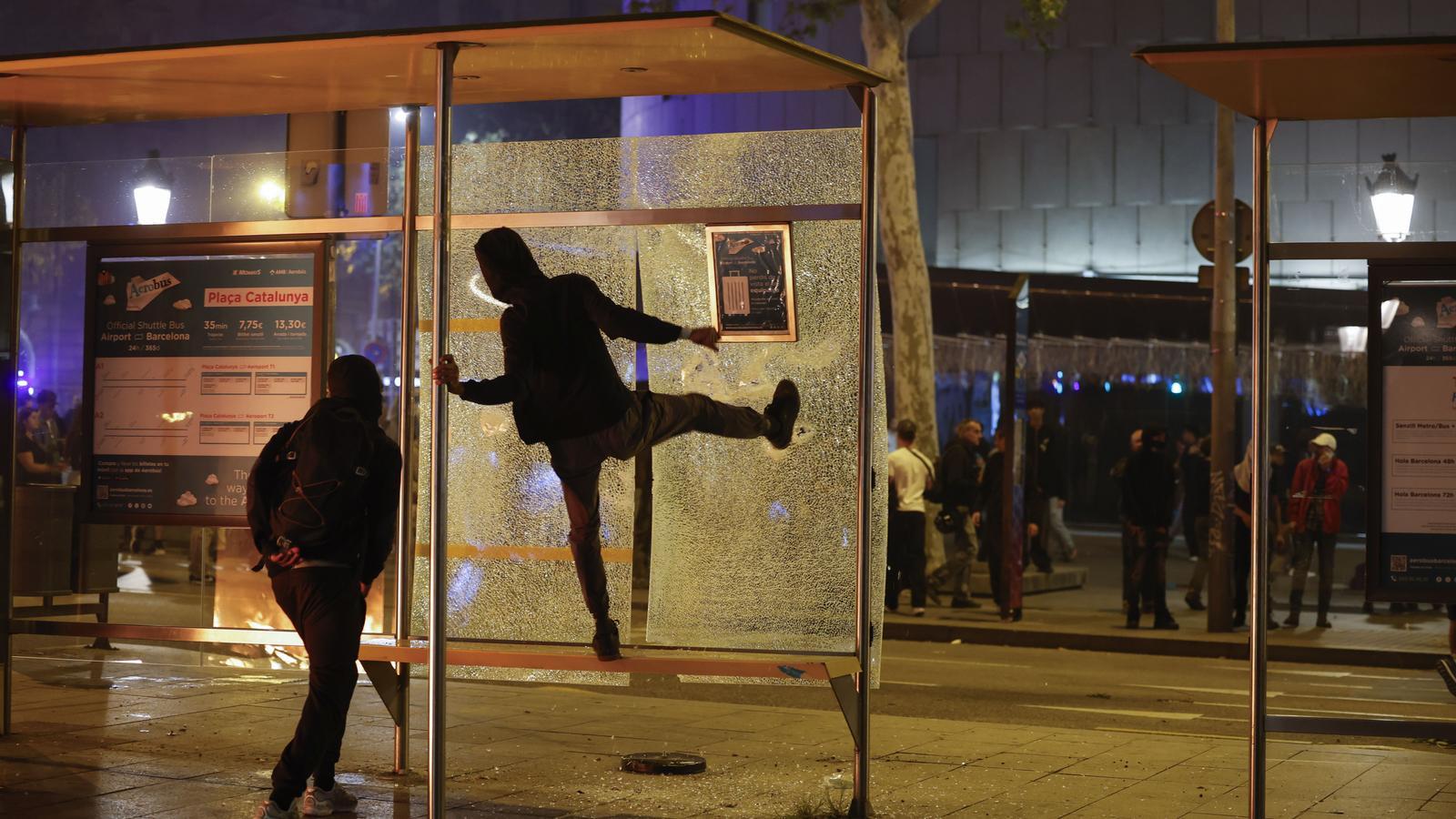
They move through the crowd. The orchestra accompanies them for a good while, with a shrill voice singing I will survive. They walk down the Ronda de la Universitat towards Plaça de Catalunya and, suddenly, everything changes. Very young boys and girls, hooded, almost children, drag bicycles and set them on fire. Others kick the bus shelters with brutal violence, until the glass shatters. The trash cans burn like candles. It smells of scorched plastic. Sirens, running, and the thunder of all the shutters going down at once.
—What are they doing? —Mercè asks—. Why are they doing it?
Ricard has no answer. He turns the chair and they flee in a hurry, amidst sirens, flames, and wild youths. Despite everything, Mercè ends up bursting into laughter, a result of the hysteria of the moment. Ricard watches her from behind as he pushes: she is talking to herself, with her hair blown back by the speed of a wheelchair that almost skids. Now, closer and closer, Dancing queen plays.
A trash can is not just any object. Someone drew it and decided on its height, the thickness of the sheet metal, and the shape of the opening. Someone manufactured it and someone bolted it to the ground. Behind a bus shelter, there is a competition and months of plans and calculations. Behind a shared bicycle, there is an idea of a city. Creating it takes years; undoing it, a few minutes and a lighter.
What is public is the heritage of those who have none. The bus shelter is the roof for those who do not have a car; the bench, the terrace for those who cannot afford one. Burning it does not shake any system; we will all pay for it, including those who did it. And the flower stalls on the Rambla, damaged that night, were precisely the most fragile and the most ours that was in the square. Not to mention the looting, which does not only harm multinationals, but also people who earn their living from these businesses.
Perhaps in high schools there are plenty of reasons to be indignant. But burning things to be in the photo does not vindicate anything.
Let everyone do what they want, Mercè used to say. With their own life, yes. With things that belong to everyone, no.
Sunday, at breakfast time, Mercè asks her son to take her to buy flowers at Plaça de Catalunya.
—Mom, yesterday they damaged the stalls there.
—I know. That's why.
For some time now Mercè has been forgetting the most recent things, but not this time.
