Experts see little economic rationale, from an oil perspective, in the White House's coup against Maduro.
5 min
The decrepit state of Venezuela's oil infrastructure causes, as seen in the image from 2022, serious episodes of environmental pollution, in this case in Lake Maracaibo.EFE
LondonHe Washington's coup against the Nicolás Maduro regime has been forceful. But it is not the first time that US planes and helicopters have operated over Venezuelan airspace. In June 1958, in a country parched by extreme drought, "a convoy of planes loaded with drums [drums] water"Intended to help the population of Caracas. Gabriel García Márquez explained it, Gabo, in "Caracas without water",published in Journalistic workVolume 4, page 609.
Seven decades after that episode, the nature of the White House intervention, in light of the new US security strategyIt couldn't be more different. There was no humanitarian emergency, or not like the one back then, nor—despite the official narrative—a fight against drug trafficking. Even less credible is there a short-term prospect of democratization for Venezuelans. Is the reason oil? Yes, but not exclusively. There are other factors at play: for example, driving China out of Washington's backyard.
"The US doesn't need Venezuelan oil; they're already the kings of the world. They're the biggest producers and exporters," says Mar Reguant, an energy researcher at ICREA-CSIC and a professor at Northwestern University in Illinois. According to theEnergy Information AdministrationIn September 2025, the United States produced 13.8 million barrels per day, well above the 9 million from Saudi Arabia, OPEC's top producer, the organization of producing countries, which Venezuela co-founded in 1960. A glance at the country's production figures reveals the true state of a declining industry: just over 920,000 barrels per day in 2024. In the 1990s, production exceeded three million.
The excuse of Venezuelan oil is not, therefore, the issue. "It's more about geopolitics. Cuba won't even have enough to eat," says Reguant. Among other reasons, because what the Caribbean country contributes to the global market doesn't even represent 1% of total extraction and, in business terms, is negligible. Martijn Vlaskamp also said so a few days ago in that same newspaper. Professor Ramón y Cajal at the Barcelona Institute for International Studies (IBEI), a researcher in natural resource policy, wrote thatdespite having enormous potentialVenezuela is currently a minor player in the global market, with significant infrastructure problems."
A moment from the meeting at the White House this Friday night between the President of the United States and his team and the heads of the most important oil companies with interests in the Caribbean.Reuters
Pauline Heinrichs, from King's College London, a specialist in climate and energy warfare studies, emphasizes: "The economic arguments for fossil fuels are weak in the context of Venezuela." She stated this during a briefing organized this week by Global Strategic Communications Council (GSCC). Further proof is that Maduro's removal from Miraflores Palace has not altered crude oil prices. The markets have calmly absorbed the blow, as analyst Julian Popov, former Bulgarian Minister of the Environment, also noted during the same GSCC session: "After the attack on Venezuela, there has been hardly any reaction from the oil market, nor do I expect it to have any significant effect."
And yet, Donald Trump has insisted throughout the week, in interviews and statements of all kinds, that with control over Venezuela's crude oil, and the promise of forced delivery under threat of between 30 and 50 million barrelsPrices will fall. He also stated that he will make Venezuelan oil wells profitable again: "Our major companies, the largest in the world, will invest billions of dollars, repair damaged infrastructure, and start generating money for the country." He conveyed the same idea almost point-blank.This Friday night, the big oil companies will be in the spotlight.He has summoned them to the White House to practically demand investments of up to $100 billion to revive the country's industry. For now, it seems more like a demand made with a gun to the table than a plan with layoffs and furloughs that would excite everyone.
The curse of abundance… and of numbers
The president's diagnosis, and his expectations, don't seem very realistic. At least not for the moment. To paraphrase Gabo, it could be said that since the industrial exploitation of black gold began in Venezuela in 1914, the country has been shaped by such sudden wealth that it has ended up replacing development with the illusion of abundance. And in that illusory abundance lies, in part, its misfortune.
Officially, according to OPEC data, Caracas has 303 billion barrels in reserves. This would represent a figure close to 17% of the world total, ahead even of Saudi Arabia, which has 263 billion barrels. This crude oil existing beneath Venezuela's subsoil is equivalent to 41 and a half years of US consumption at the current rate: about 20 million barrels per day. With this dataAccording to official figures from the U.S. Energy Information Administration, Trump's announcement that prices would fall with the delivery of 30 to 50 million barrels per day is irrelevant. "It's his usual populism," says Reguant. Because, in practice, that amount wouldn't even last three days, assuming consumption remained stable at the aforementioned 20 million barrels.
Reserves i exportacions de petroli
Oil & Gas Journal, EIA, Observatory of Economic Complexity (2023) Opep i Reuters/ARA
But the concept of oil reserves "is not stable," explains Professor Adi Imsirovic, an energy systems expert at Oxford University. The OECD rigorously distinguishes between proven, probable, possible, and contingent reserves. Proven reserves are not a constant: they represent the oil that can be extracted economically with existing technology and current prices. OPEC consolidated Venezuela's figure in 2008, when the price per barrel was approaching $140. The crude that is extracted is sold at a discount of about $25 compared to Brent crude, which is around $35 per barrel. Some recent reports from Bloomberg even indicated that Caracas sent crude to Beijing at a price of $14 per barrel. All of this implies that, with current extraction and refining costs, partly due to the poor state of the infrastructure, and the investment that would be needed to recover previous production levels, truly profitable reserves could fall below 100 billion barrels, "less than a third of the total also cited."
The Viceroy's Dream
To this must be added the nature of the crude oil. Venezuelan oil is extremely heavy, rich in sulfur, and expensive to produce. It must be diluted with naphtha or diesel and its sulfur removed with hydrogen, a costly process that only highly sophisticated refineries can undertake, primarily on the US Gulf Coast—Texas and Louisiana—and in some newer plants in India, China, and the Middle East. It is no coincidence that it is sold at steep discounts.
Xi Jinping and the President of Peru, Dina Boluarte, in November 2024, when the port of Chancay was inaugurated.EFEArchive image of the port of Chancay, in Peru, built with Chinese funding.5
To this context, we must add another factor that would explain Trump's policy: the oil of Guyana and Suriname, currently much more profitable than Venezuelan oil. In fact, Trump has sought not only to reshape the political landscape in Caracas, but also to secure US energy hegemony in the new oil epicenter of the Caribbean and the South Atlantic, which has shifted from Venezuela to these two territories. As a side effect, he wants to distance China from the hemisphere, where it has made significant investments in recent years, especially in Peru, where President Xi Jinping inaugurated the new port of Chancay at the end of 2014, at a cost of $1.3 billion, to decongest the port of Callao and create a hub for trade between Latin America and Asia.
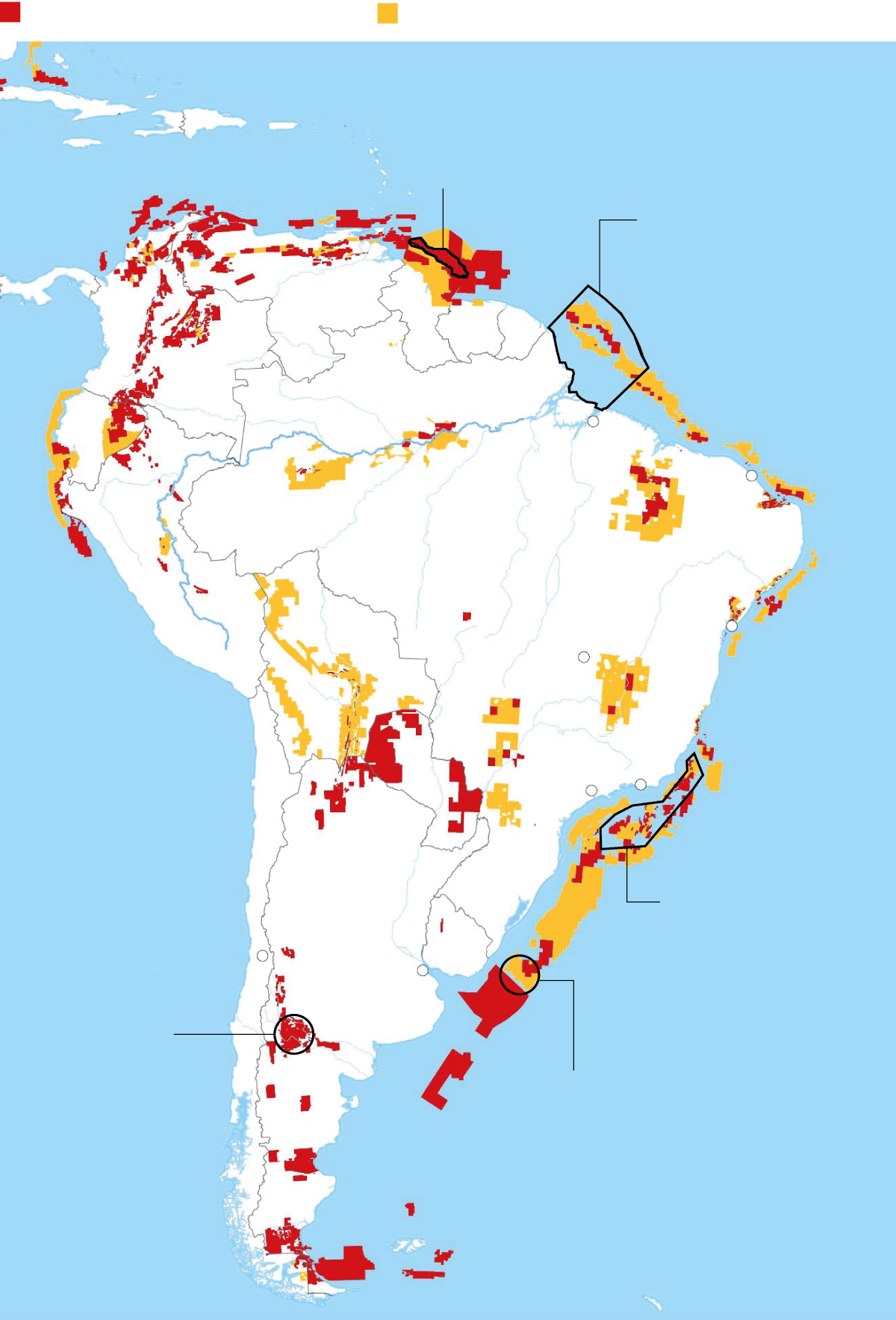
La creixent regió petroliera de l’Amèrica del Sud
Els països del continent n’estan incrementant l’extracció, amb el Brasil, l’Argentina i Guyana al capdavant. Aquestes són algunes de les zones destacades d'exploració i de producció
Zones d’exploració o de producció
Zones d’estudi o reservades
Bloc Stabroek
Aquest descobriment petrolier del 2015 ha transformat Guyana en l’economia amb un creixement més ràpid del món.
Regió Foz do Amazonas
El Brasil ha autoritzat l’estatal Petrobras a fer perforació exploratòria en part d’aquesta zona d’alta sensibilitat ecològica.
Veneçuela
GuYana
Colòmbia
Equador
riu Amazones
Perú
BRASIL
Bolívia
oceà
Atlàntic
Paraguai
Xile
oceà
Pacífic
Regió del presal
Més del 75% de la producció petroliera del Brasil prové de reserves ubicades sota gruixudes capes de sal antiga.
Uruguai
Argentina
Vaca Muerta
Jaciment d’argila fullada a l’Argentina que podria produir més d’un milió de barrils de petroli al dia per al 2030.
Conca de Pelotas
Una potencial nova àrea petroliera per al Brasil i l’Uruguai.
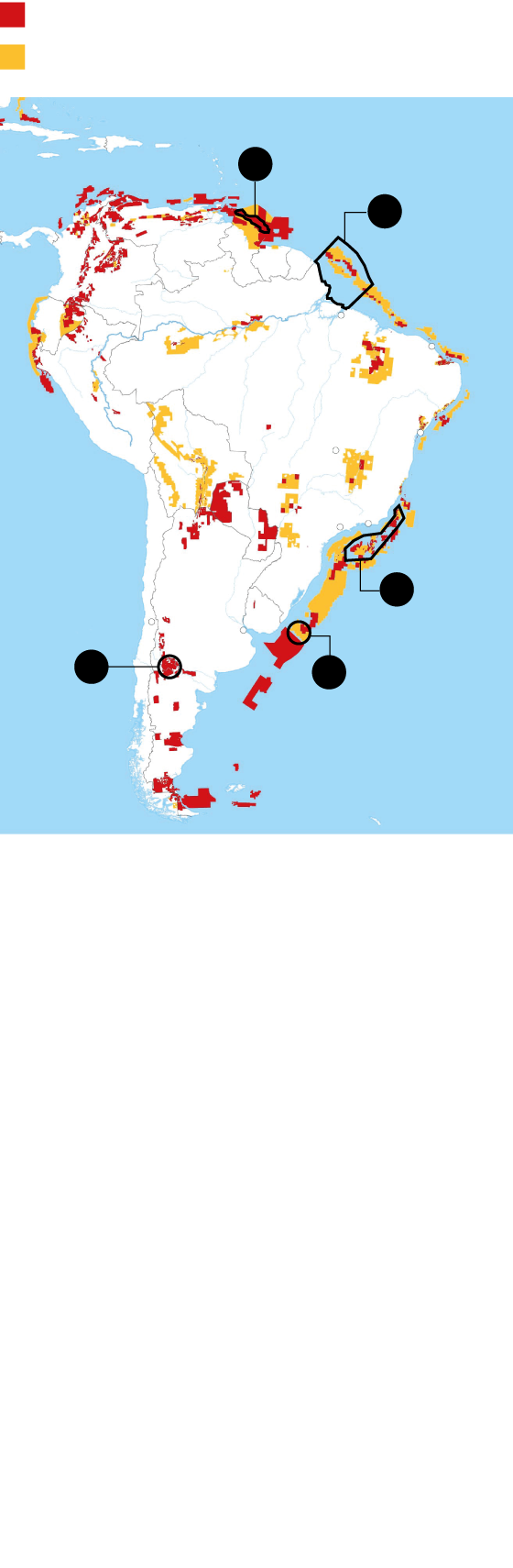
Zones d’exploració o de producció
Zones d’estudi o reservades
1
2
Veneçuela
GuYana
Colòmbia
Equador
riu Amazones
Perú
BRASIL
Bolívia
oceà
Atlàntic
Paraguai
oceà
Pacífic
Xile
3
Uruguai
Argentina
5
4
1. Bloc Stabroek
Aquest descobriment petrolier del 2015 ha transformat Guyana en l’economia amb un creixement més ràpid del món.
2. Regió Foz do Amazonas
El Brasil ha autoritzat l’estatal Petrobras a fer perforació exploratòria en part d’aquesta zona d’alta sensibilitat ecològica.
3. Regió del presal
Més del 75% de la producció petroliera del Brasil prové de reserves ubicades sota gruixudes capes de sal antiga.ecològica.
4. Conca de Pelotas
Una potencial nova àrea petroliera per al Brasil i l’Uruguai.
5. Vaca Muerta
Jaciment d’argila fullada a l’Argentina que podria produir més d’un milió de barrils de petroli al dia per al 2030.
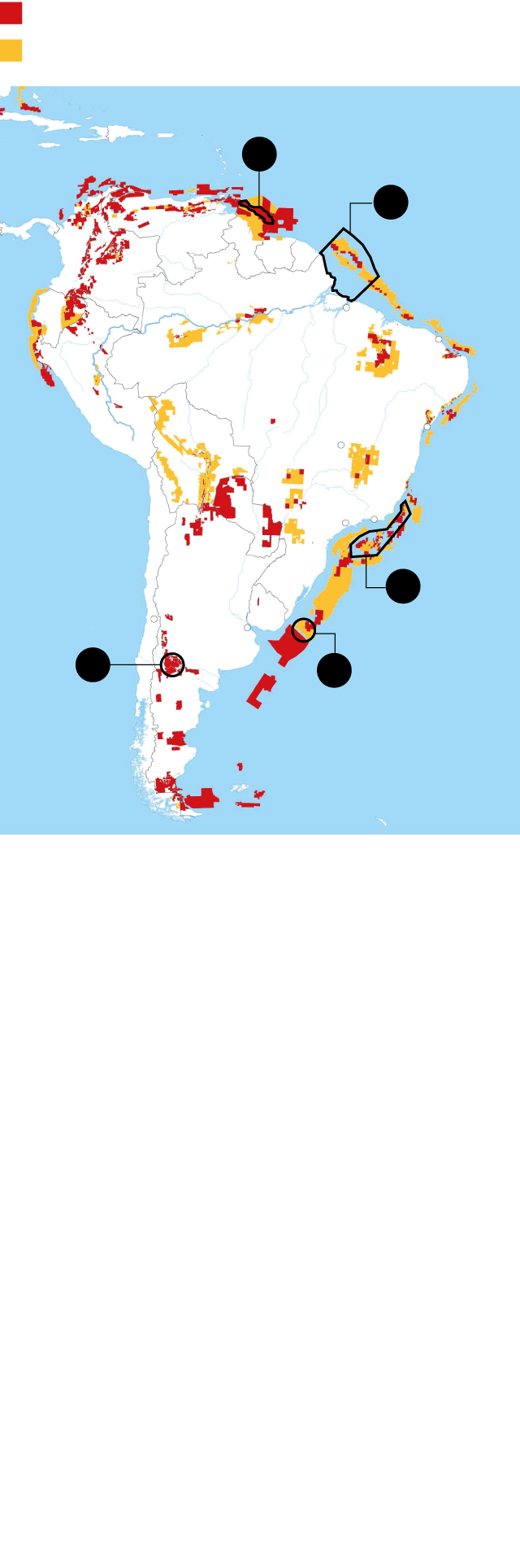
Zones d’exploració o de producció
Zones d’estudi o reservades
1
2
Veneçuela
GuYana
Colòmbia
Equador
riu Amazones
Perú
BRASIL
Bolívia
oceà
Atlàntic
Paraguai
oceà
Pacífic
Xile
3
Uruguai
Argentina
5
4
1. Bloc Stabroek
Aquest descobriment petrolier del 2015 ha transformat Guyana en l’economia amb un creixement més ràpid del món.
2. Regió Foz do Amazonas
El Brasil ha autoritzat l’estatal Petrobras a fer perforació exploratòria en aquesta zona d’alta sensibilitat ecològica.
3. Regió del presal
Més del 75% de la producció petroliera del Brasil prové de reserves ubicades sota gruixudes capes de sal antiga.ecològica.
4. Conca de Pelotas
Una potencial nova àrea petroliera per al Brasil i l’Uruguai.
5. Vaca Muerta
Jaciment d’argila fullada a l’Argentina que podria produir més d’un milió de barrils de petroli al dia per al 2030.
CNN/ARA
Unlike Venezuelan crude, Guyanese crude is light and cheap to extract. The discoveries reported on the Stabroek blog have transformed a country of fewer than a million inhabitants into an emerging power, although it is true that Its population has benefited very littleGuyana already produces more than 600,000 barrels per day and could exceed one million before the end of the decade. Suriname is following the same path, with promising results in its offshore basin. The new map would explain why Venezuela has ceased to be indispensable and why Washington can afford a more aggressive policy: the oil critical to US interests is no longer under the Orinoco River, but off the coasts of Georgetown and Paramaribo. Finally, the expansionist ambition that Maduro has displayed throughout his presidency in the region around the Essequibo River (Guyana), where it is estimated there are up to 25 billion barrels, perhaps helps explain the true reason for Trump's coup. It must be kept in mind that without Caracas's oil, Venezuela would be in dire straits. Havana, heir to the Castro revolution, may have its days numbered.And Marco Rubio would enter the island where his parents were born as the new viceroy of the pearl of the Antilles.
The new Eldorado of the Caribbean: how Guyana and Suriname have displaced Venezuela
Latin America's energy map is undergoing a radical transformation. Where the world once looked to Lake Maracaibo, today drilling rigs are focused on the so-called "Guiana Shield." But new deposits are emerging all over the subcontinent.
In just under a decade, Guyana and its neighbor Suriname have gone from being forgotten corners of the oil industry to becoming the great dream of American private capital. In Guyana, the American presence is not only economic, it is almost foundational. The Stabroek Group consortium, with its various oil fields, led by ExxonMobil (45%), has designed a wealth-extraction machine of relentless efficiency.
With committed investments exceeding $55 billion through 2026, the company has secured six key projects (such as Liza, Payara, and Whiptail) capable of producing crude oil with operating costs of just $35 per barrel. This figure guarantees profits even if the price of oil were to plummet. Despite the rivalry between the United States and China, China National Offshore Oil Corporation holds a 25% stake in Stabroek.
This deal is so lucrative it has caused seismic activity on Wall Street. Chevron, the only US company with a concession in Venezuela, in a $53 billion transaction ratified in July 2025, acquired Hess Corporation with a single objective : to gain a foothold in Guyana. For Hess, that country represented 70% of its future value; for Chevron, it was the springboard to Suriname, where the alliance between APA Corporation and the French company TotalEnergies is already preparing a $10.5 billion investment for the GranMorgu project, which contains at least two oil fields. However, China has also entered Suriname through an agreement that grants Beijing majority control (70%) of new exploration projects in blocks 14 and 15, in a strategic alliance with the state-owned Staatsolie.
The key to success and entrepreneurial ambition lies not only in geology, but also in the rules of the game. Guyana has offered one of the most favorable contracts in history: a royalty of only 2% and the possibility for companies to retain up to 75% of the oil initially to recoup their investments. This allows for a return on investment in less than five years. Suriname, being more protective with a 6.25% royalty and the participation of the state-owned Staatsolie, maintains a business framework that also encourages investment.
Venezuela is the mirror in which no one wants to see their reflection. With royalties reaching 33%, a tax burden close to 50%, and the legal requirement that the state-owned PDVSA control 60% of any project, foreign capital has fled. And while Guyana and Suriname are thriving with state-of-the-art infrastructure, some estimates suggest that Venezuela would need more than $100 billion and a decade of political peace just to return to what it was twenty years ago.