Jean-Pierre Filiu: "Trump acts with video game logic, doped with artificial intelligence"
Arabist and former diplomat, professor at Sciences Po

-
CAT -
CAST
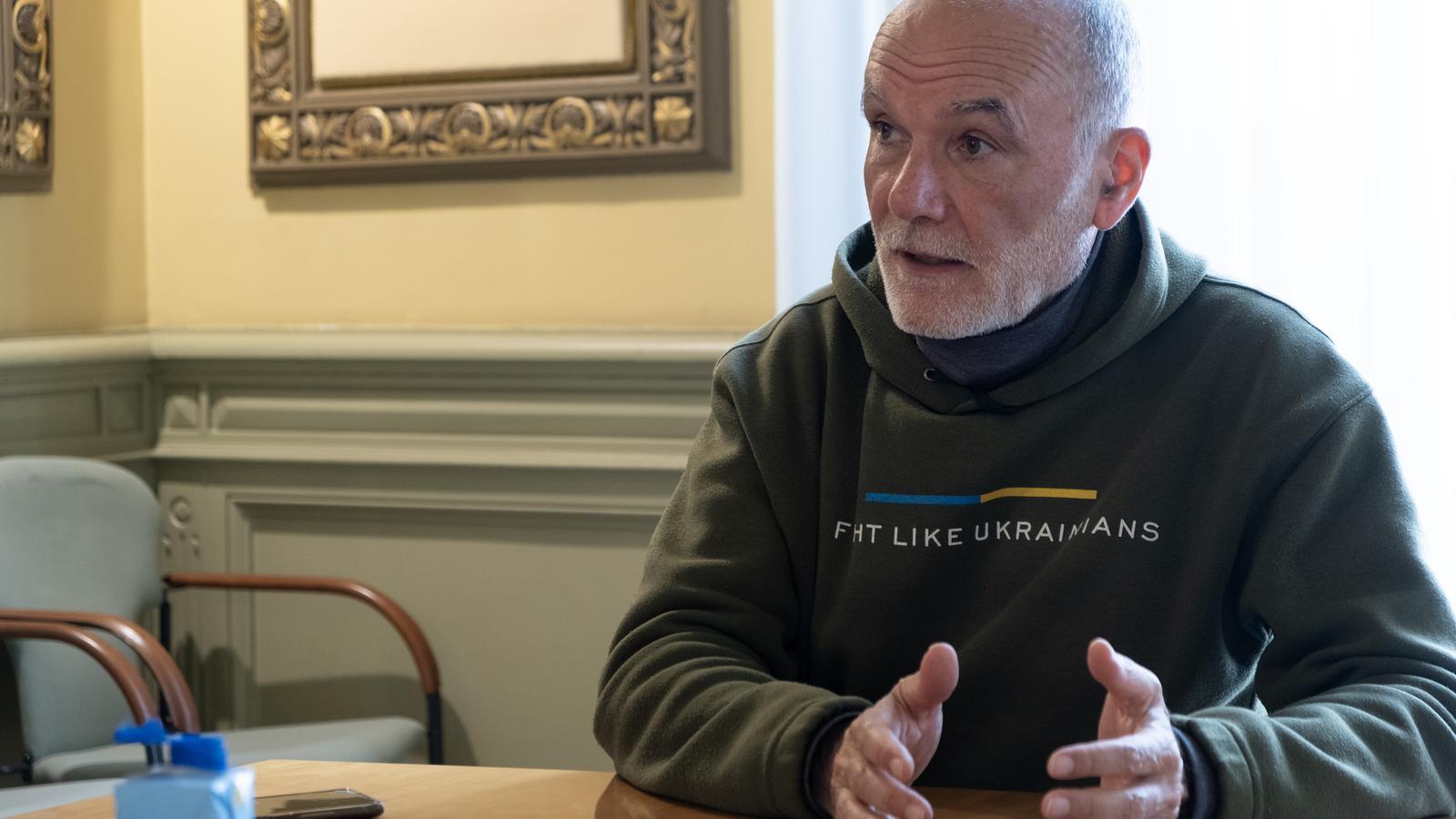
BarcelonaJean-Pierre Filiu is one of the foremost experts on the Arab world in Europe. A former French diplomat, Arabist and historian, and professor at Sciences Po, he visited Barcelona at the invitation of the European Institute of the Mediterranean (IEMed). He was one of the few European analysts to enter Gaza since October 7, 2023, and recounts his experience in A Historian in Gaza, which the publishing house La Cebra has just released in Spanish.
He says that what has happened in Gaza cannot be understood without going there.
— Everything I knew about Gaza has disappeared, it has been shattered. They have reduced to dust one of the oldest cities in the Middle East and one of the most prosperous oases in the region. It took me a few days to process it. Since there are hardly any buildings left standing, you have no perspective: there is only a sea of tents. And people's stories overwhelm you: accounts of destruction, of flight, of bombings, of loss, of impossible grief. I had never seen a place where refugees were expelled five times, ten times... And each time they lose someone or something, until in the end there is almost nothing left. What I have seen is not a war, it is the annihilation of the Gaza Strip as a living space. They want to transform what was once a people proud of its culture, language, and identity into an amalgam of bodies: bodies to feed, bodies that need medical attention... The illusion of a ceasefire has been sold, when on average four Palestinians are killed every day. But in Gaza, because there is no independent press or NGOs, all this can continue in general indifference. And this is what weighs most heavily on the population: the feeling of abandonment.
Where are we in the war between the United States and Israel against Iran?
— Trump and Netanyahu have probably saved the Islamic Republic of Iran when they intended to destroy it. In January 2026, the Tehran regime was at its lowest point in history due to the fierce repression of popular protest. Certainly, they have beheaded the Islamic Republic, but they have allowed it to regenerate through martyrdom, revenge, and, above all, by appropriating Iranian patriotism –Persian patriotism–, which is an eternally renewable energy. The country is destroyed, but we must remember what happened in Gaza: if in two and a half years of war they have not managed to expel Hamas from a small territory, they will not achieve it in a few weeks in Iran, a country three times larger than France. In the end, it will be necessary to negotiate. And I say this as an ex-diplomat: a negotiation, even if imperfect, is always better than a war that is believed to be won from the outset. Trump and Netanyahu have been completely mistaken. Therefore, if negotiation is necessary, the fundamental issue is the mediator, because between the two sides there is not only mistrust but a profound lack of understanding. The fact that the United States has had no diplomatic relations with Iran since 1979 means they don't know how to talk to them. Europe could mediate, but it has no will to, and neither do the Pakistani generals. The ideal would be a return to Oman's mediation, which was on the verge of reaching a good outcome before the outbreak of this war and would be much more effective, in my opinion, than the routes through Pakistan.
¿Has Netanyahu dragged the United States into war?
— There is not a single case in the history of Israel where the elimination of enemy leaders has led to lasting stabilization. Each time it has provoked a much more difficult process, in which the enemy regenerates and a new generation becomes even more radicalized. Trump acts with a video game logic, fueled by artificial intelligence. He thought the beheaded regime would collapse. I believe that one day documents will appear confirming that such a serious decision for the United States and for world security was made on the basis of very few elements, without any state institution being convinced: not the CIA, nor the Pentagon, nor the State Department.
Israel and Lebanon have now signed a ceasefire. It seems Netanyahu did not want it: was he forced into it by Trump?
— Netanyahu needs war to avoid prison. Every time a war stops, it is bad news for him. But it must not be forgotten that there was a ceasefire since November 2024, and that this ceasefire was permanently violated by Israel, with approximately one Lebanese dead every day. And that Hezbollah has preferred to play the Iranian card against the integrity of Lebanon: pretending to avenge Ali Khamenei, it sacrificed Lebanon to Iran. What is incredible is that, having a peacekeeping force on the ground and all the necessary UN resolutions, Trump's mediation is being trusted. And it is a pity, because the current Lebanese government is the most respectable, the one that wants to re-establish sovereignty over the entire territory and the one that fights most effectively against impunity and corruption.
You consider Putin the great winner of this war.
— As a historian I can say that the winners are not necessarily the ones who fight. For now, Putin is the big winner. Firstly, due to the rise in oil prices, which brings him billions of dollars; also due to the lifting of sanctions, which has allowed Russia to deliver oil not only to India, but also to Cuba. And there is also a component of credibility: we have seen an American president who says one thing and the opposite every day, who issues ultimatums that are not affirmations of power but rather narcissistic blackmail. On the other hand, Putin appears much more measured and stable, in his violence and brutality. What most disturbs countries and economies is unpredictability. And Putin has many flaws, but he is predictable.
And Europe?
— Europe must exist as a power, simply to survive in a world of predators. We must stop seeing the Middle East solely as a collection of crises to protect ourselves from: we must see opportunities there. Europe can mobilize a response. Today, in Gaza, it only plays the role of jailer, with its presence at the Rafah crossing. But it should propose a mechanism for truce supervision and assume it, or align its association agreement with Israel with its principles. The Middle East does not need more bombings, more violence, more wars: it needs rules, rights, and predictability. The only power that can provide this is Europe. And, if it does not, the European construction itself could be threatened in its foundations by the unleashed violence in the region.
