The war in the Middle East threatens a resource more vital than oil.
Desalination plants that produce drinking water in Gulf countries are highly vulnerable, and Iran is suffering from a severe drought.


-
CAT -
CAST
BarcelonaThe world depends on oil supplies from the Middle East, and now all eyes are on how The US and Israeli war against Iran drives up the price of Brent crude. and anticipates a global energy crisis. But there is another critical resource for sustaining life, very scarce in the region and infinitely more vulnerable: water. The countries of this desert region have responded to the lack of water by building desalination plants that make seawater drinkable. But this technological marvel has also become a strategic vulnerability: in these three weeks of war, there have already been attacks against these plants or very close to them. If they become targets, the impact would be devastating, since there are no alternative sources of supply.
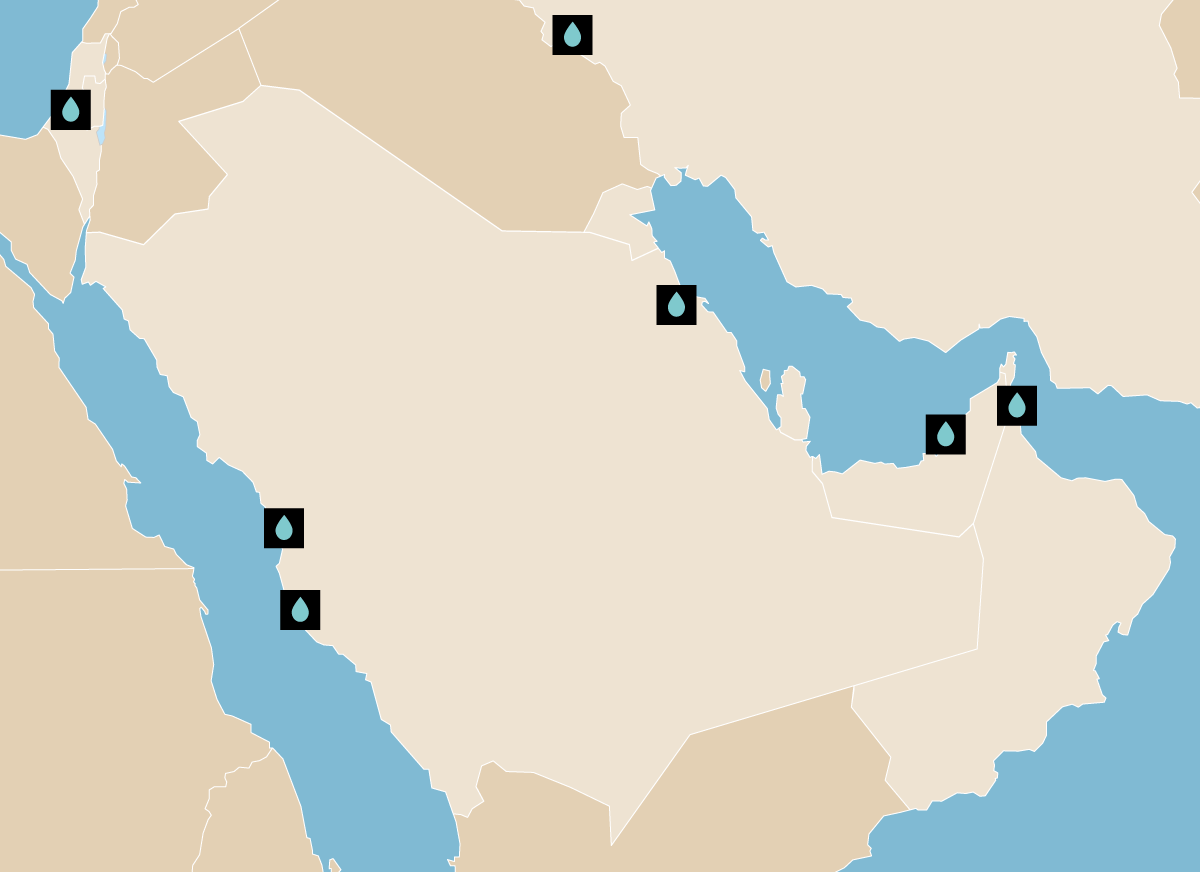
Principals dessalinitzadores
ISRAEL
Sorek
IRAQ
JORDÀNIA
IRAN
KUWAIT
Ras Al Khair
BAHRAIN
Fujairah 2
QATAR
ARÀBIA SAUDITA
Taweelah
EAU
Rabigh 3
OMAN
Shuaiba 3
mar Roig
IEMEN
Principals dessalinitzadores
ISRAEL
IRAQ
JORDÀNIA
IRAN
KUWAIT
BAHRAIN
QATAR
EAU
ARÀBIA SAUDITA
mar Roig
OMAN
IEMEN
Principals dessalinitzadores
ISRAEL
IRAQ
JORDÀNIA
IRAN
KUWAIT
BAHRAIN
QATAR
EAU
ARÀBIA SAUDITA
mar Roig
OMAN
IEMEN
The Persian Gulf region is a desert, without major rivers, with very little rainfall, and where groundwater is also scarce. For a century, the solution has been to invest the enormous resources obtained from oil in obtaining drinking water by desalinating seawater. Thus, the petro-monarchies transformed one of the driest landscapes in the world to accommodate luxurious urban societies thanks to desalination plants, a handful of facilities that make life possible in large urban centers. 70% of Saudi Arabia's drinking water comes from these plants, and in Kuwait and Oman, the percentage rises to 90%. The region's major cities, such as Dubai, Doha, and Abu Dhabi, also depend on them. Even Israel, which has waged wars to control the water sources of the Jordan River, relies on five coastal desalination plants, which supply half of its drinking water consumption. In total, 100 million people across the region drink desalinated seawater. And ten of the world's largest desalination plants are located on the coasts of the Persian Gulf or the Red Sea. A technological marvel, but also a huge vulnerability in times of war.
"Wars over water and with water as a weapon have always existed in the region, and Israel is an example: one of the first attacks on Gaza in 2023 destroyed the Strip's only desalination plant," Xavier Sánchez Vila, professor at the Polytechnic University of Catalonia, explained to ARA. "Destroying the desalination plants would cause a serious problem in the region," he warned.
Exposed Infrastructure
First, these are highly vulnerable infrastructures because they are outdoors and very difficult to protect, beyond each country's air defense systems. Furthermore, being located on the coast, they are more exposed to attacks, not only from the air but also from the sea. "Just one bomb can halt production for a few days, even if only partially, and that can already have an impact on the population. And if the attack is not just local but several plants are taken out of service for just a few weeks, it would be difficult to find alternative water supply sources, because the only solution would be to bring water in from elsewhere, by ship or road," he warned.
In addition, these plants are more difficult to repair than an oil installation. They require large amounts of energy, special materials such as membranes or thermal systems, and continuous chemical and mechanical treatment processes. "A repair can take weeks or months," Sánchez Vila points out. Therefore, like all civilian infrastructure, these facilities are protected by international law, and attacking them is a war crime.
But even if desalination plants don't suffer direct attacks, they can be seriously affected by war, for example, if there's an oil spill at sea or if crude oil seeps into aquifers. We have precedents: in 1991, a Kuwaiti oil spill in the waters of the Persian Gulf threatened the plant that supplies Riyadh, the capital of Saudi Arabia, for weeks.
Another weakness is the high energy consumption of desalination, which is why in many cases they are built next to power plants. And we must also consider that drinking water reaches inland cities—like the Saudi capital—through kilometers-long pipelines that are also vulnerable to bombing. A water crisis would go far beyond the problem of supplying the population. Sanitation systems would fail, hospitals would struggle to function, and all economic activity would suffer, because industry and tourism also depend on a stable water supply.
Drought in Iran
Although less dependent on desalination, Iran also has a water problem. It has been suffering from drought for years.This situation has been exacerbated by the climate emergency. The country is in conflict with Iraq over the management of shared rivers and the irrigation of the Mesopotamian wetlands. It also has some desalination plants and faces the challenge of supplying water to large cities like Tehran, located far from the coast. The combination of the climate emergency and poor government management, particularly regarding agriculture, has dried up wells, and reservoirs are empty. Attacks on its water infrastructure could severely worsen this underlying problem.

