France spends a quiet night after the curfews in the center of Paris and other cities
Emmanuel Macron rejects the resignation of the Interior Minister and asks him for "new methods" in the face of the protesters

-
CAT -
CAST
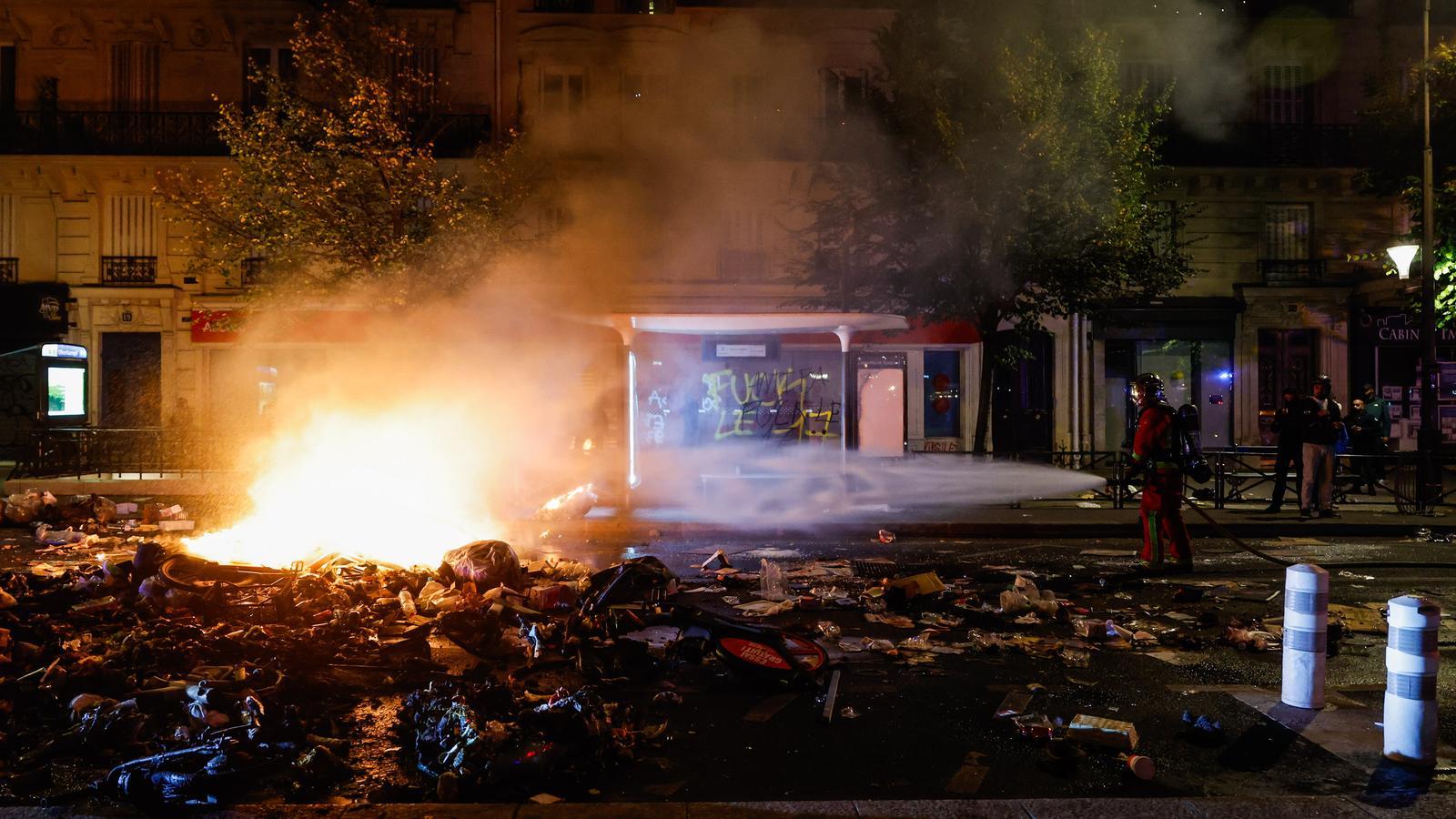
ParisFrance spent a quiet night from Monday to Tuesday, after several localities decreed nighttime curfews to try to curb the riots of the previous days. "The selective curfews have contributed to the tranquility of this night," stated Prime Minister Sébastien Lecornu in a message on his social networks, adding that they will be repeated "where the situation requires it."
In Paris, the curfew was in effect until 6 a.m. around the Place de la République and the streets in the Les Halles area, where a good part of the violent clashes and looting of shops took place during the weekend. In the French capital, demonstrations had also been prohibited in certain sectors of the city during the night. The Lyon prefecture took the same decision for the city center.
In addition, several other municipalities announced nighttime curfews only for minors: Lille, Nice, Douai, Wattignies, Coulaines, and Denain. In Marseille, one of the cities most affected by the violent acts this weekend, demonstrations and gatherings were prohibited.
The day of mobilization last Saturday against the increase in the cost of living –which also featured thousands of peaceful protesters– has led to a wave of violence never seen in the country before. Faced with the repetition on Sunday of massive looting of shops and unauthorized demonstrations, and the announcement by the movement of the yellow vests of a new protest for next Saturday, Prime Minister Sébastien Lecornu has opted to authorize extraordinary measures. The head of the executive has asked the prefects to decree "partial and localized" curfews to contain the protests.
The prime minister referred to a "very geographically uneven situation" and "a very localized chaos in urban centers." "We will not allow [the looting] to become chronic," he stated. If the surgical curfews and the ban on holding demonstrations do not serve to stop the riots, Lecornu does not rule out declaring a state of emergency.
In the midst of a social and political crisis, the government is also trying to make gestures to reduce the economic impact of the riots that have affected thousands of businesses across the country, which have had to close while repairing the damage: the prime minister has announced that he will increase the partial unemployment benefit from 60% to 100% of the gross hourly wage for workers affected by reduced working hours mandated by the company. This measure will be implemented this very Tuesday, despite the tensions of recent months in the markets with France's public debt. The Ministry of Commerce has estimated at 3,000 the number of businesses affected by acts of vandalism and looting and has promised support aid for partial closures or tax benefits.
Cornered by criticism regarding the lack of foresight regarding the riots and the low police presence on Saturday, the French Interior Minister, Laurent Nuñez, submitted his resignation early this Monday, but President Emmanuel Macron rejected it. The head of state asked Nuñez to remain in office, to draw "lessons" from the chaos of the weekend, and to deploy "new methods of action on the ground as quickly as possible [...] against the protesters." "Given the need for continuous command of law enforcement in the current context, the President of the Republic has rejected" Nuñez's resignation, the Élysée announced this Monday. The head of state also reiterated the call for "transparency," and pointed to the "errors in anticipation and intelligence" that have caused disturbances, destruction, and looting of numerous businesses.
In an interview on France Inter, Nuñez assumed responsibility. "I am responsible for everything that happens on the ground," the Interior Minister acknowledged. "In certain places, the security measures we established were disproportionate to the number of participants," he admitted. "The turnout was clearly higher than what we had foreseen or anticipated," he added. The forecasts he had estimated the number of protesters on Saturday at 200,000, while the real figure was 500,000. On Saturday, 60,000 personnel were deployed, the minister detailed, including "all mobile units, gendarmes, and police officers."
New demonstrations next Saturday
The success of Saturday's call and the great discontent in France regarding the government's inaction in the face of rising fuel prices and the lack of responses to student demands, have led the yellow vests movement, which called for the massive demonstrations two days ago, to maintain their challenge to the government with a new day of protests next Saturday, which they announced this morning as a "second act". On the website 17octobregiletjaune.net, this coordinating group has published a map of the mobilizations planned for October 24th, with several dozen actions already scheduled. "It is clear that there is a huge push for there to be a second act," explained Benjamin Ball, editor of the website, to Agence France-Presse.
The Prime Minister is to chair an interministerial crisis meeting this Monday to calculate the extent of the damage and announce new measures. Macron addressed the French on Sunday in a televised message during prime time in which he assured that the acts of violence "have no justification", and attributed the looting and the harshest clashes to "far-left fringe groups" and "delinquents", whom he distanced from the students who have been protesting for weeks and who, he admits, raise "legitimate demands".
Acts of violence, "unacceptable" to the EU
The European Commission has described as "unacceptable" the violent acts that have been recorded at the protests and has stood in solidarity with the French authorities in their efforts to ensure security. However, Brussels has defended that protesting peacefully is a fundamental right. "Those who demonstrate peacefully must not be equated with those who exercise violence –argued the spokesperson for the Commissioner for Home Affairs, Markus Lammert–. Arson, looting, and attacks against individuals or public buildings are unacceptable".

