Le Pen capitalizes on the chaos due to the protests in France and warns that they are "a threat to democracy"
Six months from the presidential elections, the far right would obtain double the votes of Mélenchon

-
CAT -
CAST
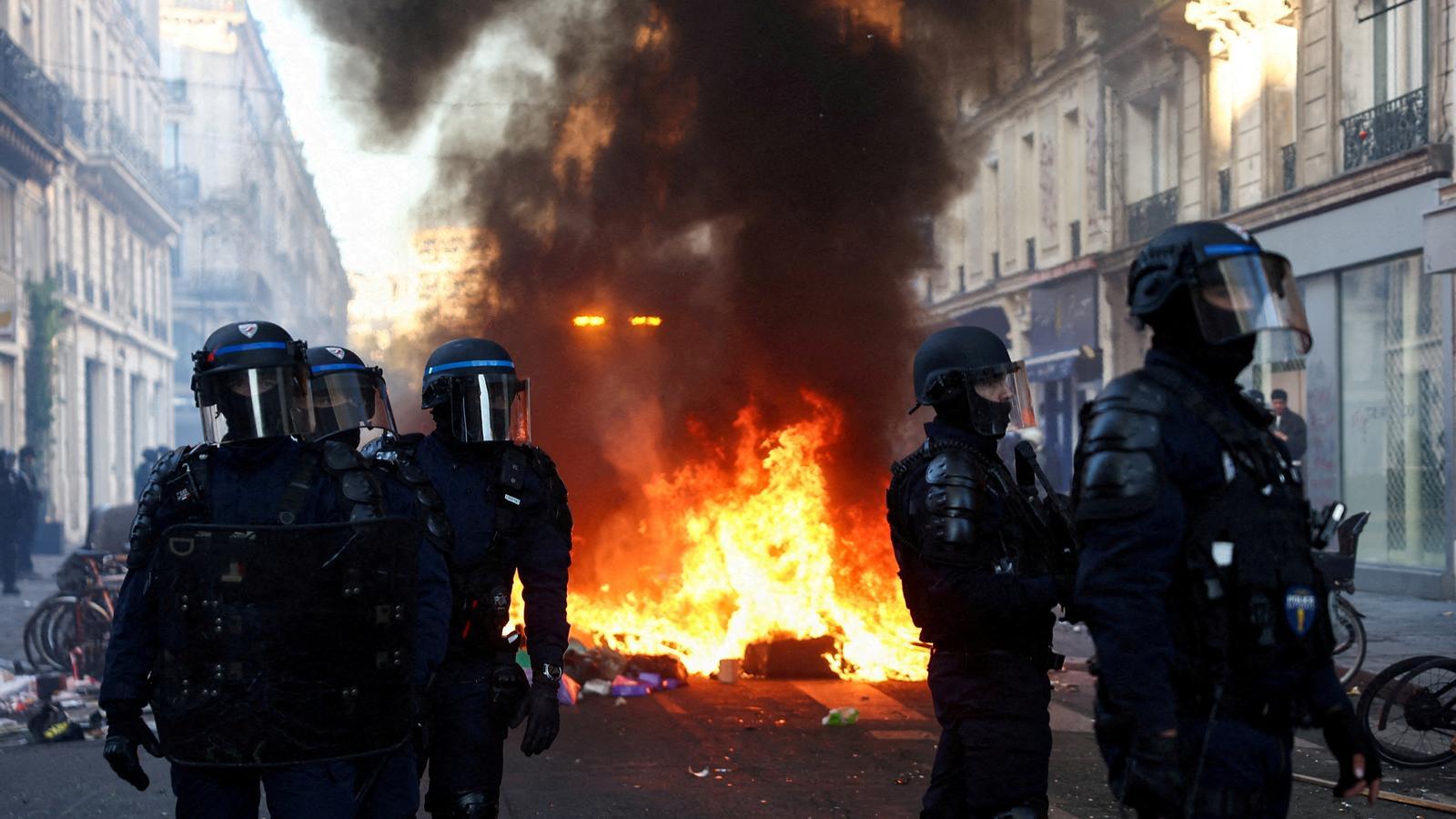
ParisThe images of young people smashing shop windows, looting stores and burning urban furniture in different French cities last weekend have given an electoral boost to Marine Le Pen, who aspires to take the Élysée in the presidential elections to be held in six months' time. "Dear vandals: you are the best campaign agents for Marine Le Pen," lamented the day after the riots the chronicler of Libération Luc Le Vaillant. "Your looting, your pillaging operations, your revolutionary 'reappropriations' are the best way to bring Le Pen to power. It makes one wonder if you are not the fifth column of the far right," wrote the journalist.
The polls prove the Libération chronicler right. According to the latest voting intention survey published this Wednesday by the conservative newspaper Le Figaro, conducted hours after the riots, the far-right leader consolidates her first position and would dispute the runoff with Jean-Luc Mélenchon, leader of France Unbowed (LFI), the radical left party. The National Rally (RN) candidate extends the lead that the polls were already giving her and would obtain twice as many votes as the left-wing candidate.
Marine Le Pen would be well ahead of the trio of pursuers, between 34% and 38% of the votes in the first round. The France Unbowed candidate would obtain between 15% and 20% of the votes, ahead of the centrist candidates. In the second round, in which only the two most voted politicians advance, the far-right candidate would win by a very wide margin over the radical left candidate (68% against 32%). In the first round, Mélenchon would be ahead of the former prime minister and moderate right candidate, Édouard Philippe, who would obtain between 12% and 16% of the votes.
Threat to democracy
Marine Le Pen is rubbing her hands at the chaos experienced over the weekend and is trying to gain political profit from it with an eye on the presidential elections. On Sunday evening, the day after the first night of street violence, the populist leader made a speech public from her office, with presidential airs. Sitting behind a desk with the French flag behind her and a gown on a hanger –an allusion to her background as a lawyer–, and with a serious demeanor, Le Pen denounced the "deep crisis of confidence and authority" that France is experiencing, and presented herself as the only possible alternative to restore order and calm to the Republic. The chaos experienced "is a threat to democracy," she asserted. "The authority of the state has been challenged," she insisted.
National Rally has not participated in the protests and is amplifying its discourse as a party of order: Jordan Bardella, Le Pen's number two, has promised to “restore order” after the presidential elections. And the leader boasts that the chaos is pushing moderate voters to choose her ballot. The social crisis favors the far right, which can project the image that it is the only capable relief to a macronism that is on its last legs. And furthermore, the chaos takes off the agenda the conviction against Le Pen for corruption —still pending the final appeal— or the latest accusations of antisemitism against Bardella.
Collapse of macronism
The wave of protests in France has further polarized the presidential election scene and has left President Emmanuel Macron more weakened, unable to respond to the students' demands and to take decisive measures to limit the rise in fuel prices, the trigger for Saturday's mobilization. The tenant of the Élysée, who cannot run for re-election nor has a majority in the Assembly to pass laws, appears helpless in the face of the social, political, and financial crisis the country is experiencing. Macronism, now, is running out of steam. "Six months before the presidential elections, October 17 runs the risk of becoming the symbol of the definitive collapse of Macronism," wrote journalist Solenn de Royer this Tuesday in a column in Le Monde.
In a gesture of helplessness, Macron and his government have sought to place the responsibility for the riots and destruction on what they call ultragauche, and by extension on the figure of Mélenchon. "Far-left groups have organized the violence," accused Prime Minister Sébastien Lecornu. President Macron lashed out against the "factionalists," and Éric Ciotti, the mayor of Nice and an ally of Le Pen's far-right, denounced the "red fascism." The traditional right goes even further and this week has openly called for the outlawing of France Insoumise, whom they accuse of seeking "insurrection."
Mélenchon has condemned the looting, but at the same time has denounced that "screens are flooded with images of violence," which cover up the fact that on the streets "tens of thousands of people have demonstrated peacefully." He has also held the government responsible for an "aberrant response that has opened the door to chaos." In fact, French media have confirmed that at Saturday's protests, the police fired tear gas before the riots even began.

