A guide to understanding the world in 2026: the 10 issues that will shape the agenda
With geopolitics becoming increasingly chaotic and brutal, it will be a year of global readjustment, according to CIDOB analysts.

-
CAT -
CAST
BarcelonaThe first year of Donald Trump's second term has consolidated a dynamic that had been brewing for some time, but which has now accelerated: economic and technological coercion in relations within a Europe caught between the United States and Russia. In a context of tariffs and expansionist interventionism, China seeks to project stability and expand its markets, while new alliances are being forged in the Global South. 2026, therefore, will be a year of "global readjustment" in which "the capacity to adapt to a brutal geopolitics will be tested." This is the prediction of researchers at CIDOB, who have selected the 10 issues that will shape the global agenda in 2026. We review them one by one.
Impunity of Interventionism

At the end of November, the US published its new national security strategy. In the document, under the pretext of guaranteeing American security, Trump clearly states Washington's intention tointervene in other countries to further their interests. "Trump symbolizes the growing wave of states that are moving outside the law," CIDOB points out. In recent months, amid attacks on alleged drug-running boats in the Caribbean and the Pacific and the embargo on Venezuelan oil tankersThe US president has threatened military intervention in Venezuela, Colombia, and Mexico, as well as seizing control of the Panama Canal. All of this through actions—or warnings—outside the bounds of international law.
CIDOB points out that "the impunity" of acts like these "has turned military intervention into yet another instrument readily available to governments or international actors willing to use increasingly unregulated violence." This "legality vacuum" could worsen in 2026, primarily due to two possible conflicts: a US attack against Venezuela and the resumption of the war between Israel and Iran, which began in June of this yearThen, Israel launched an unprecedented attack against Iran, which responded with hundreds of missiles against Tel Aviv. The conflict was put on hold, but it remains to be seen whether it will reignite.
The privatization of peace

In an increasingly less multilateral world, international relations are based more and more on agreements between magnates serving their own profits, according to the authors of the CIDOB report. Figures like Trump, Turkish President Recep Tayyip Erdoğan, and Chinese President Xi Jinping, and countries like Qatar, Saudi Arabia, and the United Arab Emirates have signed agreements in which the interests of large multinational corporations play a central role. Examples include the agreement between Azerbaijan and Armenia, under which US companies will manage the construction and operation of a railway corridor on the Armenian-Iranian border, and the reconstruction of Gaza, valued at $70 billion, according to the UN. In this latter case, several proposals exist, but Washington's, which anticipates $185 billion in profits for US and European companies, is considered the frontrunner. And amidst this business, the vast fortunes of the Persian Gulf are positioning themselves as new mediators in international conflicts, attempting to leave their mark on the agreements.
More weapons, troops, and military AI

In 2026, the global arms race is expected to continue, which this year has reached a key moment with Trump's demand that NATO members invest 5% of their GDP in defense. Spain has rejected it, but has increased its spending to 2%.During the first half of 2026, the EU will launch key defense projects, aiming to create a drone wall in Eastern Europe to protect itself from Russia. In this context of militarization, large defense technology companies are becoming integrated into state decision-making, influencing resolutions according to their private interests.
With rearmament at the heart of many countries' defense policies, military spending on AI is projected to exceed $30 billion. As the EU strategy demonstrates, drones have fully entered the realm of warfare, no longer just as a tool for recording, shooting, or bombing. They are also used to generate fear and destabilize regions, as is the case with... Russian air raids in Poland and Romania, or The drones that Israel has used in Gaza emitting the sound of a baby crying to terrorize the Palestinians. China will play an important role in this, since according to data from think tank Atlantic Council: The Asian giant dominates 80% of the global drone market.
A global race to diversify business alliances

While the impact of US trade tariffs was mitigated in 2025 thanks, in part, to massive imports before the tariffs were implemented, the consequences will be more visible in 2026. The World Trade Organization estimates that the percentage of global trade adhering to its rules has fallen to 74%, and it remains to be seen how countries will seek alternative trade arrangements in the face of the uncertainty and volatility of Trump and competition from China. It will also be interesting to see what role India ultimately plays, as it is currently negotiating trade agreements with more than 50 countries. Thus, the web of trade relations is being reshaped, and it is possible that in 2026 we will begin to see new alliances emerge as a result of these developments.
A brake on the tech bubble?

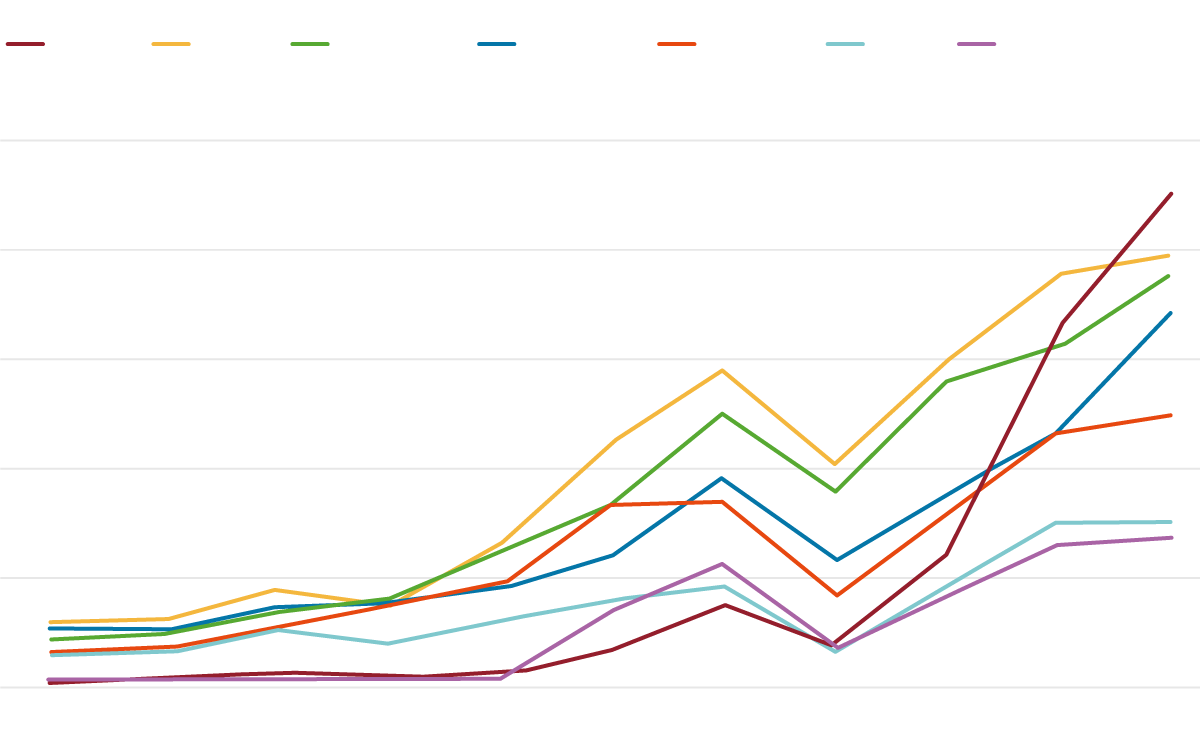
Another factor that has helped mitigate the impact of US tariffs, according to the Organisation for Economic Co-operation and Development, is the massive investment in AI. But one question remains: Will this sector generate enough profit to justify the massive investment currently underway? There is a risk of a bubble forming.Since the major technology companies are all investing in each other, and if these multi-million dollar investments among large corporations slow down, it will have a significant impact on the global economy. In this area, China is also trying to compete with the US by efficiently bringing existing technologies to market instead of investing in technological innovation.
Nvidia
Apple
Microsoft
Alphabet
Amazon
Meta
Tesla
5
4
3
2
1
0
2015
2016
2017
2018
2019
2020
2021
2022
2023
2024
2025
Nvidia
Apple
Microsoft
Alphabet
Amazon
Meta
Tesla
5
4
3
2
1
0
2025
2023
2019
2015
2021
2017
Nvidia
Apple
Microsoft
Alphabet
Amazon
Meta
Tesla
5
4
3
2
1
0
2025
2023
2019
2015
2021
2017
So far, this investment spiral and technological competition has extended Silicon Valley's influence worldwide. The EU, which has often made efforts to minimally regulate the sector and prevent private interests from infringing on individual and collective rights, is considering delaying the implementation of regulations on some AI systems until the end of 2027. Meanwhile, the Gulf states are betting on AI to protect their wealth and global influence.
Generation Z, between expectations and reality

This past year has also highlighted the discontent of Generation Z worldwide, which She has led protests against social inequality, lack of opportunities, and government corruption.In countries like Morocco, Indonesia, the Philippines, Peru, and Mexico, uprisings have occurred. In some cases, such as Nepal, Madagascar, and Bangladesh, the revolts have toppled the government. It remains to be seen whether these outbursts of discontent and indignation will translate into votes in 2026—Bangladesh, Nepal, Morocco, Peru, and Bulgaria are holding elections—or whether the conflict will reignite in the streets and transform into another form of political expression.

- If you want to explore the map in more detail, open the high-resolution version in another tab.
Socioeconomics of fear

The housing crisis and inflation have marked 2025 in many parts of the world, especially in the Global North, and 2026 doesn't appear likely to be a better year for the working class and the lower middle class. The cost of a basic food basket is 34% higher than in 2019, according to the European Central Bank (ECB), and public debt is steadily increasing. This rise in debt is also affecting the largest and richest countries. where large multinationals such as Amazon, Meta, Starbucks and HP have announced job cutsIn the Global South, according to IMF data, 47 countries will have allocated more than 50% of their income to debt repayment, and another 75 states will have dedicated more than 33%. In Latin America, this represents the worst level on record, and worldwide, 5.2 billion people live in countries where debt obligations exceed social spending. All of this coincides with a severe cut in humanitarian aid implemented by Trump. In many cases, the money that doesn't reach impoverished countries is also not allocated to social spending in the aid-sending countries, at a time when states are focused on increasing military spending. European strategic disorientation

In the context of the battle for global hegemony among great powers, the EU finds itself in a moment of disorientation, caught between internal divisions and external threats, CIDOB points out. Europe sees its traditional ally, the US, as increasingly distant. In its new national security strategy, Washington has admitted in writing its desire to destabilize the EU. fostering far-right formations in the Old Continent that align with US interestsUnder Trump's demands to increase military spending, the EU will have to perform a balancing act by 2026 to boost economic growth, contain the public deficit, and simultaneously increase defense budgets. All of this will take place against a backdrop of a rising far right in most countries of the continent and after the 27 member states have decided to tighten immigration policies and increase border controls, in addition to weakening climate agreements. Climate: a victim of geopolitics

Regarding climate change, 2025 has once again highlighted the lack of consensus on climate governance worldwide. The most obvious example was COP30, held in Brazil, which It ended without agreements on reducing fossil fuels. And without financial support from developed countries for the climate transition in the Global South. However, some agreements were also reached on climate adaptation financing for 2035, and it is expected that by 2026 renewable electricity will exceed 20% of global production for the first time, with the Global South leading the adoption of green technologies. Furthermore, during the past year, as in 2024, China's exports of green technology continued to surpass those of US oil and gas. In general, however, major powers are taking steps backward on green issues. In the EU, the ambition of environmental policies is decreasing and the responsibility of the private sector is being diluted, and this January Washington will make its second withdrawal from the Paris Agreement effective. Trump already took the US out of this agreement during his first term, but Biden rejoined the pact when he arrived at the White House. Autocratization of the U.S.

CIDOB is also paying close attention to the situation in the US, as in his first year in office, Trump has increasingly expanded the limits of presidential power, declaring national emergencies to justify extreme policies. He has also purged several state agencies and sidelined the heads of independent organizations, amidst a full-scale attack on civil rights. The 2026 midterm elections will put American democracy to the test.
-
Venezuela: weapons in the Caribbean
The US is maintaining its military deployment in the Caribbean and the Pacific in an operation aimed at pressuring Maduro to relinquish power. Trump has also warned that Colombia and Panama will be the next targets.
-
Ukraine: Peace or surrender
With peace talks between Kyiv and Washington progressing in recent days and the resumption of contact between the Kremlin and the White House, it remains to be seen how the peace proposals will evolve, which for now are, according to CIDOB, more of a "freeze of the front line".
-
The Middle East: A Peace with Shadows
In Gaza, Lebanon, and Iran, three precarious truces threaten to collapse at any moment. During 2026, Israel and Lebanon will hold elections. Syria will continue its fragile transition. And Iran, for its part, seems determined to advance its nuclear program.
-
Sudan: Two Years of Violence and Humanitarian Crisis
Following the capture of Al Fashir by the Rapid Support Forces and the shift of the violence to the Kordofan region, the civil war is expected to continue escalating in the coming months. While Trump announced his interest in mediating, this conflict has triggered the world's most severe current humanitarian crisis, and the two main external backers—the United Arab Emirates and Egypt—remain at odds within the country.
-
Democratic Republic of Congo: The gap between diplomacy and the front lines
Despite the Doha framework agreement signed at the end of 2025, violent clashes have not ceased, and negotiations could break down at any moment due to the advance of the insurgent group (M23) southward. Meanwhile, other armed groups affiliated with the Islamic State are also exacerbating the humanitarian crisis, with more than 5 million people internally displaced.
