Armenia maintains its course towards the West with Pashinyan's broad victory
The prime minister does not obtain the necessary supermajority to culminate the peace process with Azerbaijan

-
CAT -
CAST
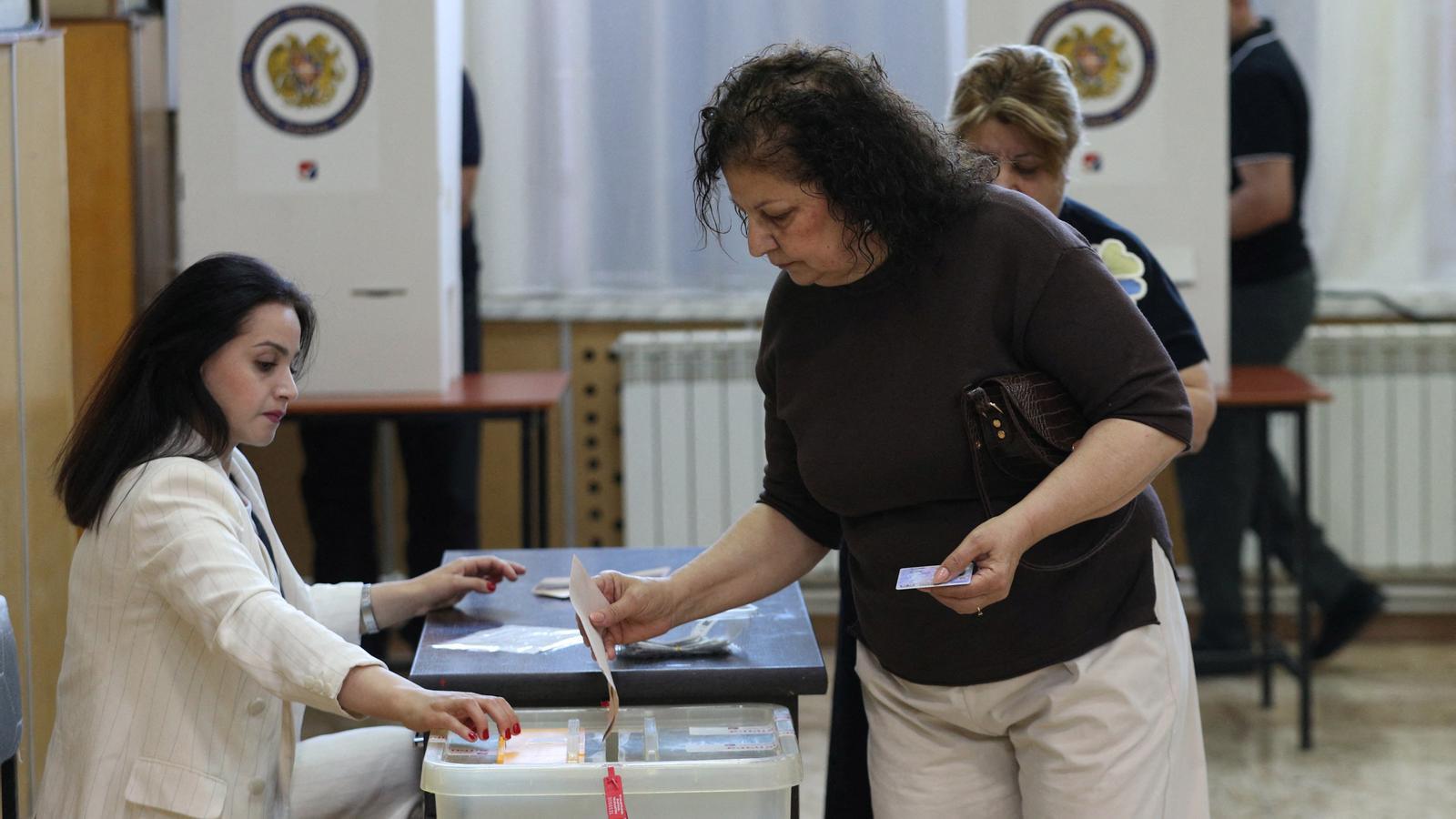
MoscowThere was no surprise in Armenia's legislative elections. The party of Prime Minister Nikol Pashinyan has achieved a comfortable victory that will allow him to form a government and continue with the strategy of approaching the European Union and the United States and distancing himself from Russia. These results also validate the peace process initiated by the Armenian leader almost a year ago to put an end to a conflict of nearly four decades with Azerbaijan. However, the parliamentary majority is insufficient to amend the Constitution and remove the claim to the Nagorno-Karabakh territory, as Baku demands to finalize the agreement.
Pashinyan's party, Civil Contract, obtained nearly 50% of the votes and 64 seats, eleven above the absolute majority. Only two other parties surpassed the representation threshold, both pro-Russian. The main opposition party, Strong Armenia, led by Russian-Armenian billionaire Samvel Karapetyan, achieved 23% of the votes and 29 seats, while the Armenian Alliance, of former president Robert Kocharyan, narrowly missed 10% of the votes with 12 deputies. Turnout was 59%, almost ten points higher than in 2021, but fragmentation meant that nearly 17% of the votes cast went to extra-parliamentary candidacies.
Pashinyan, who declared victory in the early morning, with just 10% of votes counted, assured that he “will continue to strengthen ties with the West,” and the President of the European Commission, Ursula Von der Leyen, responded: “Armenia can count on us.” At the same time, the prime minister-elect insists that he will maintain membership in the Eurasian Economic Union, the supranational organization led by Russia, and denies that relations with Moscow are deteriorating, despite the fact that in recent weeks they have banned imports of Armenian products and threatened to cut off the supply of gas and oil to Yerevan. “I don't see any tension, it's artificial tension,” Pashinyan said during election day.
The Kremlin has put aside coercive rhetoric in its first official reaction and prefers to wait and see the next moves of the new government. The spokeswoman for the Russian Ministry of Foreign Affairs, Maria Zakharova, pointed out that they will "shape" their position "taking into account the real steps taken by the Armenian leaders." Furthermore, she warned Pashinyan of the risk of making "unilateral" decisions in a context of "extreme polarization" because it could lead society to "greater division and unrest." The diplomat also regretted that the campaign and election day were marked by "unprecedented harsh repression" against the pro-Russian opposition and denounced Western interference, especially from the European Union.
The opposition leader has described the electoral process as "shameful" and has denounced more than 700 arrests of his supporters and candidates in recent days. Armenian authorities claim it is an operation to dismantle a vote-buying network linked to Karapetyan's party, who is also under house arrest, in his case for allegedly calling for the overthrow of the government in 2025. Pashinyan has stated that a large part of the opposition votes have been bought and added that the leaders of the pro-Russian forces must be prosecuted. Critics, however, consider it an example of the growing erosion of political pluralism and the lack of judicial independence under Pashinyan's increasingly populist and personalist mandate.
Insufficient evaluation of the peace process
Despite the decline in Pashinyan's popularity after the defeat in the Karabakh war in 2023, which ended with the forced exodus of more than 100,000 Armenians, the Civil Contract has achieved more votes than in the last elections, albeit with fewer seats. The prime minister's party has fallen far short of the two-thirds majority in Parliament needed to call a referendum and make the constitutional changes required by Baku and, therefore, will have to seek alternative ways to unblock the agreement with Azerbaijan.
Pashinyan, who has not wanted to comment on how he will resolve this issue, has called for the peace process to be "institutionalized" and for the border with Turkey to be opened. "The people of Armenia have voted for peace, prosperity, and regional cooperation, and I hope they will receive positive reactions from Turkey and Azerbaijan," said the candidate. He also believes that the work to build the corridor between the Azeri enclave of Nakhchivan and Baku through Armenian territory, the so-called Trump Route, must begin "as soon as possible".
