The beaver returns and the jackal arrives: new neighbors for Catalonia?
The expansion of these two species poses ecological opportunities and conflicts that farmers, ranchers, and administrations will have to manage
-
CAT -
CAST
They are two animals that we associate with distant and wild lands, but it seems that soon we will be able to find them in our rivers and mountains. The most precocious is the beaver, the largest rodent in the northern hemisphere, which is arriving in Catalonia via the Ebro. The jackal still lives far away, but the expansion of its European population suggests its arrival in the coming years. The arrival of one and the other promises new challenges, opportunities, and conflicts that will have to be managed with care.
The situation of the beaver (Castor fiber) in Europe is a story of success and resilience: after having been reduced to only 1,200 individuals scattered in eight isolated populations at the end of the 19th century, the species has recovered to the point that the current population is estimated at a minimum of one million seven hundred thousand specimens, spread across more than twenty countries.
This large rodent, weighing 35 kilos (the second largest in the world, only surpassed by the capybara), lives in several centers close to us. The most immediate is on the Ebro, where in 2003, 18 specimens were illegally released between Navarre and La Rioja. Now, just 23 years later, "there are more than 1,000 animals spread over hundreds of kilometers of the Ebro and its tributaries," assures Davide Serva, a researcher at the Doñana Biological Station (EBD-CSIC).
In La Rioja alone, beavers already occupy some 378 kilometers of river. It is a lightning-fast colonization that promises to fill several Catalan rivers with these animals. For the moment, there is no record of their presence in Catalonia, despite some possible unconfirmed isolated sightings. But everything suggests that they could spread through the lower section of the Ebro following their progression and go up the Segre and the Nogueres towards the Pyrenees, although the numerous reservoirs on these rivers may greatly slow down the process.

But we can also receive beavers from the north: in the Rhône river there is a significant population that is gradually approaching us. "Recently, beavers have colonized the Narbonne basin, so they are a short distance from Catalonia following the coast," explains Duncan Halley, a researcher at the Norwegian Institute for Nature Research (NINA), Norway's leading institution for applied ecological research. In conversation with ARA, Halley assures that "beavers can swim in saltwater, as has been seen many times in different places in Europe," and this means that these animals could reach Roussillon and Empordà by sea. And, as if all this were not enough, there is still one last option: it has also been colonizing the Occitan Tarn river and, given that it is a tributary of the Garonne, it could go up its course and reach the Aran Valley.
A colonizer that transforms rivers
Beavers tend to move quickly along a river system. "Their expansion speed is about 15 kilometers per year, as we have seen in La Rioja, where the beaver colonized 300 kilometers of river in about 18 years," comments Serva in conversation with this newspaper. But, as Halley explains, dispersal between different river systems is slower because "they tend to be reluctant to move far from the water, as they have short legs and cannot outrun predators in speed." "In their day-to-day life, they try to always have an easy retreat route to the aquatic environment," he states. Their great current expansion throughout Europe is due "simply to the fact that they are reoccupying their natural niche now that they are no longer persecuted," asserts Halley.
Experts consider that the effects of the beaver on the ecosystem are mostly positive: "They increase the diversity of the riparian habitat and help to cushion floods and droughts," assures Serva. For the researcher, "there can also be conflicts due to damage to plantations, or dams that block irrigation canals," circumstances that can be managed with various protection measures, just as is done throughout Europe. In any case, these are limited damages, since the vast majority of conflicts between beavers and humans occur in a very narrow riparian strip, of only about 20 meters from the water's edge. Hunting them is not an option, because the European Commission treats the beaver as a native species in Spain, which is why it is protected by the habitats directive.

The mysterious canid that comes to us from the east
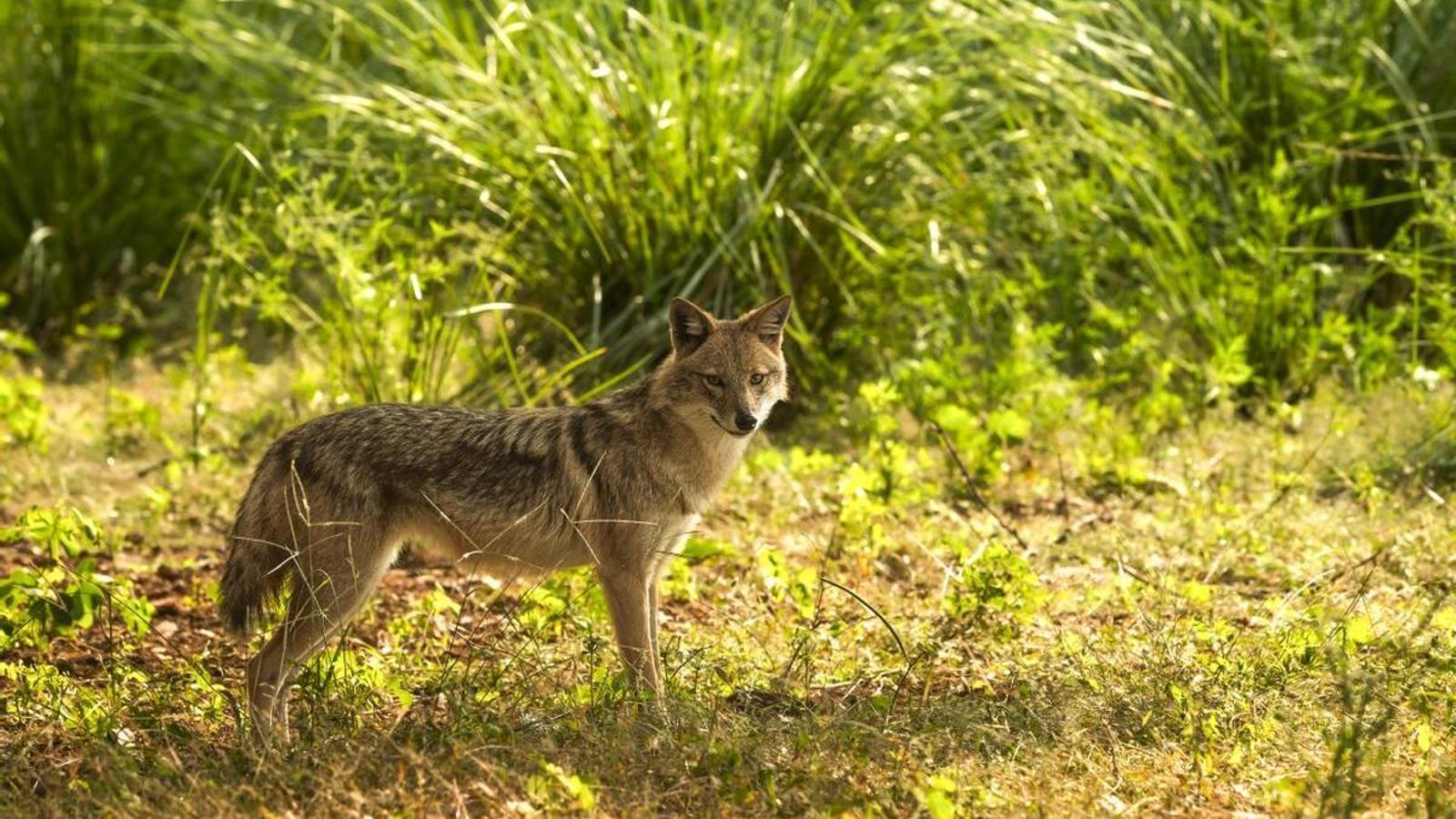
The word jackal might seem very exotic to us, but in Eastern Europe, there is a significant population of the golden jackal (Canis aureus) that is spreading towards us. Just as paleontological remains of the beaver have been found in Catalonia and, therefore, it is a return, the jackal's story promises to be a success story of an absolute newcomer, as there is no record of it ever having lived among us.
This canid is very intelligent, so much so that it has learned to live in the vicinity of villages because it knows that wolves flee from people and do not approach them. Thus, it uses human settlements as protective shields against its great enemy, the Canis lupus. It is worth mentioning that both are competitors and that the wolf is the dominant species.
They are not very large: adults are at most one meter long and weigh up to 15 kg, like a medium-sized dog. Their appearance resembles that of a wolf, but with a shrunken air. They live in family groups composed of a breeding pair and their offspring.
It is estimated that the European population of this animal currently exceeds 100,000 individuals and that it is especially abundant in countries like Bulgaria, Hungary, or Serbia. In recent years, many animals have been detected wandering further afield, so "the dispersal front reaches Spain, to the west, and Scandinavia in the north," according to Miha Krofel, a specialist in jackals and professor of animal ecology at the University of Ljubljana, in Slovenia, in a conversation with ARA.
As initial findings, in 2023, a specimen was found run over on a road in the Alavese municipality of Agurain, and in 2024, another one was detected in the surroundings of Zaragoza, while in France, they have already been located in several departments. In Germany and Poland, the first reproductions have already been confirmed, and in northeastern Italy, there is a small stable population.
What makes the jackal come towards us? According to Miha Krofel, its expansion is caused by "the extermination of the majority of wolf populations in Europe, a process that reached its peak during the second half of the 20th century," although in Catalonia it is earlier. Even though wolf populations are now recovering, there are still many empty spaces that the jackal colonizes in the absence of its enemy. Since the jackal needs time to colonize new areas, "the expansion did not reach Western Europe until a few years ago," asserts Krofel.
And there is no lack of space to run: the habitat models developed by this researcher indicate that the jackal could colonize around 75% of European territory in the near future, a huge extension. In fact, according to these models, most of the Iberian Peninsula presents a suitable habitat for this canid and, for the most part, free of wolves. This makes it considered quite likely that this animal will end up colonizing most of the Peninsula.
At the very least, this is what Miha Krofel believes, according to whom "the establishment of the jackal in Catalonia in the coming years is very likely," although it is very difficult to know when. It could be tomorrow or ten years from now. In any case, this researcher is convinced that "in a few decades there will be a stable population in Catalonia, at least where there are no wolves."
The ecology of the jackal is quite similar to that of the fox: it feeds mainly on rodents and carrion, but can complement its diet with fruits, insects, birds, amphibians, reptiles, and larger mammals. "They can cause damage to livestock, especially to poultry or small lambs. But these ravages are minor compared to those caused by larger carnivores," points out Miha Krofel. On the other hand, they help to control some agricultural pests, such as voles and mice. In any case, it is of little use to kill them, because, according to Krofel, "they can increase reproduction when they are persecuted, and that is why shooting jackals does not usually affect their population volume, as also happens with foxes."
A coexistence that will need to be managed
Beavers and jackals show how animals spread freely, without asking for permission, across a Europe where they are no longer pursued to the point of extermination. They will enrich a Catalan fauna that currently already includes bears, an incipient population of wolves, and the arrival of some scattered lynxes. Farmers and livestock breeders will have to adapt to this, and management measures will need to be implemented to make possible a coexistence that is considered inevitable and that in many places in Europe has been proven possible.
