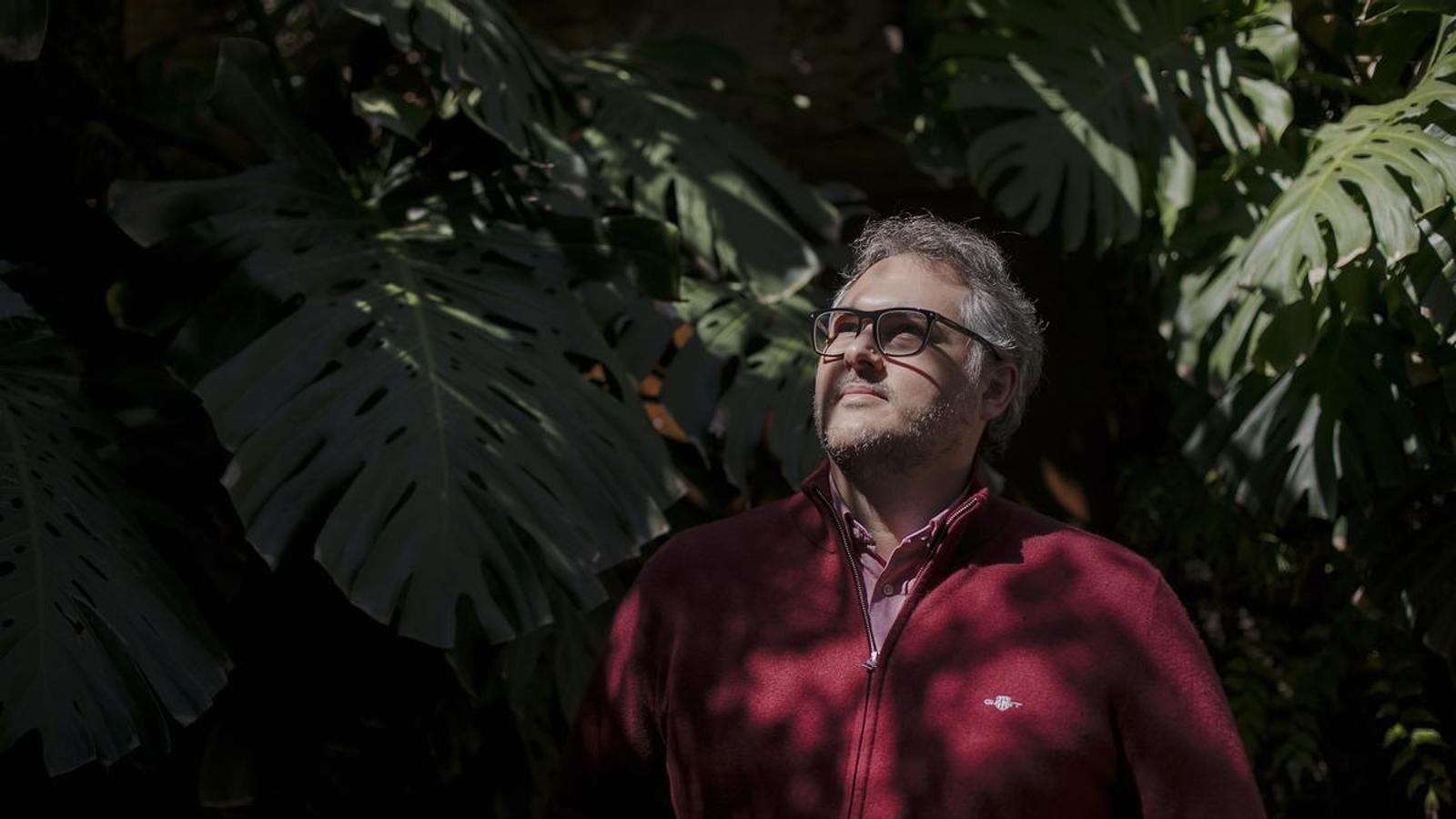
Andreu Escrivà: "80% of what is cultivated is to feed animals; so much meat is neither healthy nor sustainable"
Environmentalist and climate communicator
-
CAT -
CAST
In the early morning of January 17, 1994, a strong earthquake shook Los Angeles. Just after, lights appeared in the sky. People, frightened, began calling the city's astronomical observatory to find out what that unusual sight was, asking if it had anything to do with the earthquake. The scientists, at first, didn't understand anything, because there was nothing abnormal in the sky, until they realized that, since the power grid had gone down and there was no electricity in a large part of the city, the Milky Way could be seen clearly. Our own galaxy.
With this anecdote, which highlights the absolute disconnection that many humans have from nature, environmentalist Andreu Escrivà (Valencia, 1983) begins his latest essay The Earth Is Not Your Planet (Sembra, 2026). It is an ode to the beauty and uniqueness of the world we are lucky to inhabit, to the "dazzling biodiversity" that fills it with life. But, above all, it is a forceful call to wake up and take action to end the threats that seriously endanger the rest of the beings with whom we coexist.
Escrivà is a reference in communicating the climate crisis, and this work earned him the nickname "climate bore" on social media. In 2016, he won a European science communication award with It's Not Too Late Yet: Keys to Understanding and Stopping Climate Change (Bromera, 2017).
After four books focused on communicating the climate crisis, what led you to want to talk about another crisis, that of biodiversity?
— My academic training is, in fact, in biodiversity. During my PhD in the ecology department, I focused on studying very small organisms found in ponds, which I had to observe for many, many hours. Since then, I had always had the urge to disseminate the need to reconnect with nature, this idea of observing it, valuing it, and loving it. Furthermore, a moment came when I realized that the effort I was making to disseminate climate change was contributing to hiding the serious biodiversity crisis that is underway and of which we are not aware as a society.
How serious is it?
— There is sufficient scientific evidence to consider that today we are living a sixth mass extinction. A decline that is measured in tens of thousands of species that disappear from the planet every year, many of which we don't even know. The biologist Edward O. Wilson even estimated that around thirty thousand disappear annually. The other five previous mass extinction episodes must be sought in the fossil record.
The image of the polar bear losing its habitat due to melting caused by the climate crisis and rising temperatures unites in the collective imagination the two crises you are talking about: the climate and biodiversity crises.
— When I was little, in the Valencian Community there was a lot of chemical pollution problems in the rivers, and the image of the environment for me was the Segura river full of containers, polluted. In the collective imagination, we have the feeling of coming from other crises and adding new ones, such as that of plastics or PFAS [chemical compounds that persist in the environment]. It is all like a great environmental crisis of which we only see the climatic part, because it encapsulates the others and is easier to understand, since we can relate it to everyday things, such as not being able to sleep at night due to extreme temperatures. It also influences that we have a problem of lack of scientific literacy as a society.
In the book you denounce the utilitarian view of nature: even when we are admiring and trying to defend it, we do so from the point of view of how we will benefit from it.
— Many times I myself have spoken of species or ecosystems as allies against the climate crisis, such as marshes, which are areas that can capture a lot of CO₂, encapsulate it. But it is a mistaken narrative. Marshes have value in themselves, not because they help us fight anything. The problem is that our vision of the environmental crisis is confined to the climate crisis and, from the perspective of seeking greater effectiveness of messages, some environmental groups or associations or even scientists try to find the hook between the preservation of biodiversity and people's concerns. Where is the hook? In carbon emissions. In the end, if people are worried about emissions, about climate change, about temperatures, when they tell you "protect the whales that capture a lot of CO₂", it appeals to them.
It's effective.
— But a wrong strategy. Life has value in itself. Without seeking economic or utilitarian justifications. Whales are an incredible wonder, they have culture, transmission of knowledge, language... And they sing! In fact, the protection of these majestic cetaceans begins when their songs were discovered their songs in the 1960s. We realized that these animals are capable of fantastic things.
We must know and love, as you defend in the book, to want to protect the beings with whom we share the planet.
— The fascination with the world around us is key, the biophilia that biologist Edward Wilson spoke of. I like that there are many solar panels on the roofs of Valencia, but it doesn't excite me. Instead, it does excite me that in a garden next to my house there is a kestrel, or the other day a chiffchaff landed on my balcony, or seeing a robin while I walk. These wonders are there, and when you show people, they realize all that they were missing. Disconnecting from nature is very easy because most of us live in urban environments, with so many inputs all the time that they don't even give us time to stop and look at a butterfly in a garden. We need to recover that slowness, that stopping. I have hope that this revolution and this fight against this extinction crisis will come not out of a question of the services that nature provides, or the money we can earn if we conserve ecosystems, but out of a visceral, gut feeling: we must conserve this because we are also nature, because it moves us.

This biophilia also drives us to travel to pristine natural areas to enjoy and admire them. But this is also another pressure on the environment.
— We can and must find ways to reconnect with the closest nature. We should not only think of large natural spaces or pristine, vast areas, but of our doorstep. The greatest potential of rewilding or renaturalization happens in gardens. When there is mown grass, it is a desert for biodiversity, it offers no food to pollinators. If instead of grass we planted native plants, without too much maintenance, the potential for nature recovery would be enormous. Let's think about tree pits, gardens near home, parks, green roundabouts, agricultural areas or abandoned lots. We must reclaim spaces to restore nature.
You defend the need to withdraw from nature, to leave space for other species to live there, and also for metabolic withdrawal.
— We should eat less meat and, in particular, certain types of meat. I'm not saying we all have to become vegans, but rather that we need to eat less meat. 80% of what is grown on our planet is to feed the animals that we, a small part of humanity, devour.
The percentages you collect in the book are shocking.
— I had to check them several times because I couldn't believe them. Half of the planet's habitable land we use to provide ourselves with food. Of the 48 million square kilometers
The responsibility to reduce consumption or consume more respectfully often falls on the individual. Shouldn't it be at the structural and social level?
— It is unfair to burden people with the cost of a lifestyle that is expensive, such as being sustainable or ecological. And, furthermore, it is guilt-inducing. Living conditions are necessary, and that requires legislation. For example, regarding public transport, I don't want to be the city's superhero for not taking the car. In Valencia, opting for the bus or the metro is an act of activism and also of social class.
In Catalonia we suffer Rodalies...
— That's why legislation, political will, and courage are needed. Because if not, this responsibility falls on the people. When one has few resources, one makes worse decisions, whether in money or time. If you have a precarious life, with a very narrow margin of money after paying the mortgage or rent, of course you can't make good decisions; if a person arrives home from work at 8 in the evening, you can't ask them to stop by home to get cloth bags, to buy at the market, because it will be closed. Or not to get plastic-tray food at the supermarket when they arrive and it's about to close. And on top of that, the person leaves with a bad conscience. We need to establish dignified living conditions that make it possible to buy with a smaller ecological footprint and, in general, to live in a way that is more respectful of our environment and our health. Let it stop being a matter of voluntarism, or ideology. Let it be easy, straightforward.
