The peasantry organizes a tractor protest in Barcelona to demand solutions in the face of the "structural crisis" in the sector
Unió de Pagesos leads a mobilization, which will travel along Passeig de Gràcia and Via Laietana, in which 200 tractors are expected

-
CAT -
CAST
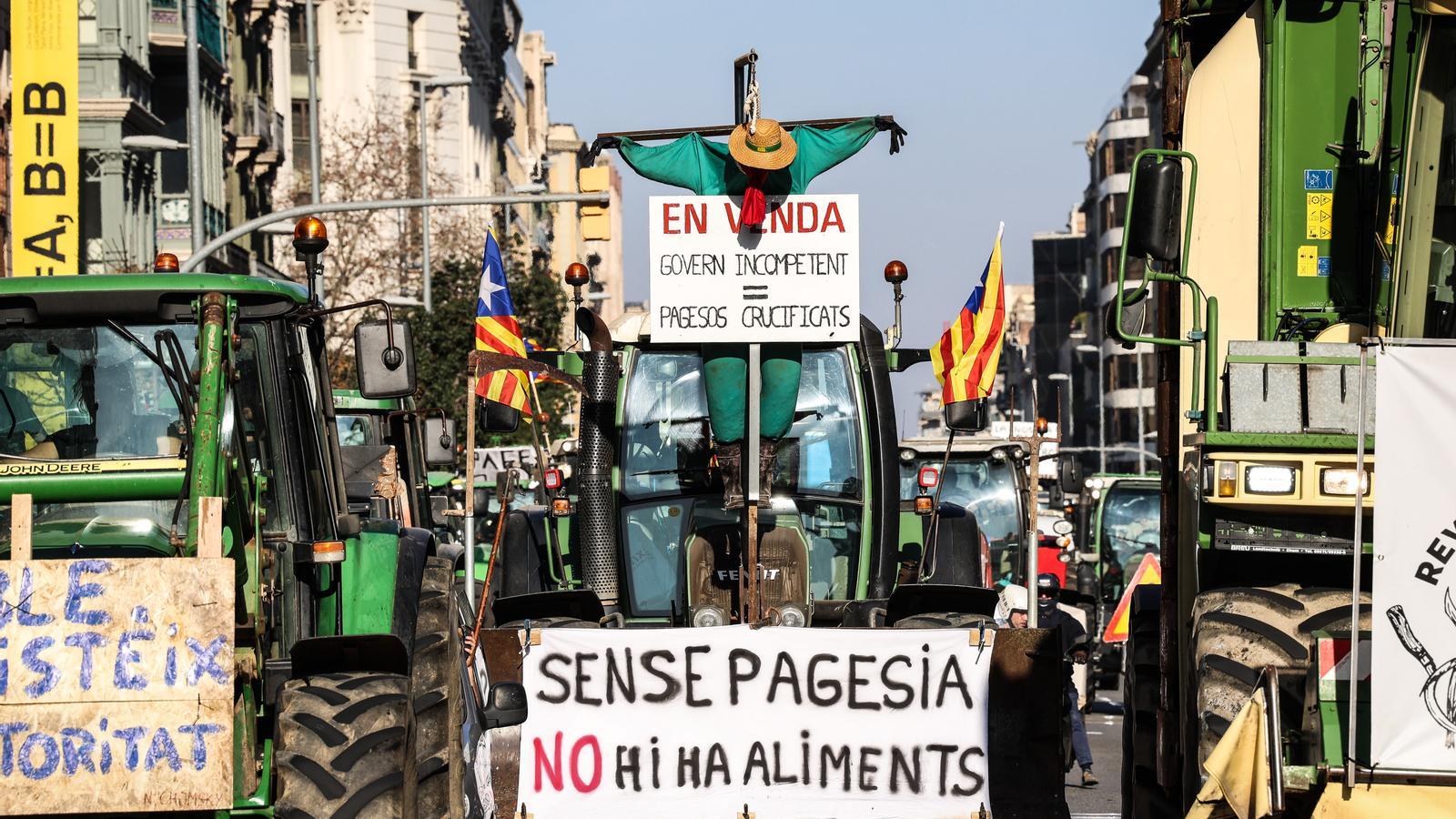
BarcelonaThe Catalan farming community is holding a tractor protest in Barcelona this Wednesday, October 14, to demand immediate solutions to the "structural crisis" situation the sector is experiencing. The demonstration, organized by the Farmers' Union (Unió de Pagesos), expects to mobilize around 200 tractors from various parts of the Catalan territory, which will gather in front of the headquarters of the State Government Delegation, the Department of Agriculture, and the Palau de la Generalitat. The march is expected to mainly block a large part of Passeig de Gràcia and Via Laietana.
In addition to the Farmers' Union as the organizing body, the tractor protest also has the support of the Agrarian Association - Young Farmers (Asaja) of Catalonia, the Federation of Agricultural Cooperatives of Catalonia (FCAC), and the Girona and Tarragona delegations of the Farmers' Revolt (Revolta Pagesa). The vehicles, coming from nine departure points spread throughout the country, have been summoned at twelve noon at the intersection of Mallorca and Roger de Llúria streets, from where the march will begin with its final destination at Plaça Sant Jaume.
During the demonstration, the union will deliver to the administrations the demands and proposals to alleviate the "chain of crises" aggravated this 2026 by what they consider an "unstoppable" increase in costs as a result of wars, unfair competition, production alterations due to climate change, livestock diseases, and continuous damage from wildlife.
In statements issued in recent days, the Farmers' Union is demanding that the Government take measures such as the granting of direct aid of up to 17,000 euros for professional agricultural holdings to deal with the effects derived from the crisis in the Middle East. Along the same lines, the union is asking the Spanish executive for professional agricultural diesel with the minimum permitted taxation, reduced VAT for agricultural production, specific electricity tariffs for irrigation, or the exemption of periodic vehicle inspections (ITV) for agricultural machinery, among others.
All in all, in the midst of a context also marked by the "abuses and non-compliance" of the food chain legislation and imports from outside the European Union that do not meet the conditions required of local producers. The latest examples of these latter issues are the investigation of 50 contracts by the Generalitat in the wine sector for the purchase of grapes below cost price and the prohibition by the European Union of imports into EU territory of meat or animal products from Brazil.
Added to all this is the concern of Catalan farmers regarding the design of the new European budget, which foresees a reduction in the resources allocated to the Common Agricultural Policy (CAP) and a more centralized system for the distribution of resources.
