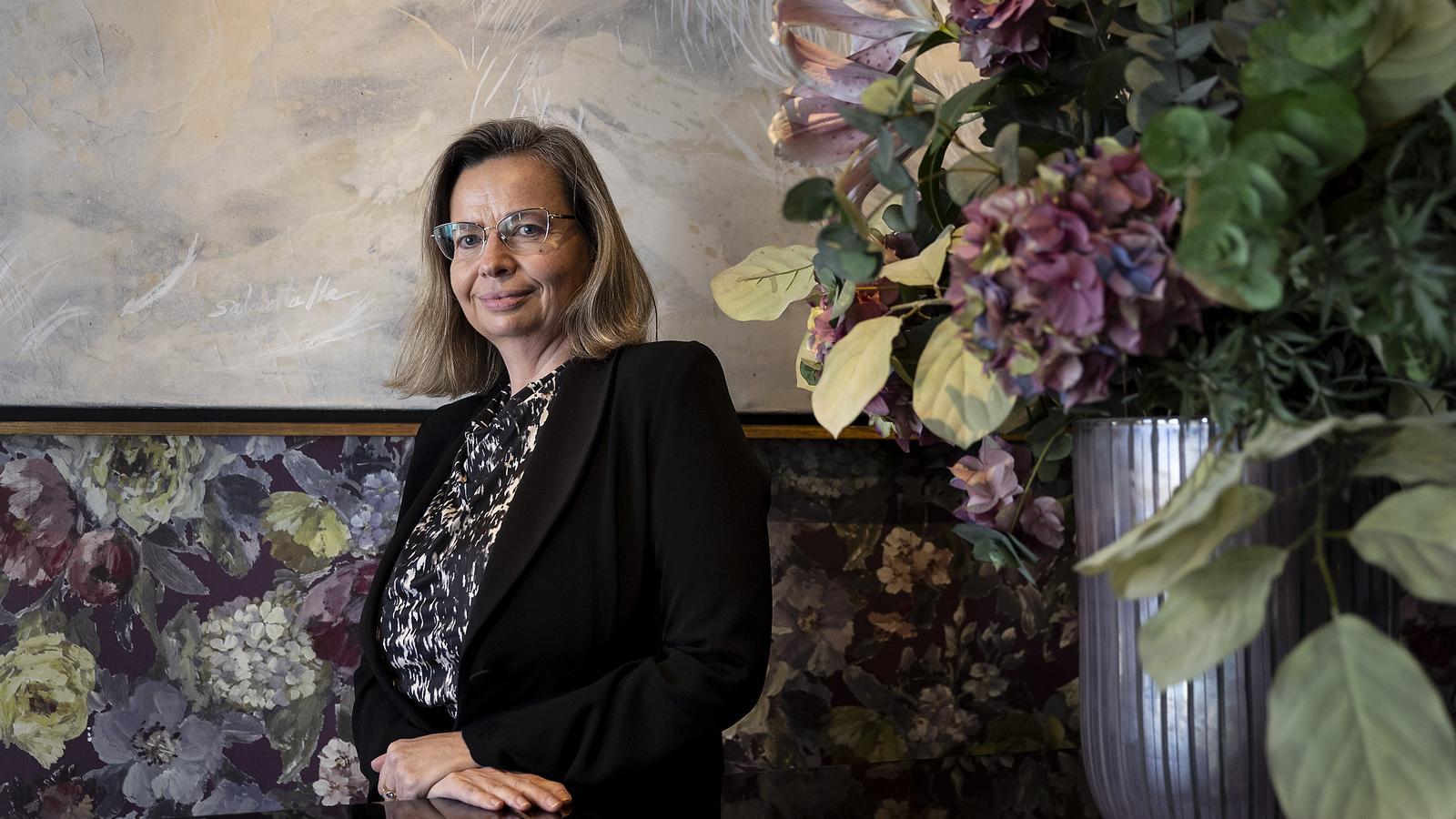
Anna Puigdevall: "We are not the causes of the problem, we do not feel addressed by the strike"
General Director of Som Habitatge

-
CAT -
CAST
BarcelonaAnna Puigdevall (Barcelona, 1968) has worked her entire professional life in the business sector, after studying physics, and for less than two years she has been part of the property owners' association Som Habitatge. They claim that they are financed through member dues and donations, and that they do not receive resources from any large real estate management company.
Do they understand the call for a general strike next Wednesday? Do they feel challenged by it?
— We can understand that a strike is taking place. We are not joining it, but we can understand society taking to the streets at this moment to tell the government that it has not done everything it should have done. Regarding housing, but also concerning wages and purchasing power.
The strike is not only against the government, but also against the employers' associations and the companies that, according to the union, participate in the accumulation of assets and speculate.
— What we are very clear about is that the responsibility for the social function of housing lies with the government. Therefore, we can understand a strike against them, but not against the owners, because we are not the cause of the problem.
Therefore, do they not feel challenged by the strike and what the participants will demand?
— We do not feel challenged because we believe that it is the government that must fix this issue.
The "social function" of housing is a legal concept which establishes that the primary use of housing is for people to live in it. Do you agree with this premise?
— The ones with the obligation to guarantee access to decent housing are the administrations and the governments. Therefore, the social function is also their responsibility. One of the major problems is the composition of the housing stock. On one hand, there must be social housing for people in situations of severe vulnerability, who find it very difficult to access housing, even at an affordable price. On the other hand, an important part should be affordable housing and official protection housing (HPO). We should multiply it by ten. In this country, 98% of the stock is free-market, and therefore, we shift the social function to the market, and it should not be like that.
The housing crisis means that more and more people need affordable housing to have a home. Should the market provide housing for the bulk of the population, even if there must be social housing available for the most vulnerable people?
— When the market has had enough housing, it has worked perfectly. The problem we have now is that demand is much greater than supply. Since we lack housing, the price rises by definition. The Bank of Spain has estimated that by 2028, one million apartments will be needed. In Catalonia, according to a study by Pompeu Fabra University (UPF) and the Association of Developers (APCE), 200,000 are missing. You will always have the accessibility problem, no matter how much you set a cap, which in a specific moment of crisis you might consider: you don't have enough apartments for everyone.
If we demand something from the administrations, we must provide them with the resources to comply. As an organization of owners, are you open to a new tax or to increasing those that already exist?
— The ones who make the most profit in the real estate sector are the administrations. The amount collected is extremely high, however, afterwards, they only allocate between 20% and 30% of what they have received in taxes from owners to housing, and that is in the best of years. If housing is the country's main problem, why don't the administrations allocate everything they collect from housing to it? Before talking about more taxes, what is needed is planning.

I mentioned the cap as a possible temporary measure in the face of a crisis situation. This is what we have right now.
— But it is not working. Administrations have the obligation to demonstrate that they have carried out the necessary actions to reverse the situation that has led to imposing caps. What makes caps necessary? First, that we do not have enough supply and, second, that people have low purchasing power. The necessary supply has not been created, nor has the issue of wages been worked on. Action is being taken on a dimension that should be temporary, but not on the root problem and, therefore, this is indefinite.
What impact have the caps had on the market, in your opinion?
— If you were to tell me: "Listen, I have the cap, but I've done it well", that would be one thing. The current cap has made the worst offer on the market more expensive, which has aligned with the average, and the best one has moved towards buying and selling. The price per square meter has risen. Therefore, the result has been a lower quality offer and the disappearance of the most economical offer. The entire current system, not just the caps, has harmed people with fewer resources, whom we would like to help.
The more apartments a landlord accumulates, the more they raise rents, according to the think tank Esade. If people who own a single rental apartment can accept lower returns, why can't "multi-landlords"?
— In the real estate sector, we talk about returns between 2% and 3% in the most expensive areas and, in others, of 6% or 7% at most. People might imagine returns of 30% and 40%, but that is not the case. As long as you have much more demand than supply, there will be many people willing to pay more for that property, because they need it. The main cause is that we do not have housing for the entire population. One of the criteria that exists is price. If an owner has one person who rents it for 50 and another who rents it for 60, they will choose the latter.
From the Tenants' Union I imagine they would tell you that, even though you could rent it for 60, you should do it for 50, because it is part of a society.
— We could talk about many nuances, but I repeat the same thing: there will always be someone who will be left out, because you do not have enough supply for everyone. We must generate more.
You propose that, to be a large property holder, one must own more than 100 homes. Is it compatible to identify yourself as an association of small property owners?
— What we are saying is that it makes no sense that, currently, an owner of four, five, or six properties can be considered a large holder. We must break the climate of confrontation that exists and the government that emerges from the elections must start from scratch with housing, stop using decrees, and create a plan to solve it.
Is it possible to buy five or six apartments just through work and savings?
— I can assure you that it is. It depends on where you buy them and how many years you work, but yes. The possibility is for people who don't spend on anything else, nor on going on trips, for example. Everyone does what they want with their money.
According to the Union, the conflict is inherent to the defense of the right to housing, because –they say– it confronts their business.
— When there has been enough supply, the market has functioned correctly. Things are not fixed with conflict, but with harmony. Without owners there are no tenants.
At the gates of the elections, has no political party knocked on your door?
— Not to go onto lists. We speak with everyone who wants to speak with us, and what we ask is that they speak with all parties and try to fix the underlying problem, not just in the short term.
