CaixaBank sees Spain as resilient in the face of war and foresees credit becoming more expensive
The company's CEO highlights the positive effects of migration and calls for "populism-free" management
-
CAT -
CAST
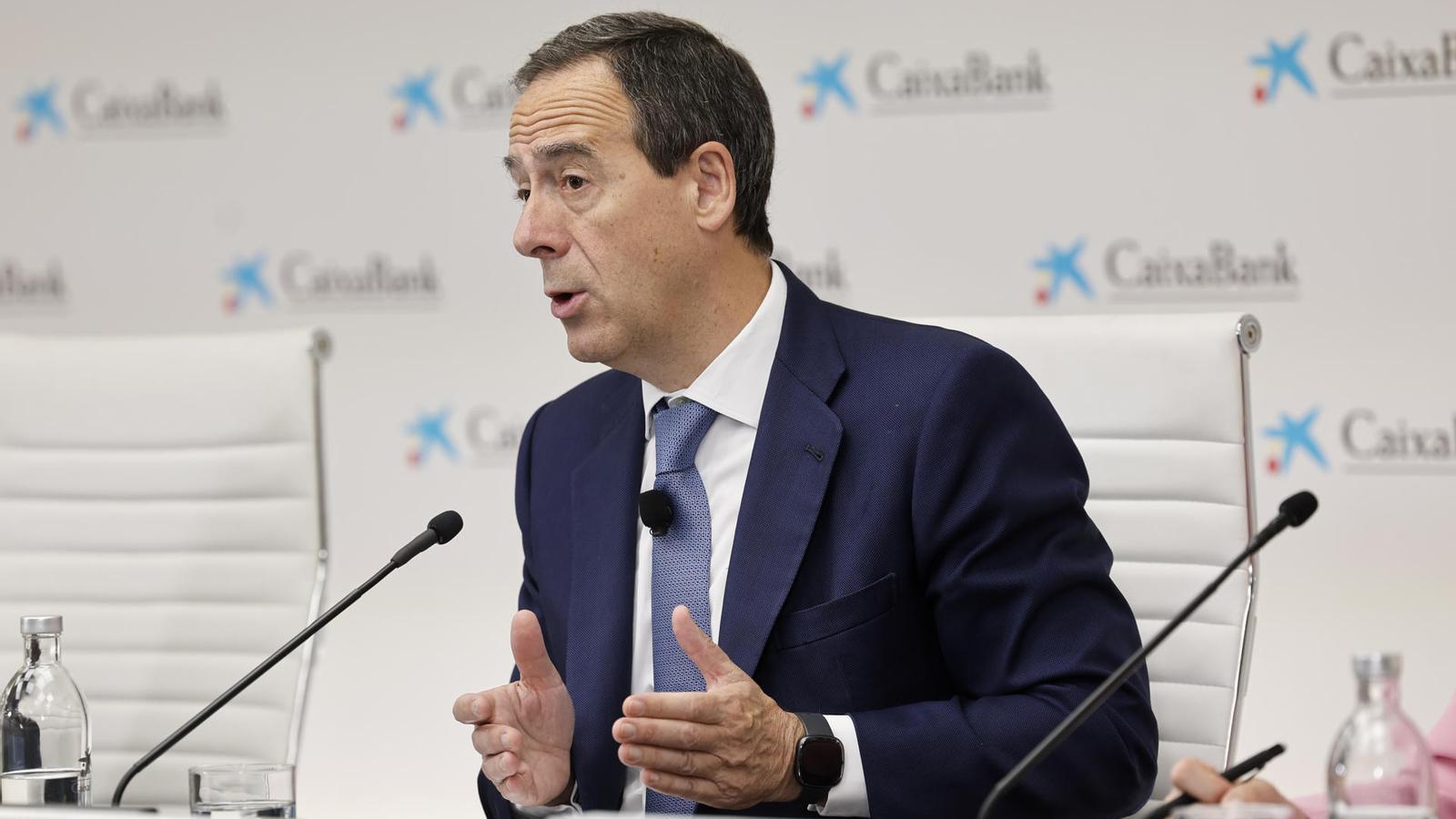
ValenciaThe Spanish financial system faces the economic uncertainty generated by the attacks on Iran by the United States from a position of "strength, resilience, and profitability" and "prepared even for the worst-case scenarios." This Thursday, the CEO of CaixaBank, Gonzalo Gortázar, wanted to convey confidence in the state economy during the entity's results presentation for the first quarter of 2026. A period during which the company has once again achieved record figures. This time, a net profit of 1,572 million euros, that is, 7% more than in the same period of the previous year.
To argue his confidence, Gortázar stated that the Bank of Spain has set its GDP growth forecast at 2.3%. However, what he highlighted most was the lower dependence of the state economy – compared to other European partners – on fossil fuels, especially gas. In this regard, he cited the "differentiating factor" of the weight of renewable energies in Spain, which means that only 20% of the time the price of electricity is determined by fossil fuel imports, while in Europe the impacts are "larger" than expected.
Regarding a hypothetical impact on credit demand due to the uncertainty of the scenario, Gortázar argued that it is "not yet being noticed in the big numbers," although he did admit that it is already perceived in "certain sectors and for certain clients." "The situation continues to be one of uncertainty, complexity, and a decline in economic activity," summarized the CEO, who made it clear that the international crisis "will necessarily have an impact" on Spain, although perhaps more moderate than in the rest of the European Union.
"Immigration policy without populism"
Another of the current issues that the financier has responded to has been Spanish immigration policy. Regarding this, and after underlining the "extraordinary and magnificent" character of the arrival of people from other countries, because it provides labor for deficit sectors such as construction or care services, he has pointed out that management marked by "institutional seriousness and not short-term populism" is necessary. This is why he has called for a serious debate on the flows that each state can assume at each moment so that emigration "does not generate tensions." In this regard, he has pointed out that at the current arrival rates of people, in 25 years half of the Spanish population will have been born abroad.
Increase in interest rates and mortgages
During his appearance, the CEO of CaixaBank also gave his opinion on the evolution of interest rates. Specifically, he assured that with inflation above 3% in the eurozone, it is "logical" for the European Central Bank to raise them to 2.75%, a decision that would mean approving three increases since the beginning of the year. Gortázar defended that these increases will serve to contain long-term inflation expectations, which he said are "what really" can damage the economy. In any case, he stated that the markets "are showing very high volatility, almost day by day," as interest rates have a great dependence on the events of the conflict in the Middle East.
In the case of mortgages, he pointed out that the increase in rates will have a lesser impact, given that the majority of his clients have fixed-rate mortgages – 56%.
. Furthermore, he confirmed his interest in continuing with the business, unlike what Bankinter announced, which explained that it considers these operations in Spain to be unprofitable. Gortázar did admit that Spain is one of the cheapest countries for mortgages, with an average rate of 2.6% compared to the eurozone average of 3.3%, but pointed out that their granting is part of a broader relationship with clients and that they will continue. In fact, the group increased its commercialization by 12% in the last quarter, at a pace that, he admitted, will probably not be maintained.
"Growing commercial activity" despite the war
The entity has attributed the good results of the first quarter "to the growth of its commercial activity" despite the context of uncertainty due to the war in the Middle East. The good commercial performance is reflected in both credit and resource mobilization. The total business volume, 1.1 trillion, represents an increase of 6.6% compared to last year. Customer resources increased by 6.3% to 733,975 million euros. For its part, assets under management increased by 10.1% year-on-year, to 202,309 million euros. The assets managed in investment funds, portfolios, and SICAVs stand at 150,973 million, 11.8% more year-on-year, and pension plans reach 51,336 million (+5.2%). Income from services (wealth management, protection insurance, and banking fees) rose by 7.5% to 1,374 million, with wealth management income increasing by 9.5%. That from protection insurance grew by 13.5%, and banking fees by 2%.
