"When there is a great harvest of oil no one complains; why do they complain if there are many books?"
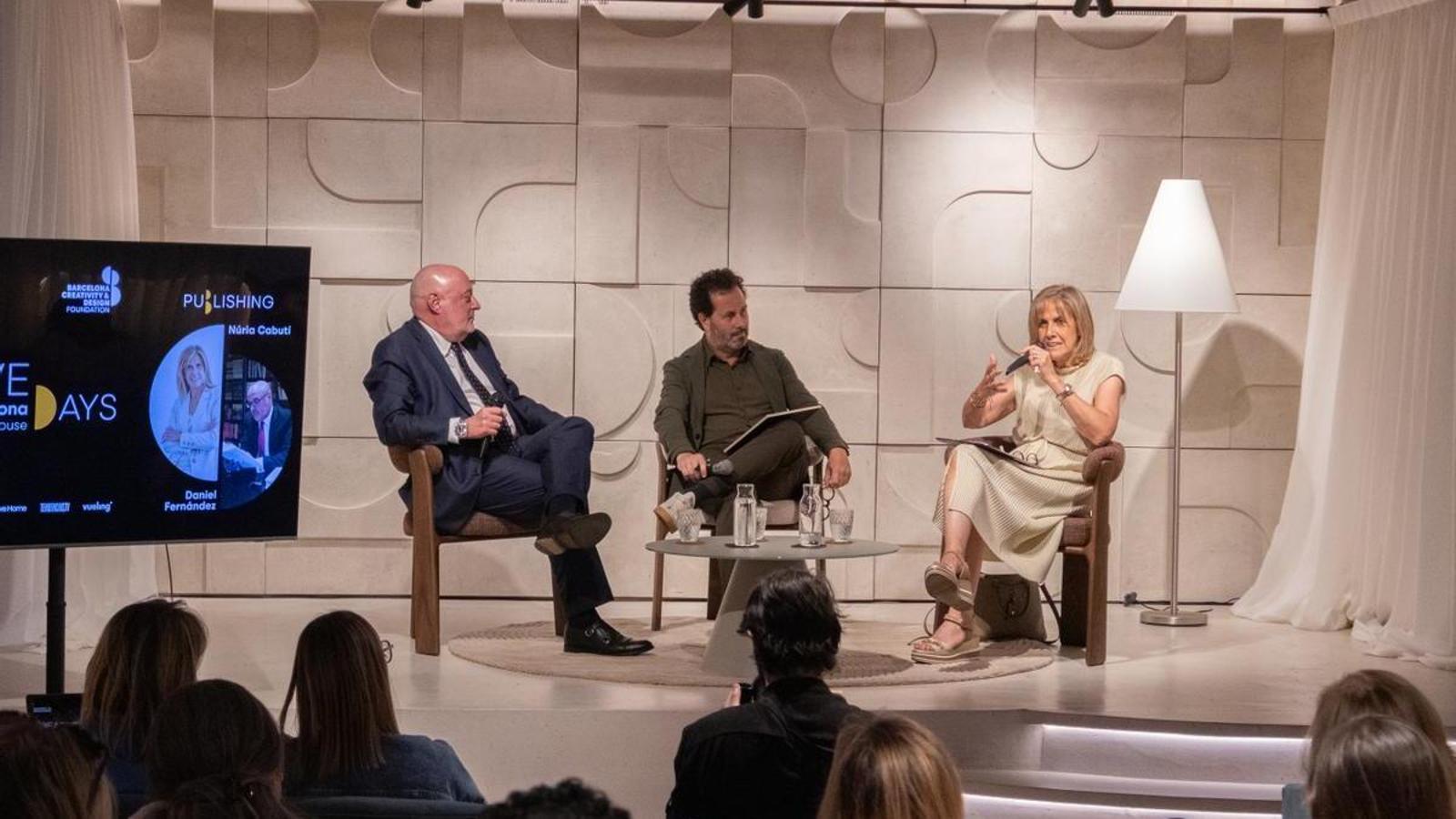
The CEO of Penguin Random House and the president of the publishers, Daniel Fernández, debate the book as a creative industry

-
CAT -
CAST
BarcelonaSometimes, environments outside your bubble allow you to speak more freely than in front of an expert but disapproving audience. Eager to see if I can catch fresh fish, I attend a talk about creative industries organized by BCD at Juno House (an elegant club located in the old flour mill on Aribau street) with the general director of Penguin Random House, Núria Cabutí, and the editor of Edhasa and president of the Catalan Publishers' Guild, Daniel Fernández. The talk begins with a brief but interesting linguistic dispute (and the event ends up being held in Catalan) which links to the fact that "Barcelona is the capital of publishing in Catalan and Spanish". "There is no other industry that, from Catalonia, leads as the publishing sector leads", highlights the event's presenter, the publicist Enric Jové. "Well, it has been difficult for us to get the Ministry of Industry to understand that we are an industry. The book's business volume in Spain is 3,000 million euros. In a very good year, Spanish cinema grosses 80 to 100 million. But they have the Goyas and a brutal propaganda machine —says the president of the Guild—. However, we are an industry that has intellectual prestige. That's why Amazon started selling books".
"The role of the editor has changed a lot in the last twenty years. Before, you would read a manuscript and decide whether or not to publish it based on intuition. Now we add market analytics and innovation: we go out looking for content on topics that are being discussed or on segments that are not covered," explains the super-editor, who comes directly from the Cercle d’Economia. Her company, which publishes for Spain, Portugal, and Latin America, had a turnover of 410 million in 2025. At Edhasa, on the other hand, they rely basically on this intangible that is "smell". "We don't do business intelligence or market forecasting. If I see that the first ten pages of an original aren't working, I confess that I jump to the last ten. I know that I must have missed some successes," admits Fernández. That's the game. "One of the magic things is the manuscript that still surprises you," says the editor.
The dangers of AI
The sector remains alert to the irruption of AI, which has even forced Amazon to limit self-publishing due to the avalanche of AI-generated content. At Penguin, they use it to improve production (they call it "time to market"), demand prediction, and distribution, not for creative jobs: "Human creativity is not surpassed by AI. AI can't do anything new, and that's what we look for as editors. We don't want more of the same. We want different things that make sense —says Cabutí—. With AI, you have to be extremely careful. As holders of intellectual property, we are very rigorous." That's why he took the organizers of the talk to task and had them change the advertising image for the event: it featured images from social media processed by AI.
Given the editorial concentration, the director of a multinational like Penguin Random House states that her philosophy is "maximum diversity and independence in the creative teams of the imprints, and maximum unification in the "back office". For Cabutí, the key to the business is investment in the distribution chain. "When I went to meetings in New York, all the gurus said that by 2025, 80% of the business would be digital," she recalls. Publishers there disinvested in warehouses, thinking it would be like in the music, journalism, or film sectors, where the business would transfer to online platforms. "The surprise is that fifteen years later, 80% of sales are in physical books; here, in England, in the United States, in Germany...", and all the platforms that have appeared have favored book promotion. They have even got young people re-engaged with reading.
Unlike small booksellers and publishers, major publishers do not think that too much is published. 100,000 ISBNs are published annually in the State, but Fernández calculates that only only 30,000 reach bookstores. "When there is a large olive harvest, no one complains. I don't understand why they complain if there are many books," objects Fernández. "Perhaps the generalist bookstore will have to choose and it will go to a specialized bookstore model. You don't go to a clothing store and expect to find all the brands, right? I don't see it as a problem," agrees Cabutí. "We publishers have a lot of ego but there are few imprints that the reader recognizes. That is what small or medium-sized publishers try to do, imprints like Anagrama, Acantilado, Asteroide...", states Fernández. And Cabutí sees it this way: "In the world there will be more and more content and it will be more fragmented. You will have to know how to position it".
