Roger Bartra Murià: "Unlike my parents, who were able to return to Catalonia, my exile has become permanent"
Anthropologist, essayist and sociologist. Son of Agustí Bartra and Anna Murià

-
CAT -
CAST
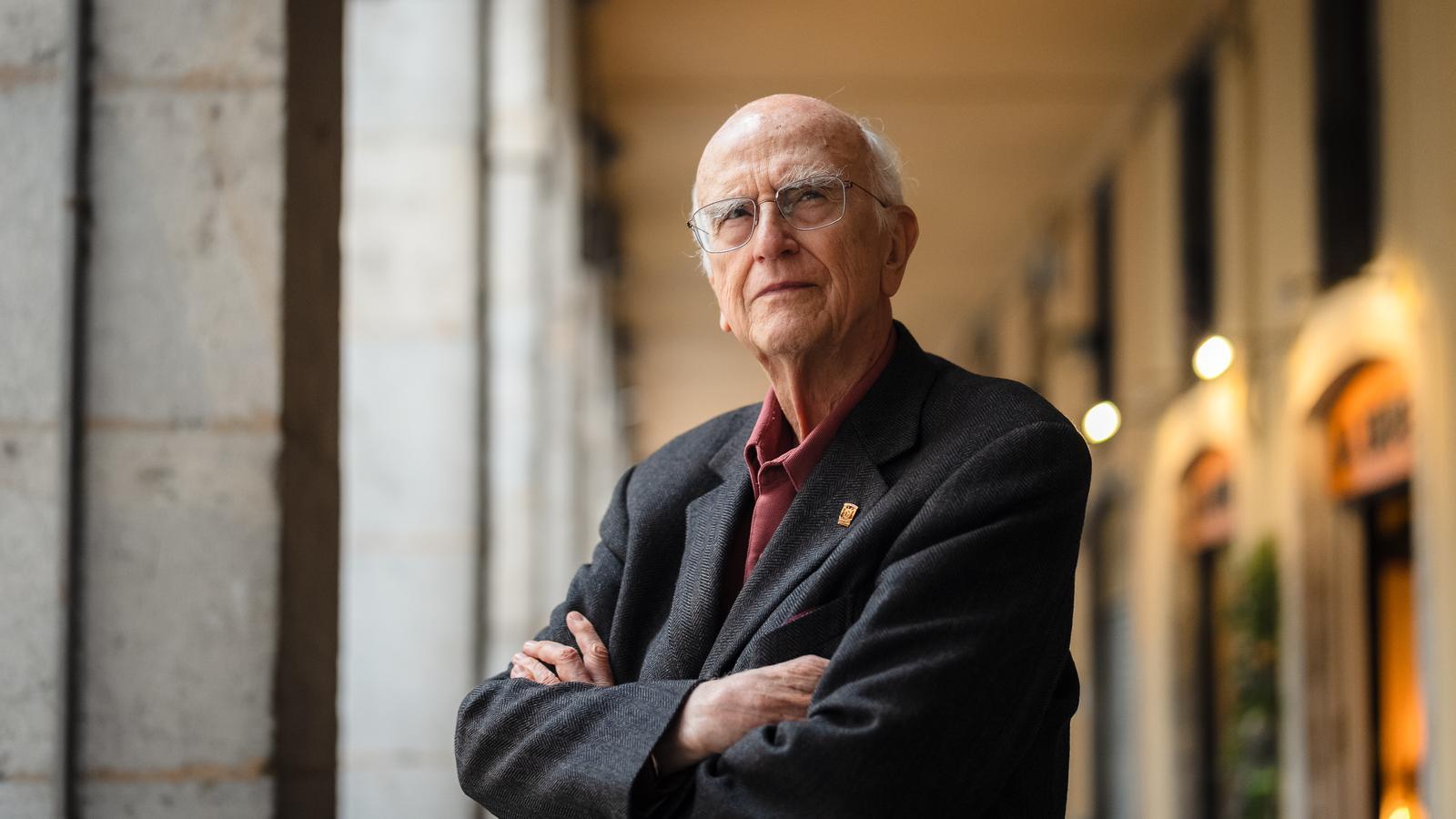
GironaThe anthropologist and sociologist Roger Bartra Murià (Mexico City, 1942) is an authority in Latin America in the field of social sciences. Son of the poet Agustí Bartra and the writer Anna Murià, he was born and raised on the other side of the Atlantic, far from Catalonia, due to the forced exile of his parents, persecuted by Francoism. Throughout his life, in Mexico, but also in Venezuela, the United States, London, and Paris, he has forged a career as a professor and intellectual, with notable contributions in areas such as exile or the construction of national identity. This week he is in Girona, invited by the Ferrater Mora Chair of the University of Girona (UdG), to give five lectures at the Faculty of Arts and a conference open to the public, on Thursday at the Centre Cultural La Mercè, on exile and travel.
What is the main idea of the conference?
— The main core comes from a book I just published, The Craft of Being Foreign,and the topic stems from my personal experience. I was born in Mexico, but I ended up feeling like a foreigner in the country where I was born. Unlike my parents, who were exiles and were able to return to Catalonia after thirty years, in my case, exile has become permanent. I grew up as a Catalan boy and teenager in Mexico, speaking a different language and living in a different culture, and that was a very unique experience. For me, this condition of being a foreigner should be understood as a craft: a creative and stimulating situation to reflect on the world, the places where one lives, and the journey.
When he was little, when did he start to realize he was the child of exiles?
— I cannot recall a time when I didn't know that my parents had had to flee from Francoism. I always knew it, even if it was in a very basic way. Exile, in fact, was part of the family's romantic story, of the foundation of the marriage, because my parents met in France, at a gathering of Catalan refugees where Mercè Rodoreda was present.
In 1970 his parents decided to return to Catalonia, when you were 28 years old. Why did you decide to stay?
— My parents didn't decide to return suddenly. They came to Catalonia for a visit, after many years of not wanting to do so because Franco was still alive. But when they arrived they were welcomed by many people and realized they had a place. They came with tourist suitcases and ended up staying. I was already living independently, first in Venezuela and then with plans to study in London and Paris. So returning to Catalonia was not a real option for me, because I had a Mexican passport, I didn't have a work permit, and, besides, anthropology practically didn't exist here.
Has the family's cultural background influenced your intellectual development?
— Without a doubt. I had a European and Catalan culture that most people in Mexico did not have. My father was very attached to Greek traditions and I grew up reading classical tragedies translated by Carles Riba. At home, literature was part of everyday life and I listened to meetings with Catalan and Mexican intellectuals. I had the historian Pere Bosch i Gimpera as my professor. And at home there was a very important presence of people like Ramon Xirau, son of the philosopher Joaquim Xirau; also the essayist and poet Manel Duran, who lived in the United States; Pere Calders, who was a great friend of the family, very charming and whom I remember perfectly, or the cartoonist and painter Josep Bartolí.
Returning to the topic of exile, in your essays you have thoroughly studied the construction of Mexico's national identity. Does the feeling of being a foreigner have to do with not fitting in with the national identity of the host country?
— Mexico built a very strong nationalist identity after the Mexican Revolution, an identity based on the idea that there is an essential way of being Mexican. I discuss this. I studied this universe of myths, songs, films, literature, and discourses about “the Mexican being” in my book La jaula de la melancolía. Then I began to investigate the figure of the savage in European culture, that is, how the West justified colonial domination over other peoples. And after all this, what I can say is that I am not a nationalist. I consider nationalism to be a toxic thing, because it transforms the characteristics of a culture into an ideology linked to political power.
Criticizes nationalism, but defends the need to value the culture of a nation.
— One thing is culture –language, literature, folklore and myths– and another is the construction of a nation-state. In Europe, nation-states were consolidated mainly in the 19th century and often disregarded different cultures, such as the Catalan one. I believe that the solution should involve overcoming the idea of the nation-state, not creating new ones. This is my utopia.
He has also studied how all this cultural fabric affects our brain.
— The study of collective identities eventually led me to the problem of individual identity and consciousness. That's why I became interested in neurology and came to the conclusion that human consciousness cannot be explained solely in neural terms. To understand human consciousness, one must understand that neural networks continue symbolically outside the brain: in culture, language, music... This set of external prostheses is what I call the “exocortex”. I develop this in Anthropology of the Brain, which is now being translated into Catalan.
