They find the 'Iliad' on the abdomen of a mummy in Egypt
The papyrus was in a Roman-era burial in the ancient city of Oxyrhynchus
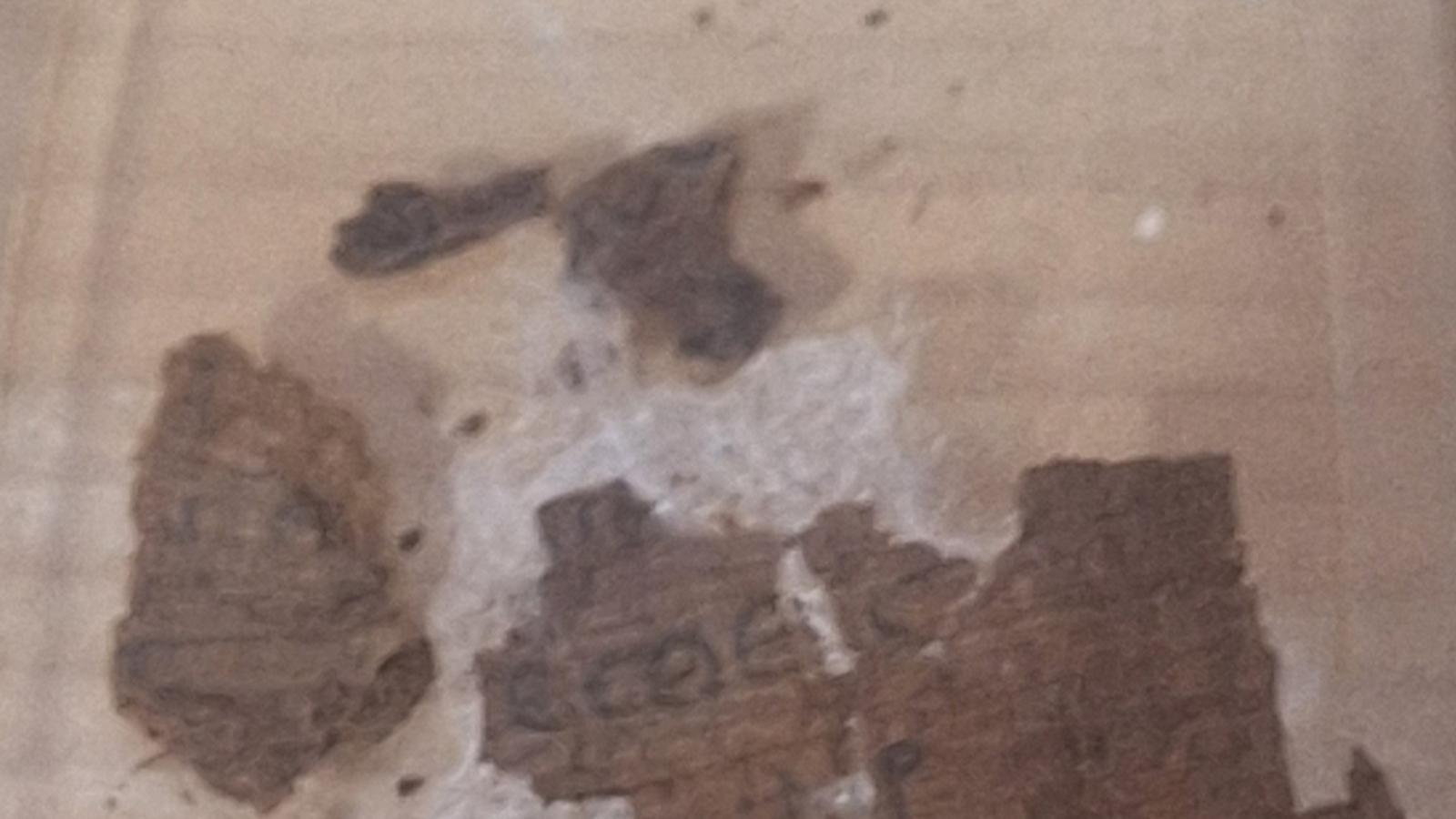
BarcelonaIt was not exceptional for Roman-era mummies to be buried with papyri. This has been confirmed by the Oxirrhynchus Archaeological Mission, from the Institute of Ancient Near Eastern Studies (IPOA) of the University of Barcelona, in the exhumations they have carried out in the Egyptian town of El-Bahnasa, ancient Oxirrhynchus. "They placed the papyri in the chest and pelvic area, under the wrapping, folded and sealed with clay, and they contained magical texts written in Greek," explains Maite Mascort, who directs, with Esther Pons, the archaeological mission that began in 1992. For the first time, however, a fragment of a literary text has appeared, Homer's "Iliad". It is not that the deceased was a lover of texts that explain the pain and anger of some of the protagonists of the Trojan War, but rather that the papyrus was reused. "A manuscript of the Iliad" was used to write the magical texts that used to accompany the deceased," assures Mascort.
After restoration, the fragment in question has been identified with considerable accuracy: it belongs to the catalogue of ships, from canto II of the
Iliad", the passage that lists the Greek forces against Troy. "It is not the first time we have found packed and sealed Greek papyri incorporated during the mummification process of a mummy, but until now they were of mainly magical content. On the other hand, it should be remembered that, since the late 19th century, an enormous quantity of papyri have appeared in Oxirrhynchus, including Greek literary texts of great importance, but the great novelty is finding a literary papyrus in a funerary context," assures Ignasi-Xavier Adiego, a professor in the department of Classical, Romance and Semitic Philology, a classical philologist and director of the Oxirrhynchus project.
Over a thousand tombs
The UB team has studied more than a thousand tombs in Oxyrhynchus over 34 years. It is a large necropolis that spans many centuries of history, from 700 BC to 700 AD. There are tombs from the Saite, Greco-Roman, Christian, and Arab periods. Its ruins – about 190 km south of the city of Cairo and on the left bank of the Bahr Yussef, an arm of the Nile that currently flows into the Faiyum oasis – also have a long history. They were discovered and identified by Vivant Denon, one of the French scholars who accompanied Napoleon Bonaparte on the Egyptian campaign (1799-1802). The first excavations were carried out in 1897 by the British Bernard P. Grenfell and Arthur S. Hunt, attracted by the news of the large number of papyri found there. At that time, thousands were already taken away, mostly written in Greek and dated from the Roman period, which are still studied today by the Egypt Exploration Society and are preserved in the Ashmolean Museum in Oxford.
The tomb where the recycled Iliad has appeared is approximately 1,600 years old. It was discovered between November and December 2025 in tomb 65 of sector 22. "Many of these mummies also have a gold tongue. They would place this piece on top of the tongue, because gold is incorruptible, and thus protect it, making it easier for the deceased to speak and deny having committed a series of sins during the judgment of Osiris," explains Mascort. "Many other papyri are still undergoing restoration, and we cannot rule out that some other literary text may also appear," he adds. Most of the tombs from the Roman period belong to individuals of high status; they could be merchants, priests...
