The man who looked at the world with dusts of joy and melancholy
The 2017 Tate Britain retrospective was a celebration of a lifetime and, at the same time, an early farewell to David Hockney

-
CAT -
CAST
LondonThe major retrospective that Tate Britain dedicated to David Hockney in 2017 –I had the enormous privilege of seeing it in a small group, without worrying about the huge crowds it caused– had something of a celebration and, at the same time, of an early farewell. It was an exhibition that not only reviewed six decades of work: it aimed and succeeded in teaching the ins and outs of an artist who had turned vitality into a form of resistance. Hockney, already on the verge of turning eighty, painted every day with the urgency of someone who knew that time is finite, but who still has things to say and/or who questioned himself and strove to try to say new things.
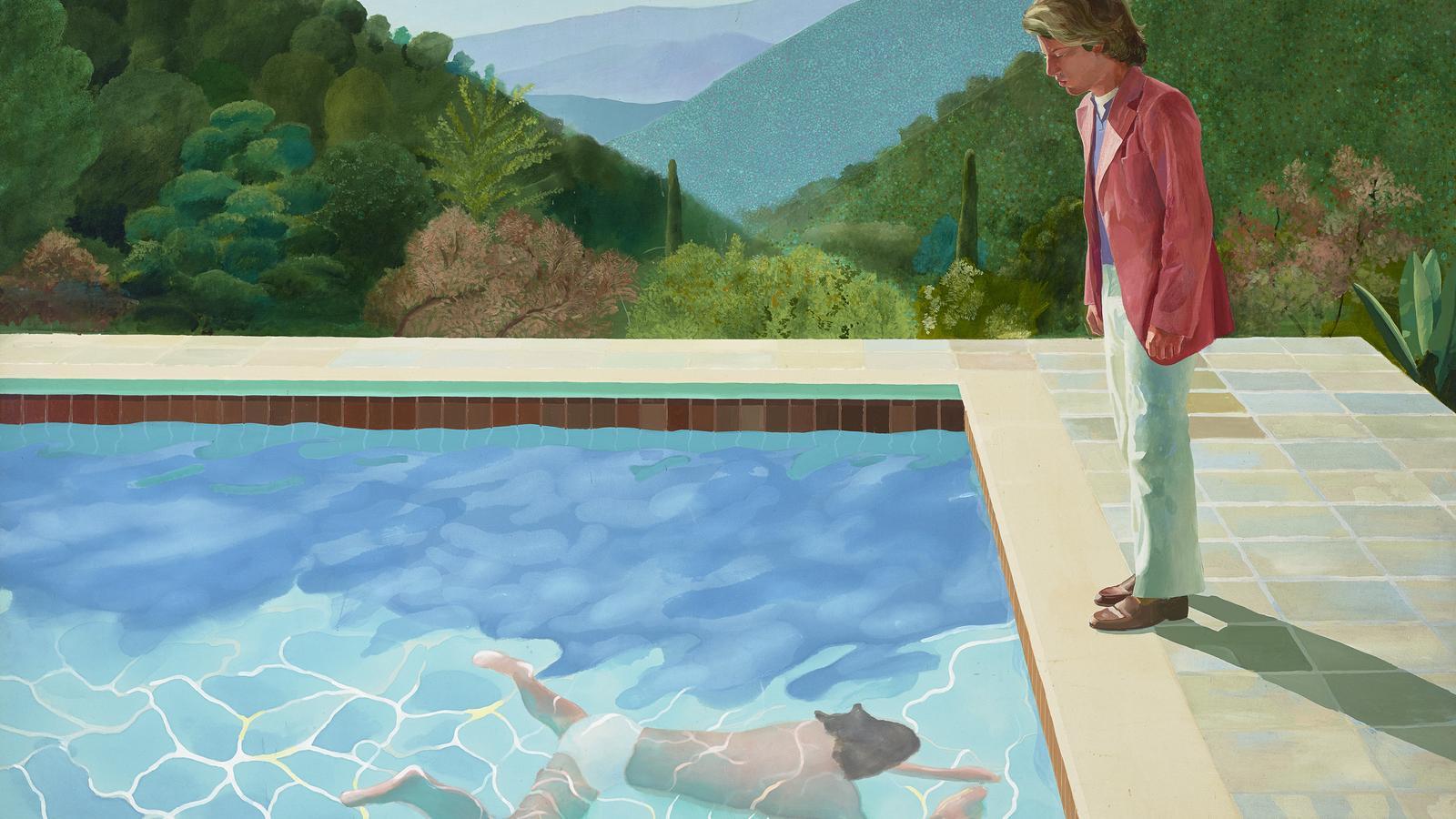
Portrait of an artist (swimming pool with two figures)Not even when experimenting with iPads, iPhones or multi-axis videos. Perhaps they were not his most inspired works – or perhaps they were so recent that they felt new to the viewer, accustomed to looking at his classics – but they revealed a permanent curiosity that does not rust.
The centre of the exhibition was occupied by what we can call the swimming pools and the double portraits. Works that reminded me why David Hockney is a contemporary classic: because he knows how to turn light into psychology. A Portrait of an Artist (Pool with Two Figures), behind its crystalline appearance, remains one of the great paintings about loss, rupture, and desire. And seeing it there at the Tate, in dialogue with A Bigger Splash, was to rediscover an artist who, with a pleasant and warm aesthetic, might have made one believe at first glance that he only painted the surface. Nothing could be further from the truth, because the true message he addressed to us was to show us what was hidden beneath.
The retrospective ended with recent landscapes, of an almost overflowing chromatic intensity. Hockney claimed that his new art had ancient roots, and it was true: Garrowby Hill and Mulholland Drive resonated there like echoes of the same impulse, that of a man who looks at the world with a mixture of joy and melancholy.
Now that David Hockney is no longer here, that exhibition is remembered as what he himself said it was: a glimpse into a lifetime. And also as an invitation to look with the same stubbornness that he did throughout his career: without fear of color, desire, or the passage of time.
