The day Eva Baltasar met the flesh-and-blood Boulder
The Texas Theater organizes a Silent Reading Party that ends with a presentation by Leticia Dolera and Eva Baltasar
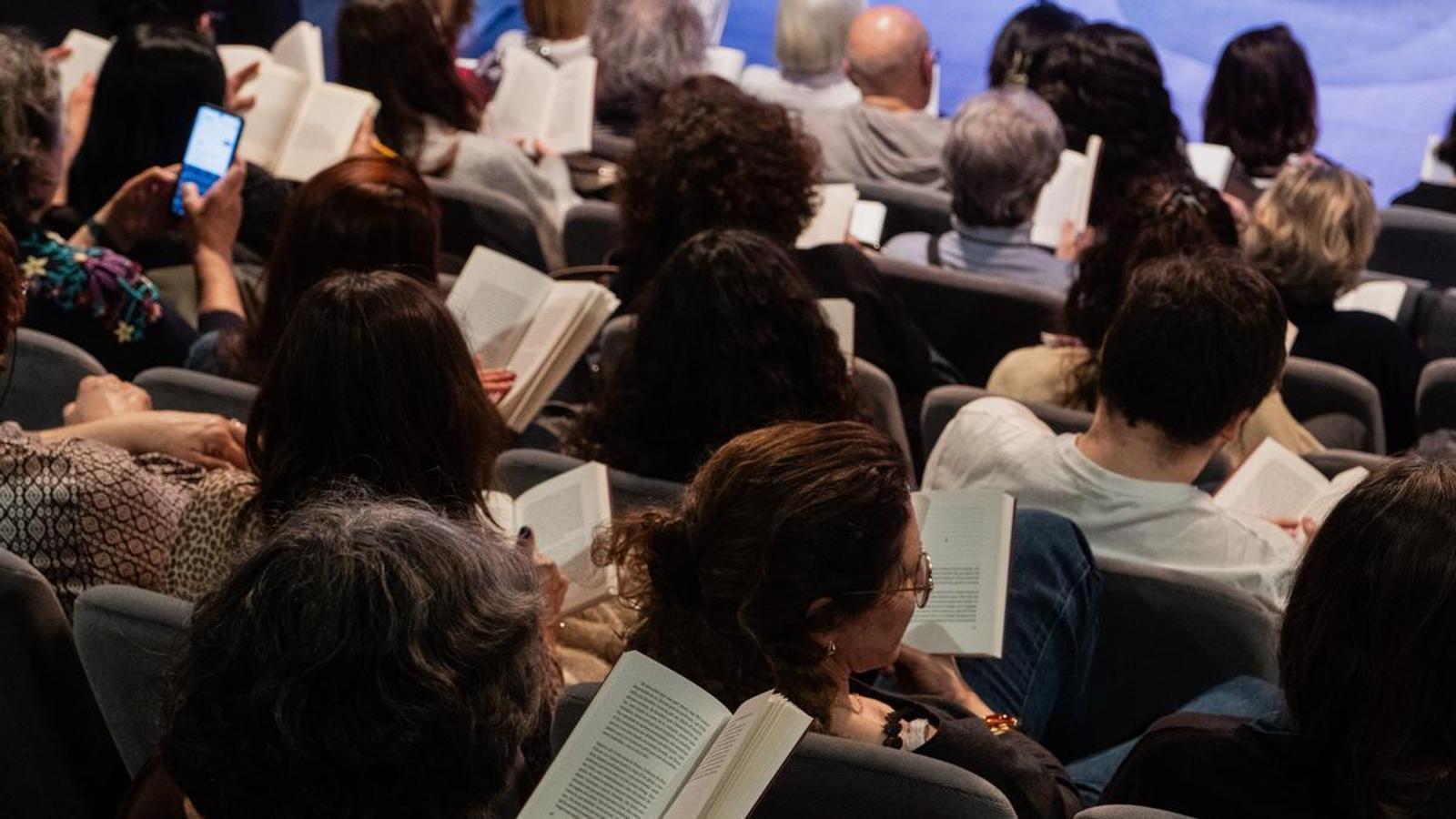

Barcelona"I poked my head into the room and a feeling of shyness overcame me," Eva Baltasar confesses to me in the dressing rooms of the Teatre Texas, where she has taken refuge so as not to disturb the public who are precisely here for a presentation... by Eva Baltasar. Before the event, the theater organized a Silent Reading Party to celebrate the premiere of the theatrical version of "Permagel, adapted and directed by Victoria Szpunberg with Maria Rodríguez Soto as the protagonist. "Reading is usually a solitary and intimate act," says the author, but doing it in a group gives it a "somewhat cathedral-like, monastic, a touch sacred" air. Even her editor, Maria Bohigas, tiptoes into the room, where in the first row is the producer and partner of Texas, Anna Rosa Cisquella, abducted by reading. "Permagel" will be Dagoll Dagom's last co-production; it wasn't "Mar i cel".
Nearly a hundred people fill the theater seats with one of Baltasar's latest books open. They don't blink, they don't speak. I count only fifteen men and five e-books
. It's impressive that not a single mobile phone rings, no coughs, nothing, just the dull hum of the air conditioners and some yawns of relaxation. Nor do I catch any young person taking a "post" for show on Instagram. Among the audience are fans of Baltasar and regulars of reading clubs. The theater managers had the idea of "crossing audiences" with Club Editor, as they call it in marketing jargon, and it worked. Sara and Judit already have tickets for the play and have read all of Baltasar. They came because "it's like going to study at the library, where you're more concentrated, for longer, and it creates an atmosphere." Víctor, on the other hand, expected the event to be more relaxed: "I came to talk about books," he admits.
The screenwriter and director Leticia Dolera will indeed talk about it, who will try to extract the essence of Baltasar's work like those lumberjacks who make sculptures out of a log with a chainsaw. The author does not allow herself to be psychoanalyzed in interviews, because she says that for that she invents stories: "I realize who I am when I write." In fact, she realized she had a novel on her hands when she was keeping a diary on the advice of a psychologist and began to put more fiction than reality into it. When she saw that she could not sustain so many lies in therapy, and it also cost her money, she quit therapy and used her protagonists to "go looking for monsters." Writing allows her to "connect with emotions we have repressed, such as violence or cruelty"; "that way I no longer need to go around the world killing people".
Wishes and not memories
It's fascinating how Baltasar explains his creative process. "I want to meet someone who seduces me. I need surprise. The character guides me: today I discovered she has a sister, today she's been a whore, wow! —he explains—. If I could, I wouldn't leave my novels." If they make her choose, she'd want to re-enter Mamut. But he fell in love with Boulder, one of the protagonists of the novel of the same name. "She's the love of my life. She's like an ex of mine. I even felt a sense of infidelity with my partner." He assures that it was so real that one afternoon, in Portugal, he saw Boulder at the top of a ferry with a sailor's jacket, embracing a woman, and he followed them until he lost sight of them. "I didn't say anything, I didn't say: 'Hey, I'm your author!'", he recalls.
There isn't much oxygen left to dedicate to the most recent novel, Peixos, but Baltasar celebrates having discovered that he can cancel the past. "I hate my past. We give it too much importance. I wish it hadn't existed." And it's the luxury he gives to many of his characters, who carry desires, not burdens. One of his desires is to turn around this "splendid society we live in," he says ironically. He explained it in Ocàs i fascinació: "You don't have to go looking for spirituality anywhere, you don't have to go to temples, nor look for masters, but rather discover what it is that already sustains us. God, and I say God because of my tradition, but you understand, God is in you. The most difficult journey is to turn inward."
What gives him hope?, Dolera asks him. "Having daughters has given me hope. And always putting writing first. I've never been married to any job, even though Permagel wasn't published until I was 40. But I knew I had to write. What matters to me in life? The few people I love, writing, and accompanying the people by my side well. And not much more."
