RCR at the Sagrada Familia: Nature, materiality and sensory experience
The basilica hosts a dialogue on Gaudí's legacy with RCR architects and architect Kazuyo Sejima
-
CAT -
CAST
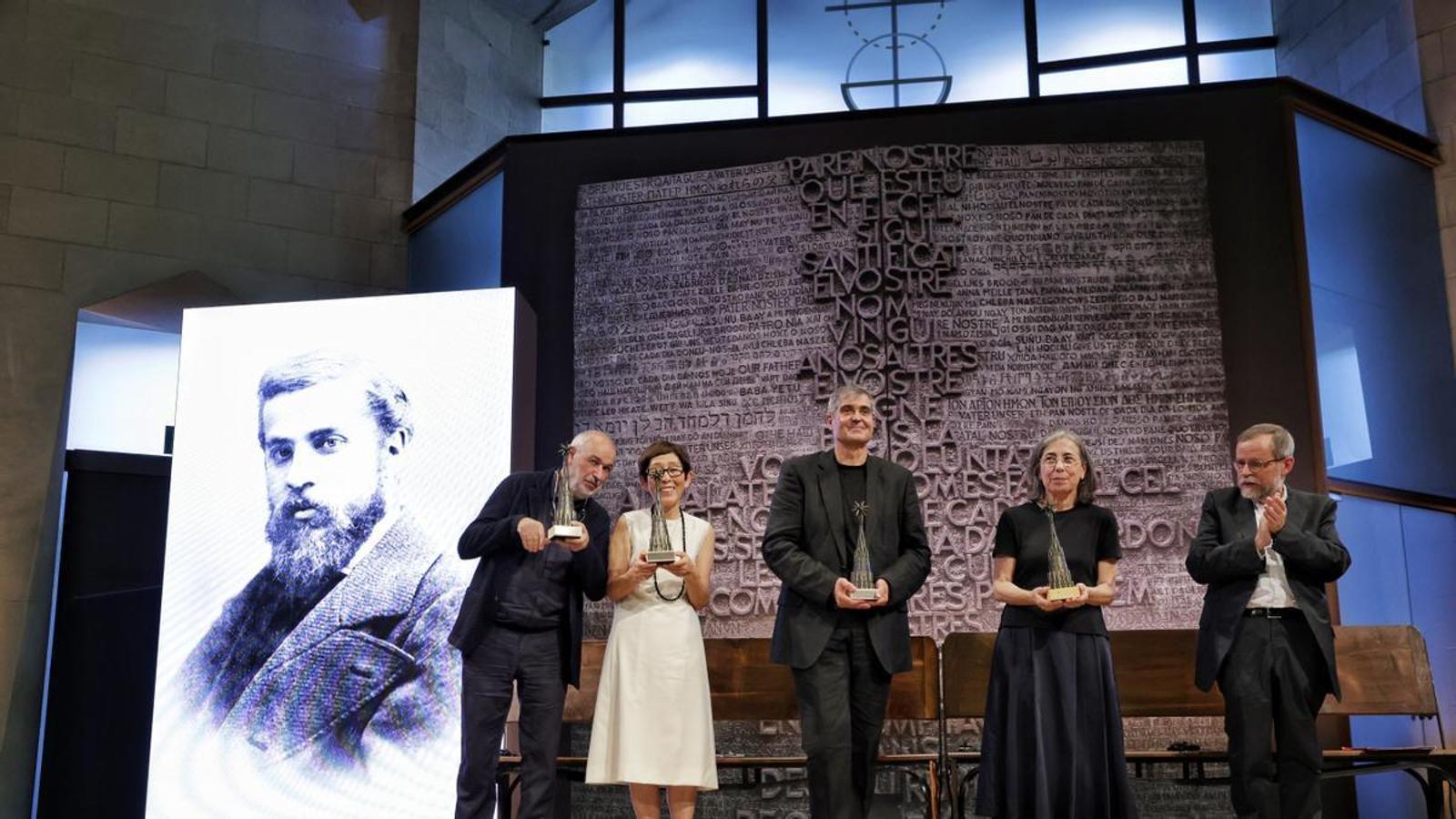
BarcelonaThe central nave of the Sagrada Família hosted on Saturday evening the conference Architectural dialogue between heritage and contemporaneity, a meeting that brought together some of the most relevant names in contemporary architecture within the framework of Barcelona's designation as World Capital of Architecture. The event was attended by RCR Arquitectes, Carme Pigem, Ramon Vilalta and Rafael Aranda, winners of the Pritzker Prize in 2017, and by the Japanese architect Kazuyo Sejima, Pritzker Prize winner in 2010. The different interventions offered a shared reflection on the relationship between Antoni Gaudí's architecture and contemporaneity, the cultural value of architecture and its capacity to respond to the challenges of today's society.The day began with the presentation and welcome from Joan Trias de Bes, a doctor architect and member of the Sagrada Família board, and with an introduction by the basilica's director architect, Jordi Faulí, who gave a brief explanation of the nave and the Nativity façade.
Regarding the conference, which was attended by 1,300 people, Carme Pigem highlighted Gaudí's inspiration from the laws of nature and his ability to transform them into architecture. Rafael Aranda addressed the transcendent dimension of the Sagrada Família as a space for connection between matter, consciousness, and spirituality. Following this, Ramon Vilalta emphasized the collective and shared character of the Sagrada Família, the result of the efforts of successive generations. Kazuyo Sejima presented her vision of architecture and the principles that marked her professional career. And Jordi Faulí championed the commitment to the future of the temple and the continuity of Gaudí's legacy.
This text is a fragment of the choral lecture Antoni Gaudí and the Sagrada Familia, which RCR and Kazuyo Sejima presented on June 27th at the Sagrada Familia itself, where their writing, divided into three parts (this is a fragment of the second), was preceded by two interventions by Joan Trias de Bes and Jordi Faulí, the architect of the temple."The relationship between nature, materiality, and sensory experience constitutes one of the fundamental axes for understanding both Antoni Gaudí's work and its relevance in contemporary architecture. Gaudí not only anticipates current concerns but also takes them to a profoundly innovative level.
Antoni Gaudí reflects on the relationship between art, truth, and nature in various texts and statements: "Beauty is the splendor of truth; since art is beauty, without truth there is no art. To find truth, one must know the beings of Creation well." In coherence with this thought, Gaudí himself states that he finds in nature his main source of inspiration and artistic renewal: "Those who seek the laws of nature to conform new works to it collaborate with the Creator; copiers do not collaborate. That is why originality consists in returning to the origin." Likewise, he insists that "returning to the origin is projecting man's spirit onto nature, so that it may be infused into his works," and he defines himself within a Mediterranean tradition in which the plasticity of harmonic volumes, modulation, and color expresses the balance between feeling and logic, as Gaudí explained.
Nature, which Gaudí always calls "my teacher", is understood as a generative principle of the form, structure, and meaning of architecture. His work is based on the understanding of the internal laws of the natural world, which allows him to generate forms that not only evoke nature but also function like it. In nature, he finds the essential foundations of architectural elements. This integral conception positions him as a key precedent for many current concerns, even though his level of synthesis is not easy to achieve. It is not about superficially imitating organic forms, but about understanding the structural systems that govern them. The use of geometries such as the catenary or hyperboloids responds to physical principles observed in nature and allows for the development of efficient and coherent constructive solutions. "It is the form that nature provides in the neck of mountains, in branches, in the joints of living beings [...]". This approach is manifested very clearly here, in the Sagrada Família, where the columns branch out like trees, configuring an interior space that evokes a forest. Here, structure, form, and symbolism converge in an indivisible unity to provoke emotion.
Materiality in Gaudí reinforces this relationship with nature. Each material is used according to its specific properties and reveals its constructive honesty, its truth. Stone, iron, or ceramic not only fulfill their structural function but also provide sensory qualities that enrich the spatial experience. For example, the use of trencadís, visible in various works by Gaudí, introduces an experimental and sustainable dimension by incorporating recycled fragments into vibrant and reflective compositions that dialogue with the environment. Matter is not just a coating, but an expressive medium that connects the built with the natural.
[...]
Gaudí's true value lies not only in his formal originality but in his achievement of a profound integration between the laws of nature, constructive logic, and sensory experience.
This total integration of nature, materiality, and sensory experience represents an ideal that, in contemporary architecture, is found through other approaches.
There are lines of work that reinterpret the relationship with nature through abstraction and reduce it to essential elements such as light, water, or emptiness. In these cases, nature manifests itself through intangible elements that structure the experience of space. Unlike Gaudí, this approach does not seek to reproduce the formal logics of nature, but rather to establish a contemplative dialogue with it through the reduction of means and the minimal use of materials, which are converted into almost abstract elements. This achieves atmospheres of great purity and control, based on geometry and light.
Other approaches establish a profoundly sensory relationship with the environment, where nature is physically experienced through materials. These are selected for their sensory capacity and their texture, color, temperature, or sound is emphasized. Architecture is built from the physical experience of materials and light, generating atmospheres that evoke nature without the need to represent it formally, and in which the person's bodily perception is essential. This approach coincides with Gaudí in the importance given to matter, but differs in the language, which is more contained and abstract.
And there are even other approaches in which nature is understood as a dynamic process that translates into fragmented paths and complex geometries. Through a great diversity of materials used experimentally, fragmented and unstable compositions are generated, marked by movement and tension, creating expressive atmospheres of great dynamism.
Another line of work, much closer to us, seeks not to represent nature directly nor to translate its geometries into structures, as Antoni Gaudí does, but it does try to provide a response as rooted as possible in its context. Projects emerge that do not imitate nature, but rather frame it, filter it, and intensify it through paths and visual relationships.
Materiality acquires an essential role here, just as in Gaudí, but with a different logic. In Gaudí, the materials are multiple, with great plastic and colorful richness; on the other hand, one can work with a strong reduction and control of the material using essential elements treated with the utmost austerity and exploring the different registers that the same material can have, such as steel or concrete.
To try to work from abstraction and atmosphere, generating silent and contemplative spaces, where nature and material, light and shadow are experienced sensorially, with the will that architecture becomes a global experience for the person.
Beyond the formal differences, this richness and diversity of architecture, from Modernism to contemporaneity, coincide in the most fundamental aspect: the will to create architecture deeply connected with the laws of nature and with the sensory experience of people.
