"Our projects are full of love, but they are born out of rage"
The third edition of the Itinerant Migrant Book Fair invites you to discover stories made invisible by racism

-
CAT -
CAST
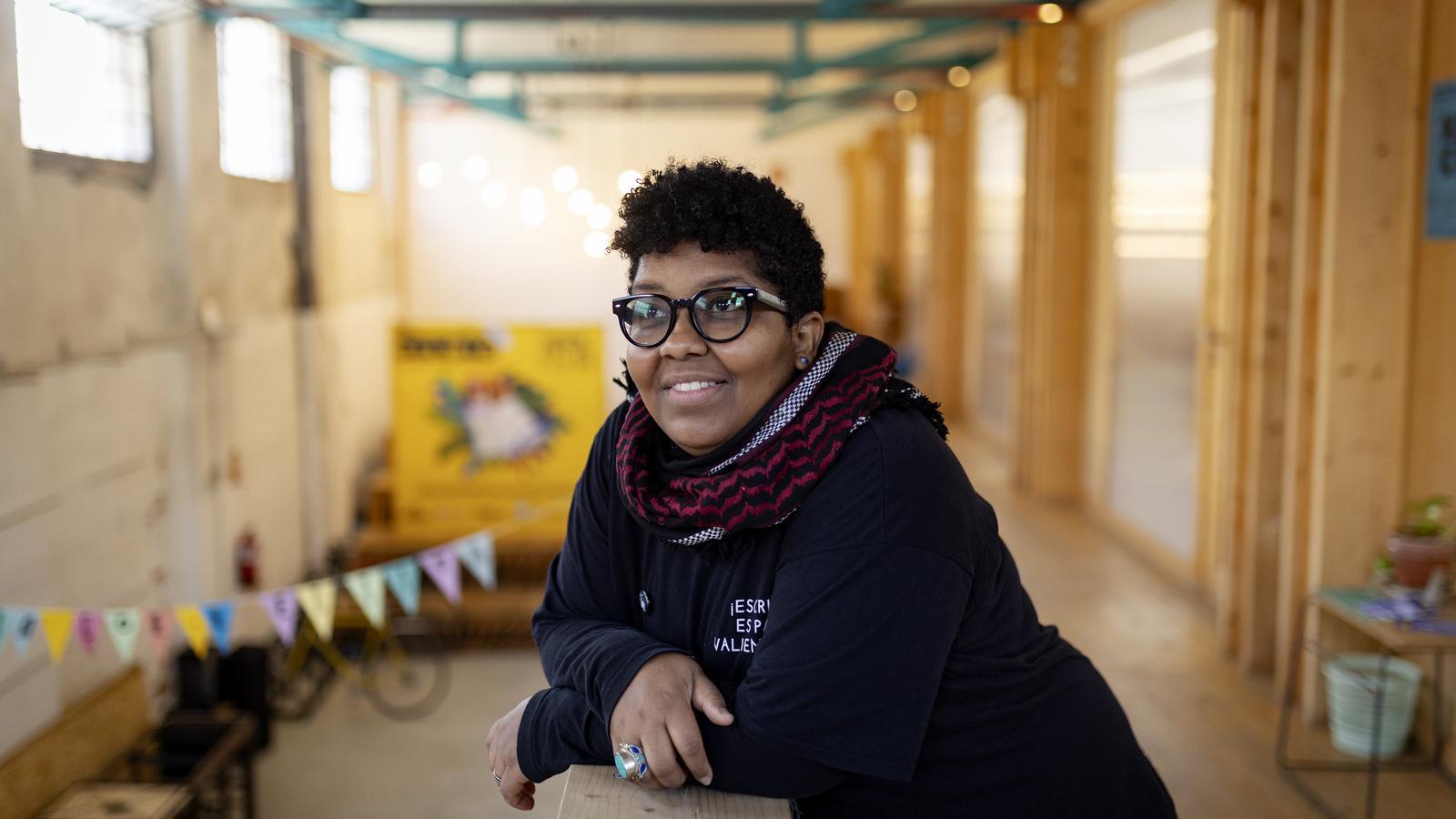
Barcelona“Before, I wanted to change the world. Now I am aware that I cannot. What I can do, at least, is help a small portion of this unsalvageable world”, explains Quinny Martínez Hernández (Colombia, 1979), poet, activist and director of FILMIG, the Itinerant Migrant Book Fair, which celebrates its third edition from April 13 to 18 in Barcelona in various venues, such as the Casinet d’Hostafrancs Civic Center – where the fairgrounds are located – or the Gabriel García Márquez and Sant Pau-Santa Creu libraries. All the activities of the event, which include from discussions to film screenings or a closing concert, are free. The team has never considered charging admission, because they follow the principles of the social and solidarity economy.
The fair was born to give visibility to migrated writers who feel rejected by the established publishing sector. With the same objective, Quinny Martínez had promoted the editorial project Plataforma Cero a few years earlier. “I did it after reflecting on how my first book was being edited. With that experience, in which I did not feel comfortable, I was very clear that an editorial label was needed to publish emerging authors like me, racialized migrant writers who are rejected by an editorial canon that does not respect our places of enunciation and that always wants to correct our way of saying things”, affirms the poet and cultural promoter.

A continuous struggle
The beginnings were very difficult and full of obstacles, but Quinny Martínez's energy and enthusiasm overcome any hurdle. “Finding funding for FILMIG was not easy. It has been, and is, a constant battle. I only had a social capital that was the result of my career as an erotic poetry writer and activist. I had been in many spaces and all the people who had shown me their affection, I kept it like in an imaginary wallet to capitalize on it later in some way, but always thinking about collective projects with a social and community impact”, recalls Martínez, adding: “We also haven't had any grants, because the required time to apply for official aid has not yet passed since we created our association, which is also called Plataforma Cero, like the editorial project. Despite this, the fair has not stopped growing and this year we have sixty exhibitors with their respective projects. The exhibitors only pay fifty euros, which is a symbolic price considering that we even give them food”.
The slogan for this year's edition is What stories are you not reading?, a claim for voices and narratives silenced by racism or marginalized by the traditional publishing sector. “What about writers like me? We are not an appendix of Latin American literature. We are part of a literature that migrates and is tired of the governments of host countries marginalizing us and then capitalizing on any success themselves. We are constantly treated as a subgenre. In my case, moreover, since I write erotic poetry, they also think I write a subgenre of poetry... How boring. We create literature and our publishing house publishes quality books. And whoever comes to FILMIG will come to a fair made by a professional team”, defends the director of the literary event.
“Barcelona is a racist city”
Since the beginnings of the fair, one of the key collaborators has been MigrESS, the Association for Migration, Social and Solidary Economy, with whom they share an office at Impuls Cooperatiu de Sants, in the self-managed complex of Can Batlló. To conduct the interview, we met there, coinciding with the weekly lunch that brings together the entire team during the most intense months of preparation for FILMIG.
For them, these meetings in a safe space are important for building ties and sharing experiences, many marked by social rejection, as lamented by one of the latest additions to the team, Mayo Trejo, a human rights activist and university professor in Mexico: “I come from one of the states most affected by organized crime, Guanajuato. I migrated to Barcelona last year. And what can I say about my experience so far? That Barcelona is a racist and xenophobic city, a city that is built to make migrants feel like outsiders. I believe this is very harmful and could be changed simply with small daily gestures. My colleagues seem very brave to me”.
It is because of this feeling of rejection that all the initiatives of the Plataforma Cero association are based on an anti-racist perspective. “Catalonia is a country with a slave-owning past. It is painful to see monuments to Columbus and slave owners in Barcelona. This is not typical of a welcoming city. Furthermore, initiatives aimed at the migrant community must be led by migrants. It is time for diversity to also reach the decision-making positions in cultural institutions. Everything we do has an anti-racist impetus to denounce these situations. Our projects are made with love, but they are born out of rage. We are tired of so much racism and so many daily gestures of contempt,” concludes Quinny Martínez.
- ‘Migrate in prose, verse and image’ Screening of the documentary 'Chiñoles y bananas', by Susana Ye, and a discussion about the challenges of migrant literature. Monday, April 13, 6 p.m. Espai Veïnal Olzinelles.
- ‘Expanded Libraries’ A meeting that claims the need to incorporate an intercultural perspective in public libraries. Tuesday, April 14, 10:30 a.m. Gabriel García Márquez Library (prior registration required).
- ‘Building bridges: literature between two worlds’. Guest country: Colombia Presentation of the community publishing house Kutosoma, based in Bogotá. Wednesday, April 15, 6:30 p.m. Biblioteca Sant Pau-Santa Creu.
- ‘Open Screens’ Screening of films and discussions with filmmakers with an anti-racist perspective. Thursday, April 16, 12 p.m., 5 p.m., and 7:15 p.m. La Lleialtat Santsenca.
- Activities at the exhibition hall From book presentations and signings to discussions on various topics. The closing concert will be performed by Masta Quba and Cecé & The Soul Kitchen. Friday and Saturday, April 17 and 18, from 10:30 a.m. to 9:30 p.m. The exhibition hall is located at the Casinet d’Hostafrancs Civic Center.
