Barcelona reactivates the archery facilities, but rules out rebuilding the demolished building by Enric Miralles and Carme Pinós
The municipal plenary approves a proposal by BComú to recover one of the icons of the Barcelona Olympic Games

-
CAT -
CAST
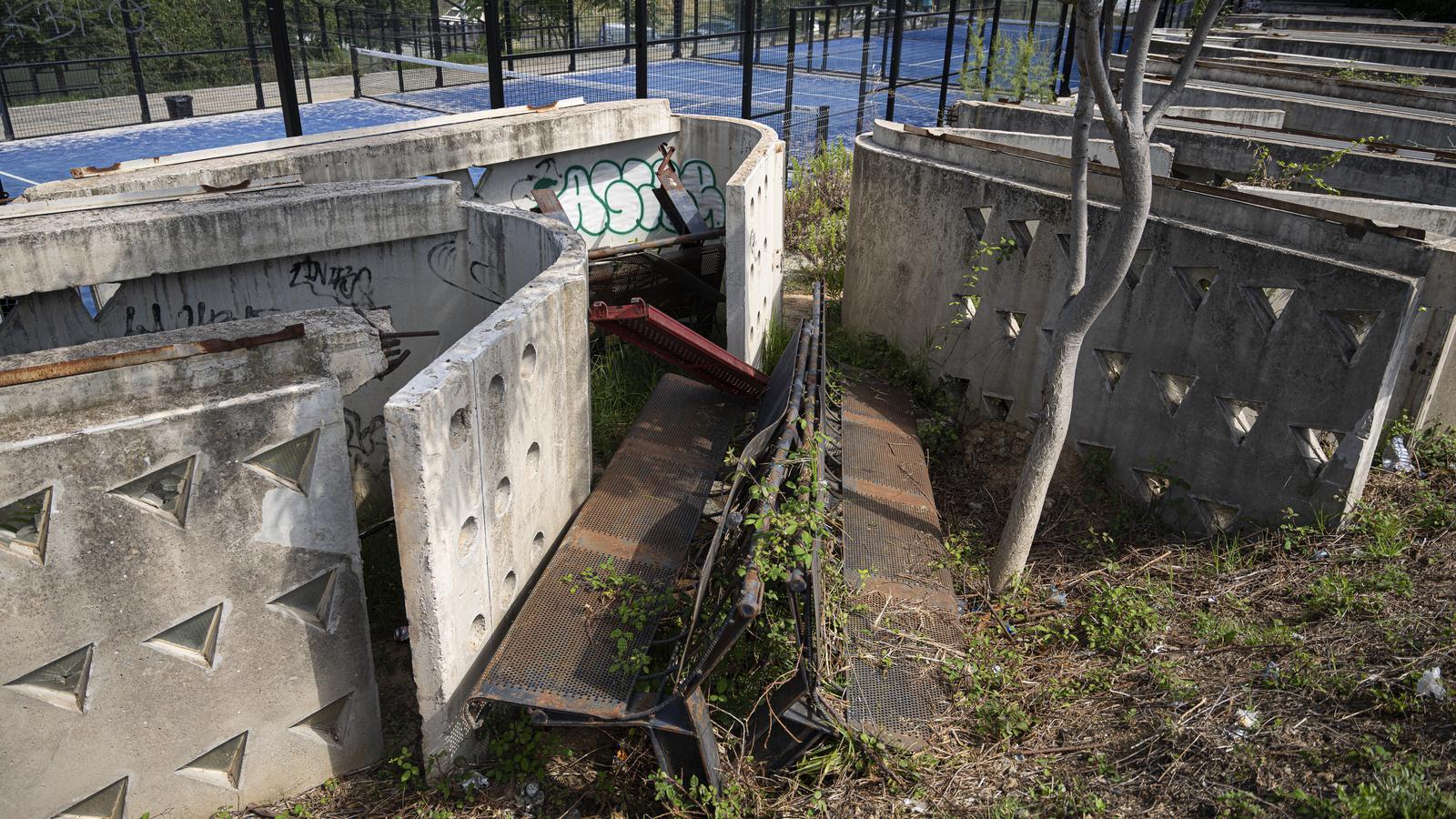
BarcelonaThe archery facilities of the Barcelona Olympic Games, by Enric Miralles and Carme Pinós, are one of the most iconic works of Catalan architecture of recent decades. At the same time, it is also a paradigmatic case of the pending path for administrations to fully value contemporary architecture and, where appropriate, to patrimonialize it. Following the collapse that occurred in Carmel in 2005, the public company GISA demolished one of the two pavilions of the building in 2008, the competition one, during the works to build a new maneuvering tunnel for L5 of the metro, with the commitment to rebuild it. A commitment, until now, unfulfilled. But now the solution could come through the municipal route: the plenary session of the Barcelona City Council has just approved, with the abstention of the PSC and the rest of the favorable votes, a proposal by BComú to renovate the changing rooms and the bar of the football and rugby fields of La Teixonera and integrate the competition building of archery, whose pieces have been abandoned on a nearby plot for seventeen years. But as ARA has learned from sources familiar with the case, the municipal government has no intention of rebuilding the building.
The latest news about the recovery of the competition buildingwas inscribed in the interventions in the nearby plot of La Llosa de la Vall d’Hebron: it was planned that the Department of Territory would fulfill its commitment coinciding with the works of an external consultation building of the Vall d’Hebron University Hospital and the construction of the new headquarters of the Agency for Public Health of Barcelona on the Llosa de la Vall d’Hebron plot, a fact that would allow resources to be saved. This Tuesday, the first deputy mayor, Laia Bonet, said that during this term they have initiated the "integral transformation" of this area, with the approval of the modifications of the Metropolitan General Plan (MPGM) of La Teixonera, which includes actions such as the covering of the Ronda de Dalt.
Currently, within this same project, the "key" phase of the new arrangement of public spaces around the Llosa de Vall d'Hebron is underway. Before the end of the year, it is planned to promote the tender for works that will allow the introduction of new citizen uses and the tidying up of the public space, where the pieces of the competition building will have to be integrated. But Bonet has not specified if the building will be rebuilt in this location. "It is evident that we have been late, and we have all been. We want this to be resolved once and for all and for it to be done by valuing sports practice and at the same time the recovery of heritage by filling it with life, which is what the architectural heritage of this city deserves," stated Pau González, from BComú.

Deteriorated facilities
The proposal has been approved more for the services part than the architectural part: the commons point out that the institution that manages the facilities, the Marcet Foundation, has not presented any balance sheet since 2019 and accumulates fines of 32,000 euros for serious infractions, including the presence of rats, and the Ombudsman has concluded twice that the right to practice sports in optimal conditions has been violated. Currently, "more than 1,700 users continue without hot water, with stands closed due to structural risk and without meeting space," say the commons. Faced with this situation, the municipal government continues to intervene no further than imposing "minor sanctions," they lament.
After listening to the proposal, Laia Bonet reproached the commons for not intervening during the eight years they governed, and acknowledged that the buildings are part "of the city's best architectural legacy." But then she called for rigor: "There are technical and management conditions that are not minor and that must be faced. We are talking about who has to assume the project, how the legitimate considerations about authorship are resolved, what specific use these spaces should have, what management model should guarantee their proper functioning. Furthermore, there is a prior urban planning reality that must be taken into account," says Bonet.
As planned in the agreement to dismantle the building, Carme Pinós delivered the reconstruction project, with a current budget of 3.7 million euros. But a few years later, events took an unexpected turn: in 2013 GISA convened a competition, which was won by the office of the late Moisés Gallego, to build changing rooms that occupy the place of the old pavilion. This project was linked to an agreement after the approval of the Special Urban Planning and Urban Improvement Plan of 2015, which defined three development phases. "Only the first one was executed. Therefore, we start from an incomplete action that, moreover, has modified the limits of the concession and conditions any future intervention. This forces us to address the entire facility with a global, not fragmented, perspective," explains Bonet.
