From the city to the planet, how architects' concerns have changed
The comparison of the UIA congress of 1996 and that of 2026 demonstrates the end of the era of iconic buildings

-
CAT -
CAST
It was almost noon and architect Joan Busquets had been at the doors of the Teatre Romea for an hour, calming the spirits of the young congressmen who had, in almost all venues, forced the suspension of sessions in protest against the limited capacity of the venues. That July 4, 1996, the first day of the World Congress of Architects ended up being held in the afternoon in Plaça del Macba and the following days in a packed Palau Sant Jordi where the speakers, many of them star architects of the moment, succeeded one another, astonished by the interest and dedication of the students and congressmen gathered. At the closing of the UIA 2026 World Congress of Architects, this Thursday morning, Joan Busquets was also there, now as honorary president. But he hasn't had to fight with anyone, quite the opposite. All have been praises for the organization and, of course, the large hall of the International Congress Center of Barcelona (CCIB) could accommodate everyone and the four large screens of a video that was being edited live were visible from all points. The organizational aspect is one of the significant changes between the two congresses, but surely the smallest.
Another, somewhat more relevant, is that of spaces. At that time, neither the CCIB nor the Dhub existed, the Three Chimneys of Sant Adrià were still a thermal power plant in full operation, and the Sagrada Familia did not even have a roof. The original venues were the CCCB and different theaters. But it was precisely in 1996 when the mayor Pasqual Maragall, in full post-Olympic euphoria, had the idea of holding some kind of cultural event that would allow the transformation of the Besòs area. The result was the controversial Forum of Cultures of 2004, which today almost no one wants to remember.
However, that swan song of the policy of major events as an excuse to transform the city left its mark. The main one, which turned a dirty facilities area like the treatment plant into an urban area, which has a giant photovoltaic panel as its symbol, but also reflects the interest in the iconic buildings that existed at that time, with the Blue Museum by Herzog & de Meuron and the CCIB itself by Josep Lluís Mateo as emblems. In the case of the Dhub, five more years would have to pass before it was decided that the Martorell-Bohigas-Mackay team would build the Design Museum, and even longer before it was decided to transform the Plaça de les Glòries from top to bottom. As at the Forum, the most interesting and costly is what lies beneath – here, the mobility infrastructure – but iconic buildings were also chosen for the exterior, such as the Dhub itself or the Torre Glòries – formerly Agbar – by Jean Nouvel and Fermín Vázquez.
Although these icons have been the settings for the congress and have demonstrated their usefulness, this way of understanding architecture is precisely what has been called into question in this second congress. If the theme of 1996 was"Presents and futures. Architectures of cities"– developed in an exhibition by Ignasi de Solà-Morales – because the concern at the time was the frantic pace of urbanization worldwide and it was about defining how to make macro-cities more sustainable, connected, and habitable, now the focus has expanded to the entire world and the theme has been "Becoming. Architectures for a planet in transition".

Thirty years ago, some were already warning of what could happen if speculation was not curbed. The Spanish architects' congress, prior to the World Cup, ended with a manifesto warning of the danger of liberalizing the profession and land that led to the 2007 crisis. In general, in the UIA's presentations, even star architects called for the social responsibility of the architect, for housing problems that were also urgent at the time, for the need to manage resources better and be more sustainable, and there were constant criticisms of the Western way of doing things and of iconic architecture designed for the rich. The reality, however, was that these concepts were shelved, and if we look at it globally, despite the real estate crisis, this iconic and massive way of building cities continues to be done as it was then in a large part of the world. One only needs to look at Dubai and many Asian, African, and, of course, European cities.
The truth is, however, that new concepts are now beginning to be introduced. The Barcelona Declaration agreed upon at the 2026 congress emphasizes three fundamental elements that change everything. One is that it embraces the current trend of building less and rehabilitating more. In the general global context where buildings and their construction cause more than a third of polluting emissions, it is about recovering and repairing what we already have, reusing both spaces and materials, before continuing this unsustainable construction expansion. But for this, they acknowledge, a return to origins is also necessary so that technology and traditional construction can coexist. Another element is accepting that we are not alone in the world as a species. Therefore, architects declare themselves against the anthropocene and assume they must work thinking about how their work affects animals and plants and in collaboration with professionals from other disciplines. And, finally, they place the right to housing at the center as a right that should be excluded from speculation. Possibly, this point of the declaration, given the state of the world, is the most complicated to apply, but if this congress has done anything, it is to emphasize collective housing and how it has changed and can adapt to new challenges. In this sense, it is this, the work of young architectural firms that have innovated in public housing in recent years, that has been wanted to be shown of Barcelona today.
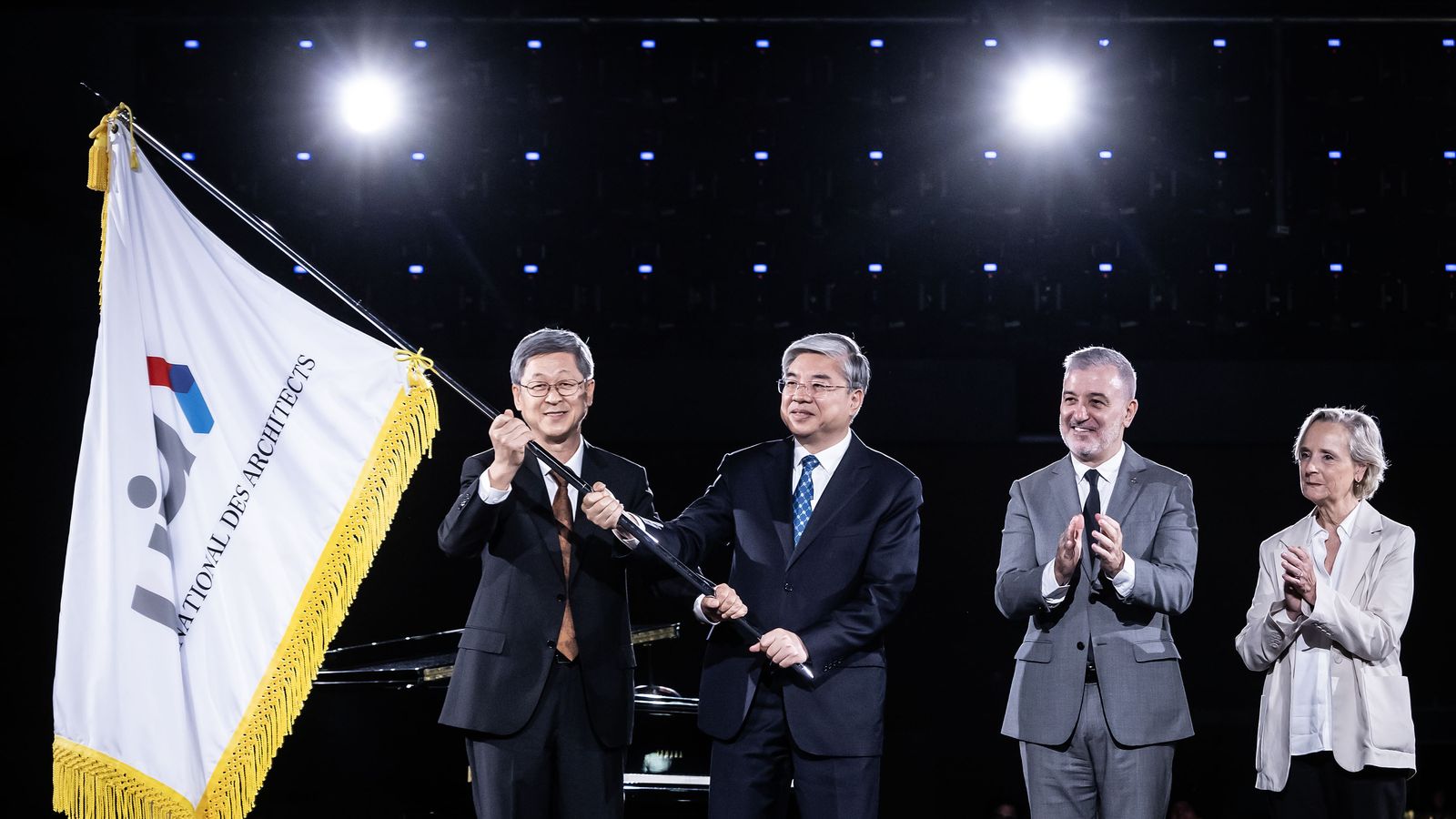
Barcelona has handed over to Beijing, which will also host the congress for the second time in 2029 and has chosen as its motto"Returning to balance: architecture for a better life for all". A balance between people, nature and technology that we will see how it is intended to be defined in a society that razed a large part of its heritage and has thoroughly exploited its territory, but which is now a leader not only in urbanization but also in sustainability technologies. The Chinese capital will also be the World Capital of Architecture that year, as Barcelona is this year. Many of the exhibitions and activities on architecture – including the main one of the congress which can be seen from Thursday to Sunday at Les Tres Xemeneies for free until July 19 – will continue until the end of the year. It is worth taking advantage of it.
