The architects against the anthropocene
Adaptation to a multi-species world and material recycling focus the first day of the UIA architects' congress

-
CAT -
CAST
BarcelonaIn the architectural treatise par excellence, The Ten Books on Architecture, the Roman architect and theorist Marcus Vitruvius proposed that architecture must fulfill three values, "firmitas, utilitas, venustas", that is, buildings must be solid enough, functional, and beautiful. But 2,000 years later, these values are insufficient to face the challenges of today's world, the ravages of the anthropocene. "Now perhaps we need other words, other ways of thinking: perhaps it is not about firmness but about instability: the ability to work with changing soils, rising seas, transforming climates, and uncertain futures," said architect Eva Franch on Monday at the first plenary session of the World Congress of Architects 2026, held in Barcelona.
"It is not utility, but ecology: the recognition that buildings are never isolated objects, too often a fiction that architecture has produced, but participants in biological, geological, hydrological, and atmospheric systems. Architecture is atmosphere, architecture is water, architecture is geology, architecture is biology," says Franch, who in her speech questions architectural beauty: "What I am about to say will hurt in this room, because we too often use beauty, and we should talk about repair and an aesthetic of care; about restitution, maintenance, and coexistence with damaged worlds, human and more than human."
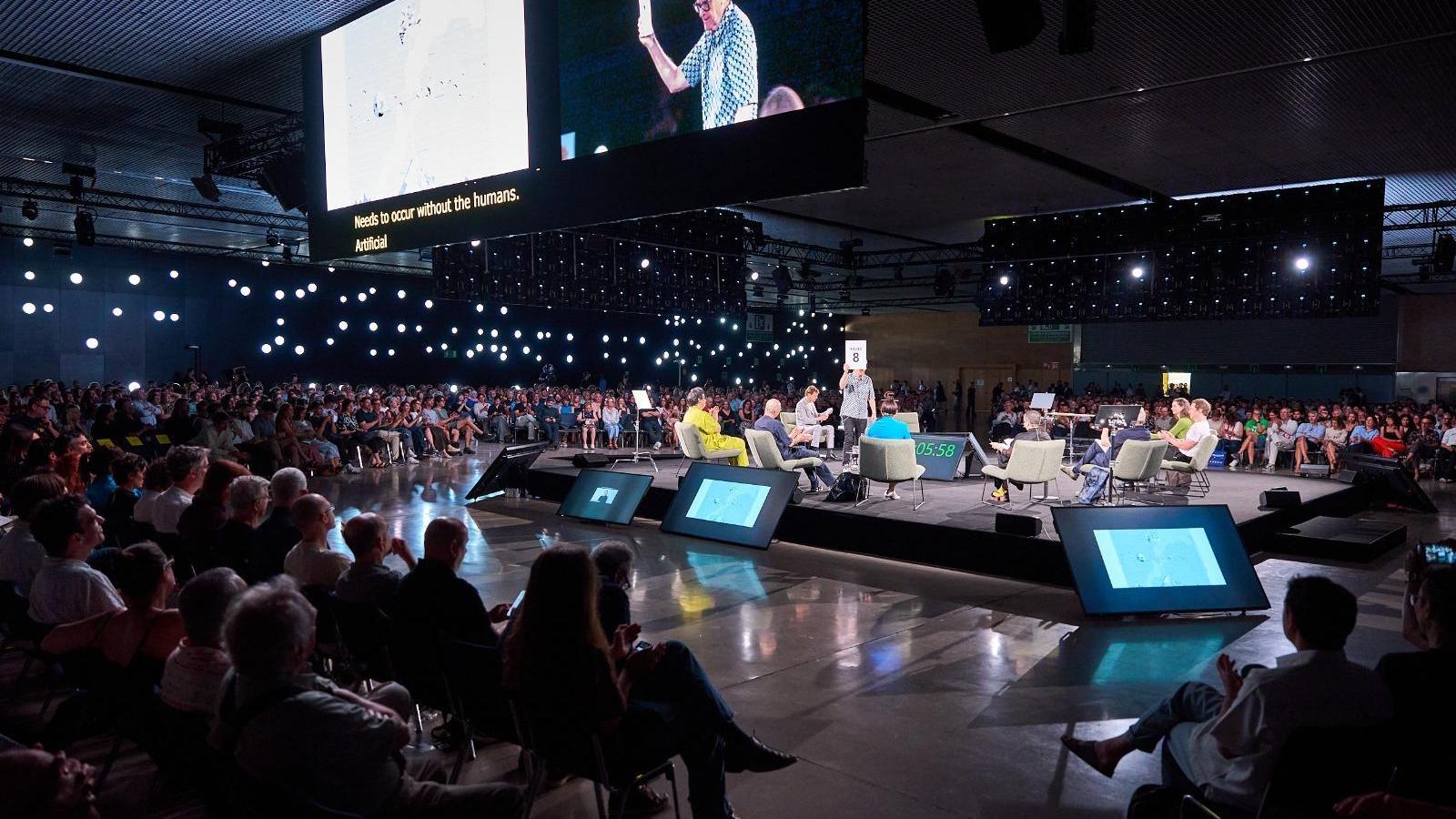
The congress began at nine in the morning, getting straight to the content. The first plenary session was dedicated to the thematic line of Becoming more than human, that is, to adaptation to multispecies ecologies, and was moderated by architect and theorist Mark Wigley and landscape architect Bas Smets. In addition to Franch, the debate also included, among others, pioneer landscape architect Dirk Sijmons and Mireia Luzárraga, from the Takk studio and co-author with Franch of the Catalan pavilion at the last Architecture Biennale, Water Parliaments. "We have worked with farmers, scientists, engineers, and we also need philosophers. Because we have to assume that we will have to lose some privileges. So we should always introduce the humanities into these issues," claimed Luzárraga.
"Becoming more than human questions the very idea of architecture and the political figure of the architect. It calls for a radical transformation of both buildings and practices. Human health is completely intertwined with that of billions of other species on Earth, as well as with the planet they all share and where they coexist. What lies beyond the human, or beyond our conventional understanding of the human, is the very basis of survival, of life. Even the most selfish defense of human life must confront whether it is necessary to subordinate and control what is beyond us. Paradoxically, humanity's best defense is to be less defensive," said Wigley, citing a text he wrote with Smets for the congress catalog.
As if it were a boxing match, the debate unfolded in ten rounds. "The ancient and persistent attempt to separate humans from the environment seriously harms both humans and the environment," warned Sijmons. "The division between culture and nature, between human and non-human is a toxic fiction. The built environment has no limits. Humans are biological, geological, hydrological, and atmospheric forces. Buildings not only defend against the climate, but they co-produce it. They not only offer separation from the soil, but they deform it," also explained this architect, who presented several alarming data, including that 40% of greenhouse gases are produced by ecosystem degradation and that the total weight of the built environment exceeds the total weight of the living world, a figure that could double by 2050.
"Everything we have built, from the pyramids to this building where we are, could double in half a century. It is evident that this will cause an enormous crisis of natural resources," lamented Sijmons. Among the solutions are to refrain from building anew and demolishing, and to make "real sacrifices" in housing comfort levels. "Regarding steel and cement, there are no direct large-scale sustainable alternatives. Therefore, we must think about alternative materials – earth, plant fibers, etc. – and, when researching them, we must also consider whether they are hospitable to other species," said Sijmons.
The challenge of recycling concrete
Among the morning's events, there was also a conversation between Jean-Philippe Vassal and Roger Tudó, one of the founders of the Harquitectes studio, about "architecture between efficiency and generosity". Tudó also participated in the afternoon plenary session on the circular economy, specifically on material recycling, with examples such as structural elements with 80% less concrete designed by the Baukunst and Structural Exploration Lab studios, which in the future will be placed in a park in Vallcarca, Barcelona. "Cement, which is the binder for concrete, is responsible for approximately 8-9% of global carbon dioxide emissions, about three times the carbon emissions of the aviation sector," stated Baukunst founder Adrien Verschuere. Currently, the construction sector crushes this waste to make it more durable and then manufactures recycled concrete by adding new cement and new natural aggregates. "This means that recycled concrete has the same environmental impact and the same carbon footprint as conventional concrete, because cement continues to be necessarily the most carbon-intensive part of concrete," he warned. For this reason, they are researching new construction methods to create load-bearing concrete structures.
