10 iconic dragons of Catalan Gothic
The dragon is fantasy and political enemy in ten iconic works

-
CAT -
CAST
BarcelonaThe images of the dragon reflect the creative audacity of the artists in creating a fantastic figure, and the scenes of Saint George slaying the dragon that exalt the figure of the saint evoke the political struggles of his time. Saint George owes all his fame to the dragon. These are 10 emblematic dragons of Catalan Gothic, one of the most splendid historical moments in art.

'Altarpiece of the Virgin and Saint George' from the church of San Francisco in Vilafranca del Penedès
By Lluís Borrassà (c. 1395). Preserved in the same church
One of the earliest images of Saint George slaying the dragon, by one of the greatest exponents of Catalan International Gothic, Lluís Borrassà. Astride a white horse, the saint delivers the mortal lance blow to the beast, a monstrous creature that has been cornered and defenseless. It can also be seen how blood has begun to flow from the wound.

'Altarpiece of the Hundred Feathers'
By Marçal de Sax and workshop (c. 1400), preserved in the V&A Museum in London
It is one of those cases where the figure of the dragon evokes evil incarnate in Muslim powers: above the image of Saint George slaying the dragon there is a scene from the Battle of El Puig in August 1237, a historical event that allowed James I to enter the city of Valencia and declare the victory of the Christian kingdom a year later. Saint George wears the flat red cross (a flat cross with straight arms of red color), the same as in the image above where he helps James I in battle.

Sculptural medallion of 'Saint George slaying the dragon' on the Gothic facade of the Palau de la Generalitat
From Pere Joan (1418-1419)
The Palau de la Generalitat houses some of the most exceptional representations of Saint George and the dragon. This circular relief, visible at the top of the facade facing Carrer del Bisbe, is considered the oldest sculptural representation of Saint George in the Crown of Aragon, and one of the best of the 15th century. The Diputació de la Generalitat were so pleased with the work that they paid Pere Joan double the agreed price, which was 10 florins. As for the composition, which reveals Franco-Flemish influences, the dragon is crushed by the horse, at the same time that Saint George pierces it with his lance.

'Saint George slaying the dragon'
Parisian Anonymous (1420-1450). From the chapel of San Jorge of the Palau de la Generalitat. Preserved in the Palau de la Generalitat
It is a masterpiece of silversmithing: the artisan melted each piece of the harness separately and then fitted them together to form a miniature armor. But, if one can say so, the figure of the dragon was poorly done, as it is simply a miniature that highlights the greatness of the saint, who in this case is not on horseback.

Key to the vault of Saint George of the Saint George chapel of the Palau de la Generalitat
Work directed by Marc Safont (1432-1434)
Another winged dragon in the Palau de la Generalitat, this time in the central keystone of the Sant Jordi chapel. In the others is the coat of arms of the Generalitat and the four bars of Catalonia. All of it, a visual manifesto of politics and the finest art. At this link you can see a 3D model of the keystone of Saint George slaying the dragon.

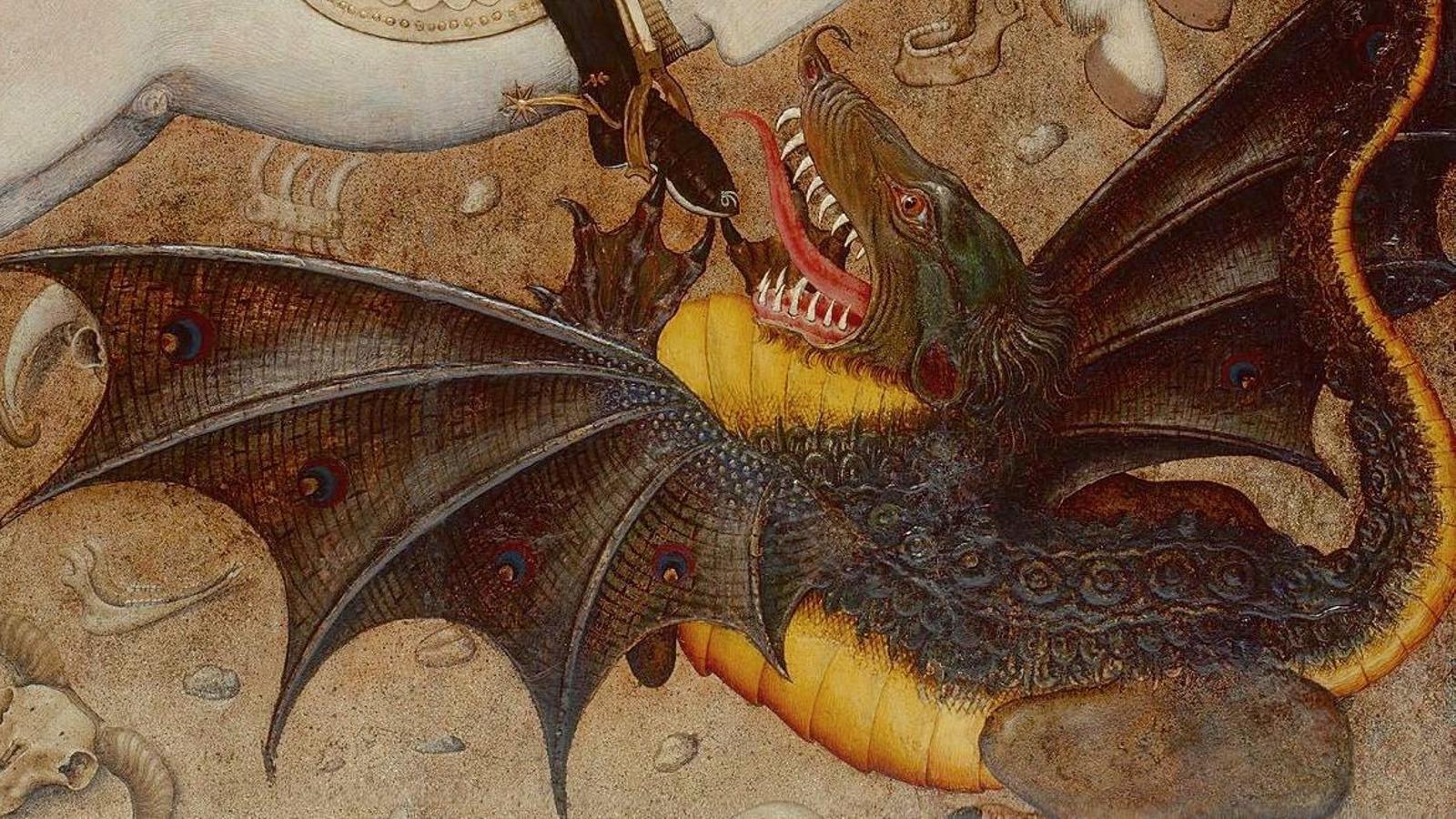
'Saint George Slaying the Dragon', by Bernat Martorell
From the altarpiece of the chapel of Sant Jordi of the Palau de la Generalitat (1434-1435). Preserved at the Art Institute of Chicago
The most spectacular dragon of Catalan Gothic art is found in the United States; you only have to see the fear with which Saint George's horse looks at it. "Martorell wanted to create a beast that inspired fear, without the scene losing its overall elegant and sophisticated tone, and without ceasing to suggest that the saint was more powerful than the monster," states Guadaira Macías, professor of art history at the UB and former curator of the MNAC. Therefore, Martorell painted the dragon "crouched, with its bat wings spread and its mouth wide open, responding to the saint's attack, showing its fangs and that undulating tongue," explains Macías. Another detail that makes the dragon more terrifying is that the head and body were worked in plaster relief to give it more "material power". Saint George killing the dragon holds curious anecdotes, such as the one experienced by Inés Tell of Pallejà, who was in contact with the museum during the twenty years she lived in Chicago. The technicians restoring the painting asked her if she could identify the language in which some small fragments of newspaper found under the dragon's wings were written, which was none other than Catalan.

Keystone of the cloister fountain of the Barcelona Cathedral
From Antoni Claperós (1448-1449)
A dragon with a very long mane is mortally wounded by the lance of Saint George. All the details of the saint and the beast are adapted to the round profile of the frame, which gives great dynamism to the composition. It is one of the most extraordinary sculptures in the entire complex of the Barcelona Cathedral. The fact that the sculpture is in the cloister, which is a space for meditation, has a pedagogical character for the members of the chapter.


Embroidered altarpiece frontal from the chapel of Sant Jordi of the Palau de la Generalitat
By Antoni Sadurní from a design by Bernat Martorell (1450-1451). Preserved in the chapel of Sant Jordi of the Palau de la Generalitat
It is considered the best piece of Catalan embroidery of the 15th century and one of the best in the European sphere. The dragon has lost the wings that can be seen in the altarpiece by Bernat Martorell, but it keeps its mouth open and its tongue waving. Also the relief, since the embroidery is filled with cotton and tow. Likewise, it is a very delicate work: the gold of the base is nuanced with stitches of yellow and green silk. The scales are made with a cord stitch and the crest is of blue, green, and gold silk. And the teeth are of silver, and the eyes and tongue of red silk.

'Altarpiece of the Virgin of the Pairs'
From Jaume Ferrer (1451-1454). Preserved in the Palau de la Paeria of Lleida
The dynamism in compositions is one of the characteristics of the International Gothic: the dragon of Saint George in this altarpiece (on the right; the one on the left is Saint Michael) is winged, and writhes from "the wound of the spear that has struck him in the neck", as art historian Isidro Puig explains. The dragon breaks the spear with one claw and with the other grabs one of the horse's legs. But, at the same time, Saint George brandishes the sword, raises it, and prepares to attack it again. The horse's attitude, rearing on its hind legs, adds dynamism and drama to the scene.

'Saint George Slaying the Dragon', central panel of the 'Altarpiece of Saint George'
By Pere Niçard (1468-1470). Preserved in the Museu Diocesà de Mallorca
The Altarpiece of Saint George by Pere Niçard is considered one of the great works of Catalan Gothic painting and one of the emblematic pieces in the entire history of Majorcan art. The dragon is very curious: its rounded shapes are more reminiscent of a dinosaur than a dragon, giving it an endearing air. And the brown color of its skin makes one think of how dragons represented telluric forces that had to be fought and subjugated. "Medieval painters do not usually paint from nature, but rather use models, although this does not mean they do not incorporate other elements they may see," says the curator of Gothic art at the MNAC, Cèsar Favà. "In the Gothic period, the dragon is highly typified, and there are precedents, including festive manifestations such as royal entries and the Corpus Christi festival," adds Favà. On the other hand, the most distinctive feature of this painting is that it includes one of the earliest representations of Palma.
