Noelia Acosta: "Between now and next year, the companies required to be audited will decrease"
Second Vice President of the Association of Chartered Certified Accountants (auditors)

-
CAT -
CAST
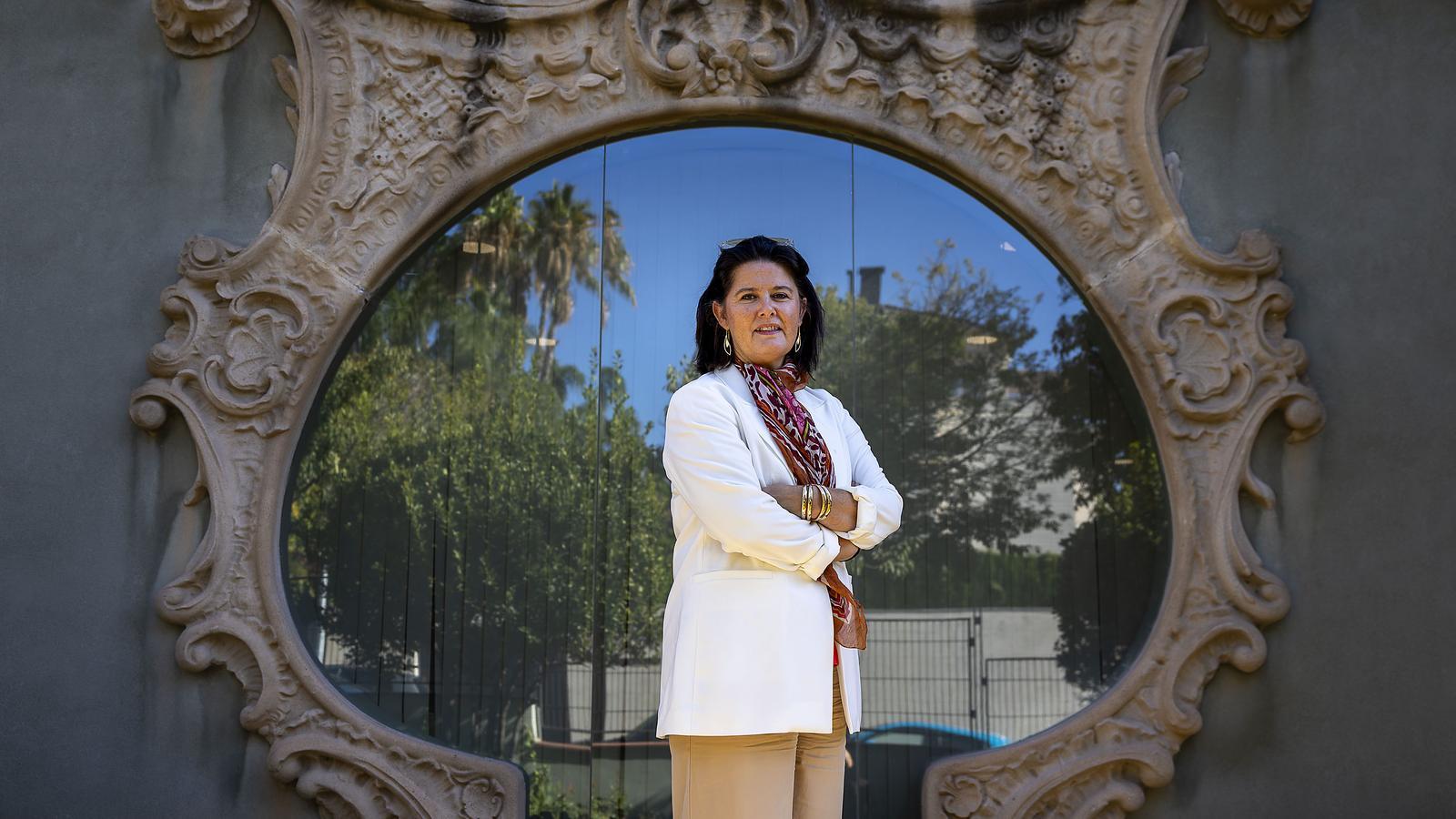
BarcelonaNoelia Acosta is the second vice president of the Association of Chartered Accountants (auditors) and a partner at Baker Tilly. Acosta, 49, asserts that her profession, to which she has been dedicated for 25 years, is subject to many regulatory changes that often arise in the wake of financial scandals. An expert in measuring the sustainability of companies and entities, she receives Companiesat the collegiate headquarters, the Torre Moré, a modernist mansion in the Barcelona neighborhood of Pedralbes, remodeled by the architect Òscar Tusquets, whom this organization, with some 2,000 members, will pay tribute to next Wednesday. Precisely on that day, they will celebrate the 30th anniversary of the creation of the association and its headquarters with challenges such as artificial intelligence (AI) and improving the balance between men and women. In the group as a whole, there is still a significant gap: 80% men and 20% women among the members. Among practitioners, the difference is reduced among those at the base: 65% men and 35% women. On the other hand, regarding executive partners, the presence of women is below 30%.
A curiosity: have you ever considered changing the name of the association and the profession?
— We cannot. It is such a regulated profession that we cannot change it. It is a profession of public interest and, therefore, the regulation is one of our drivers.
Thanks to your contact with the business world you can draw conclusions, I suppose. What is the situation of the economy and businesses?
— Our information is more qualitative than quantitative or statistical. But we have our perception of the situation.
Well, qualitatively, how do you see the Catalan company?
— Auditing Catalan companies is a job that we, mid-sized firms, essentially do. And we can say that it is a financially solid company at present. One of its characteristics is that it is assertive in the face of change, resilient. A company that stays ahead, that works hard on risks –and how to mitigate them– and strategic plans.
Given the context of uncertainty, have the timeframes for companies' strategic plans been shortened?
— Before, they used to be three to five years long, and now they have been shortened. Now they are three years long, and they are modified in each fiscal year. There is a strategy. And the tactic is carried out annually, taking into account the impact on supply chains, the price of diesel, the fear of tariffs, geopolitical instability... It is evident that this can affect businesses, which need stability. The Catalan company exports a lot, and this is a point it works on, and it tries to expand its network of clients around the world to mitigate the dependencies it may have.
During the 25 years of experience you have accumulated, I suppose your work has changed a lot...
— The regulation has been changing. Since it is a profession of public interest, we are even told what is audited and how we must audit it. There have been many regulatory changes and we have moved from a more national model to a European one, and from a model of national technical standards to international ones. And we have adapted to it. We have been moving closer to Europe. In addition to the regulation for companies, there have been our own, which are the international and national ones marked by the audit law and the regulation on independence and the incompatibility of services. It is true that this regulation has been modified due to different scandals. Each financial scandal also caused a change in the rule and more requirements regarding independence, incompatibility, or team rotation.
Do you also have difficulties attracting talent? Are there few vocations?
— The vocation for auditing is not like, for example, medicine. Those who have a vocation may have had it since high school. There are those who want to be mechanics from a very young age, or lawyers, because they watch TV shows. In the case of auditors, we find that there is no vocation because there is a great lack of knowledge about the profession. In fact, one of the paradoxes occurs later because there is no initial vocation, but once they enter the sector, there is. It is a profession that leaves a mark. Due to this lack of knowledge, it is believed to be a boring profession, associated with accounting, and very hard, and to which many hours are dedicated. And we must change this because it is not true; it is a wonderful profession to enter the business world. Having worked in auditing has many outlets and in the business world there is a very solid recognition of the auditor's profile. It is highly valued. From the professional association, we are very aware that we must work on the communication of our profession. It may seem more attractive to be a consultant and, yet, it is a very similar profession, because one works with many sectors and many clients. It is very dynamic and attractive.
And where do they go fishing? At business schools? At economics faculties?
— We are not only looking for profiles in business administration or economics but also those with knowledge in sustainability, computer science, and engineering. Since we are aware that the profession is not well-known, we are working on how to communicate it and also how to do so through different channels. We are getting very close to the universities. We have created a talent commission, and it is not only composed of auditors, but there are also people managers from multinational firms and university professors. And we are not trying to approach only the students, but also the professors to see if we can influence the subjects they teach. And to the girls, we want them to see that it is a profession in which women can have a great career. It is a profession with a lot of trajectory and future.
Are there companies or businesses that are not required to be audited and should be?
— I would first tell you that there are companies that are not required to do so and that are audited voluntarily. There are very many, because we provide them with added value and they appreciate it. And returning to your question: surely yes. And they should do it, because auditing provides transparency and guarantee to the markets. But it is a highly regulated profession and we are told what we must audit mandatorily, how we must do it, and we are supervised. Right now, the threshold to be audited has increased by 25%, starting from 3,562,500 in assets and 7,125,000 in turnover. Therefore, by next year, the companies that are theoretically obligated will decrease.
Doesn't having fewer companies audited on a mandatory basis reduce transparency?
— We must follow what is dictated from Europe, where they consider that there are administrative burdens on companies that must be reduced to improve competitiveness. They believe that European companies have a high administrative burden and include auditing firms in this, something we do not see that way. In any case, we have conducted studies and the impact of the reduction of companies required to be audited is being compensated because the trend of audit reports means that our business grows every year above the CPI. This means that we provide more services, but not only auditing. Therefore, it is a much broader business. Auditing is a multidisciplinary profession. In addition to audits, an auditor also prepares sustainability reports or is involved in tenders. In any case, the investor values audit reports because they provide the company's accounts with a seal of guarantee, and this leads companies that are not required to do so to have them, because, for example, the bank will ask them for it.
And how are the auditor's independence and responsibility guaranteed?
— We have many responsibilities linked to the guarantee that we must provide and they are diverse: civil, contractual liability, for damages that may be caused to a third party and, even, criminal, provided there is malpractice and a very large and fraudulent distortion of financial statements. And also regarding data processing. In any case, an audit job is not a total guarantee that there will be no fraud, that there will be no errors, and that the image is faithful. The auditor cannot provide this total guarantee. We provide a reasonable guarantee in accordance with procedures we have carried out, on some samples, and we do provide a guarantee, but it is reasonable, not total. Zero risk does not exist.

Now there is also non-financial auditing, but there are no widely generalized measurement and control variables, right?
— Sustainability is a challenge for auditors, along with AI. Sustainability is experiencing a moment of regulatory uncertainty. Since we began working on sustainability at a national level, we aimed for maximums, with a great deal of information verified by an independent expert. We have always fought for this independent expert to be the auditor, which is one of the perfect profiles. Regarding this administrative burden, the European directive has been modified and has reduced part of the information we had to provide. Now, we are in the midst of regulatory changes and standards have been created that have been reduced. We were providing maximum information. There was no standard rule and the European Union, with very good judgment, said that the homogenization of information was needed so that it could be comparable. These European standards were introduced to work on the homogenization of data. An omnibus directive has been created that has greatly reduced the information that must be provided and we are waiting for its transposition at the national level. Catalan companies, currently, are in a situation where they must continue to comply with the old directive and wait for the transposition of the new directive. Since the thresholds will decrease, many companies will not be obliged to provide this information. Therefore, we are in a moment of regulatory uncertainty, but companies continue to provide information as we did four or five years ago.

The other great challenge is artificial intelligence. In what way is it being applied?
— It is a time to be cautious. AI is impacting and will impact. How is it doing so? Well, in a very dispersed and very different way depending on the audit work. In the sector, four firms concentrate 70% of the turnover and 30% of the reports. There are very different levels of resources and different growth in each segment. There are the Big Four, the medium-sized companies, or the smaller ones. Surely the Big Four have adapted it much more than the rest, because they have more resources. But it is true that according to the barometer we conducted in April and which was published in our forum in the month of July, approximately 30% stated that they were already working with AI. I am absolutely sure that if we were to conduct this barometer now, the percentage would increase exponentially.
But, what about the impact on the audit?
— We must also see how it impacts our firms and our clients. There is an annual KPMG study of the most important CEOs in Spain, those of the Ibex, in which they state that the highest investment they make is in AI. If in the companies where we go they are already applying AI, we must see where they are applying it: in accounting, in statistical models, in budgets, making future predictions about cash flow statements that may affect us in asset impairment... If that is the case, how did they do it? What methodology or what source of information did they use? And we cannot stop this.
And in his case?
— I have already mentioned that our profession is highly regulated and we must be very careful about how we use it, especially regarding the data protection of our clients. We are waiting for the AI regulation to be applied, to be developed, and for the agencies that need to be created at the state level to provide instructions and parameters on the use of AI to be established. And, on the other hand, as always happens, if the regulation is delayed, we, as in other activities, adapt. And how do we do it? We have quality systems and governance codes and we introduce how some aspects of AI should be worked on, but, of course, each firm does so within its own quality and governance framework.
Can more tasks be automated?
— There is a very important point: that of the samples. We can expand them and, therefore, we can make prediction models or models on how to find irregular operations. We have more possibilities of finding them if we expand the samples. This is very important, because if we take water from a river and put it in a bucket, we have a representative sample, but if we take the entire flow of the river, we will greatly expand this sample.
But better at repetitive and quantitative tasks than at the qualitative side of the work, right?
— It will have an impact on the ways of doing things, but it cannot have, and we are sure it will not have, an impact on the result and professional judgment. We have a tendency to trust technology, but we must be cautious, prudent, which is something that characterizes us a lot, as auditors. Professional judgment will be very important to see the results we obtain from AI. It is time to bring out what characterizes our profession. A topic that worries us is how AI can impact juniors. We have many learning models, but there is one that characterizes us, which is the repetition model. We learn by repeating tasks. How do we learn to write? By repeating, right? Repetition helps a lot to improve confidence, to see things that you did not see. If they do not do these tasks, this repetition, we must change the model, and the learning model will change. How should we do it? By improving supervision, training, and accompaniment. Helping more to create this judgment.
And is it reducing jobs?
— Currently, no. Perhaps we will carry out a transformation of the jobs. If there are tasks that will be done automatically, the staff will be able to do more qualitative ones and fewer quantitative ones.
Does your job consist of detecting fraud?
— No. The auditor's job is not to detect fraud. We must be aware that it can exist in any company. Fraud comes through the financial channel. And, in the world of auditing, it has a huge impact. I believe, even, in a disproportionate way. There are other sectors in which bad things can happen and they do not impact the entire profession. In this case, it has consequences for the whole sector, because there are regulatory changes. It is also true that we are a profession of public interest and the reputational risk of fraud is very high. That is why it is very important that we work on communicating that the auditor is not an absolute guarantee that there is no fraud, but it is a reasonable guarantee.
In a market dominated by four large audit firms, what role do the medium and small ones play? Is there great price competition?
— Yes, there is strong price competition. Price is a very important variable, but the same as in other sectors. We cannot ignore that larger companies have more resources and there are also companies, for example those on the Ibex, that need entities with these resources. Medium and small firms have the role of balancing. The stratification is consistent with our business fabric. Apart from the Ibex, we have, especially in Catalonia, a very dispersed business fabric, with many SMEs, with many companies that invoice more than 5 million and whose profile of provider, accompaniment, and advisor is not that of these Big Four.
