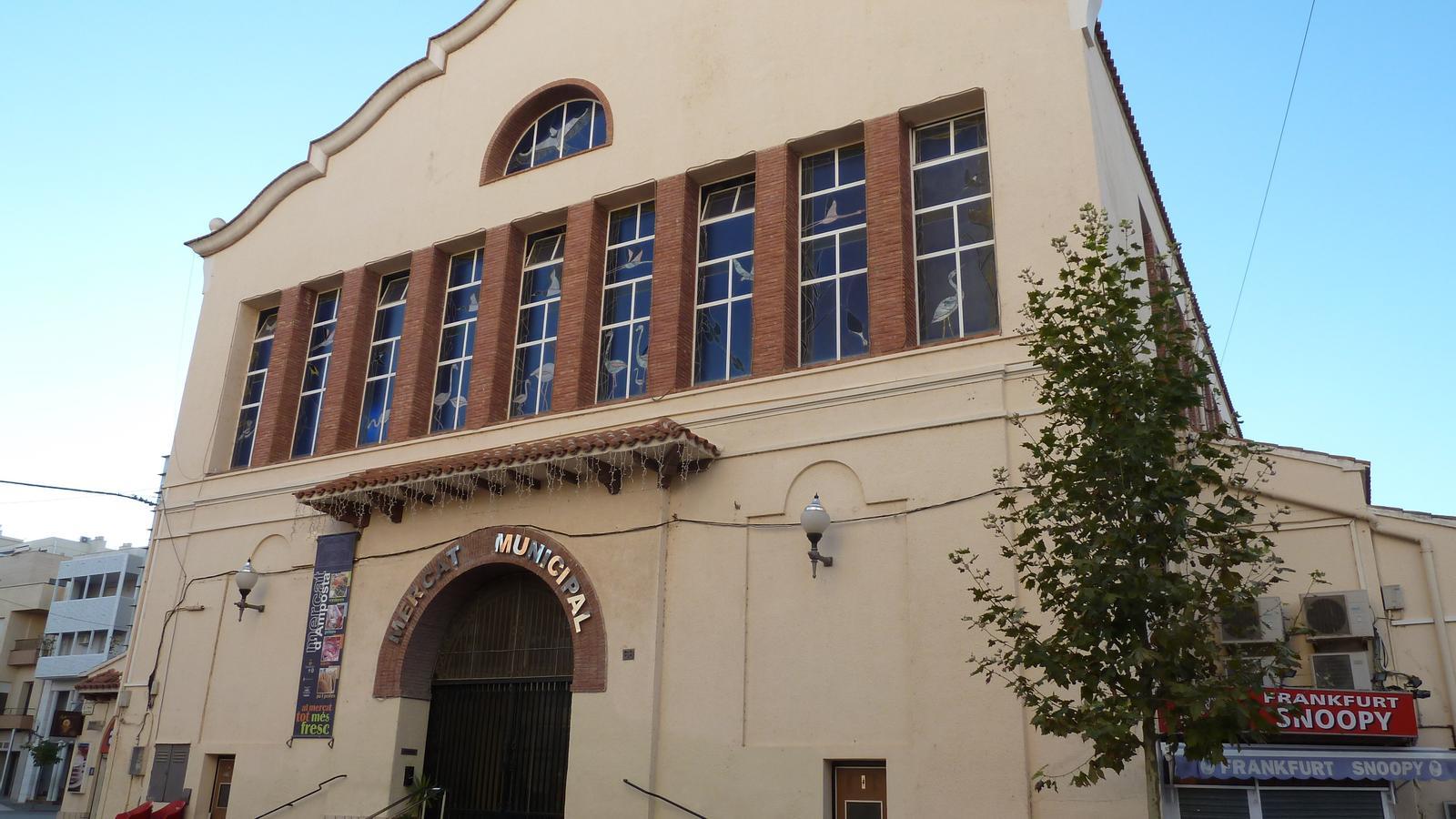
The stained glass windows of the market

-
CAT -
CAST
There are spaces that tell the past of a community better than any history book. In Amposta, this story inevitably goes through its market. Not only as a commercial facility, but as the setting where, for decades, the daily life of the city has unfolded – and still unfolds today.
Before the current building, the market was open air and movement. The Plaça Major became a hive of people, carts, and carriages arriving from all over the Terres de l’Ebre every week. It was a lively, noisy, and essential space, where buying and selling mixed with chatting and community building. Some sources place this market as early as the 19th century, first on Sundays and, over time, fixed on Tuesdays. That open-air market would, in a way, be the father of what we know today.
The need to organize this hustle and bustle and adapt it to new times led, in the midst of the post-war period, to the planning of a stable facility. In 1941, the City Council agreed to acquire the land known as “La Fàbrica”, a central space where there had previously been rice dryers and a soap factory, owned by the Marquise of Villamediana. The project was approved that same year and obtained sanitary approval in 1942. However, the inauguration would not take place until January 31, 1947.
The building, the work of architect Francesc Barba Corsini – with an initial project attributed to Francesc Ubach Trullàs –, responds to the desire to provide Amposta with a modern, functional, and centralized market. With more than 1,500 square meters, it is organized around a large nave with a gabled roof and a framework of beams that still marks the rhythm of the space today. Light enters generously through the large windows, while the side arcades, resolved with arches, establish a natural transition between interior and exterior.
For years, these arcades were also the market: they hosted itinerant vendors on weekly market days. It would not be until 1971 that they would be consolidated as permanent commercial spaces, allocated to different establishments. Inside, the arrangement of the stalls and the access with lobbies and an upper gallery reinforce this combination of functionality and a certain representative intent.
One of the most unique elements of the complex are the stained glass windows by British artist Bronson Shaw, based in Tortosa. Through them, light not only illuminates: it also tells. It features the fauna, the flora and, above all, the cultivation of rice, in a visual synthesis of the landscape and economy of the Ebre Delta that connects the building with the territory that feeds it.
The environment of the market also transformed over time. Between 1965 and 1966, the adjacent plots were urbanized with new paving and the construction of an elevated square, crowned by a circular fountain. Thus was born Ramon Berenguer IV square, popularly known as the market square, which would become a new meeting point and social hub for the people of Amposta.
Today, in a context of changing consumer habits, the Amposta Market continues to endure with a value that goes beyond the product: proximity, trust, and direct interaction. Included in the Inventory of Architectural Heritage of Catalonia, it is not only a building that tells of the past, but a space that still beats in the present. Because here, history is not only remembered: it is lived, every day.
