The millenary struggle of the Yanomami: "Protecting the Amazon means protecting life"
The Yanomami indigenous people still fight against illegal mining and invasive diseases, after the devastating years of Bolsonaro
-
CAT -
CAST
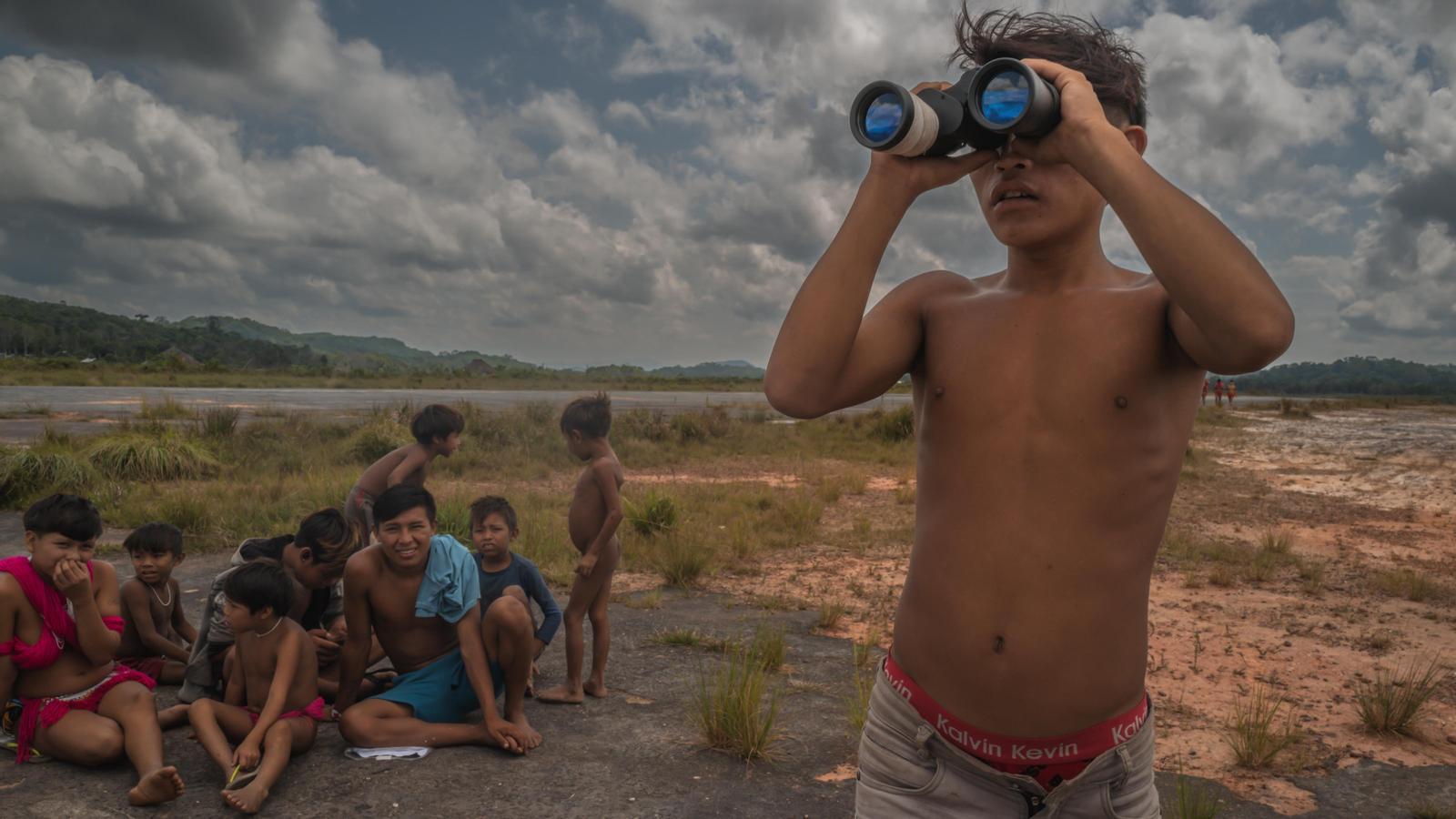
Roraima, Brazil. Yanomami Indigenous TerritoryThe heat falls on the village from the early hours of the morning. Isolated in the heart of the tropical rainforest, this Amazonian settlement follows the rhythms imposed by the river and the land. Along the Uraricoera, a tributary of the Negro River, some children play and cool off in the water. A little further on, several young people return from the bank with a canoe loaded with bundles of cassava: the tuber that sustains Yanomami life. The harvest passes from hand to hand until it reaches the homes, where the mothers wash, grate, and transform it into flour, repeating gestures passed down from generation to generation, as old as the river itself.
The quiet is broken by the roar of a river launch. On board travel two health workers dedicated to the prevention of endemic diseases, particularly malaria. With fumigation backpacks, they begin to spray houses and interior spaces with antimalarial insecticides, following the instructions of the chief of Palimiu, Fernando Palimitheli, leader of the community.

“We have gone through terrible periods”, confesses Fernando, lowering his gaze, which suddenly darkens. “The water became contaminated with mercury, our children were dying of diseases. It was a catastrophe”. His words flow slowly and heavily in his mother tongue. In recent years, illegal gold miners – the garimpeiros– have invaded the Yanomami territory and have opened wounds in the land and rivers. With them also came diseases: malaria, dysentery, and respiratory infections, which spread rapidly in communities without stable access to medical care.
The Yanomami – some 31,000 people in Brazil and several thousand in Venezuela – have inhabited the Amazonian highlands for millennia. They often live in large communal houses, the xaponos, circular structures that house several families. They practice shamanic rituals and conceive of the forest, Urihi, as a living organism, endowed with will and spirit. In their cosmology, there is no clear separation between environment and society: the forest is not a resource, but a relationship. Destroying it means putting the balance of the world at risk.
“They say the Yanomami were starving, but it’s not true –states Dario Kopenawa, president of the Hutukara association–. We have survived for centuries. Our children died from the diseases brought by invaders and from the lack of medical care.” We are in his office in Boa Vista: he is exhausted, weakened by malaria for the eleventh time. And yet, he continues. He is on the front lines denouncing the invasions of the garimpeiros and demands that the Yanomami territory finally be freed.
His father, Davi Kopenawa, is one of the most influential indigenous shamans and thinkers in the Amazon. In the book The Falling Sky he put the Yanomami cosmology into writing as a key to interpreting the present. An ancient prophecy warns that if the jungle is destroyed and the shamans disappear, the sky will end up collapsing. “We shamans work to support the sky –says Davi–. But for how much longer?”
The Yanomami indigenous territory covers approximately 96,000 square kilometers between Roraima and Amazonas: an immensity of jungle that for the Yanomami is a living organism and for the planet represents one of the largest protected areas and one of the most valuable reservoirs of biodiversity.

Here, the Amazon hosts a fundamental part of the world's animal and plant species and plays a crucial role in regulating the global climate. In this space, more than 240 indigenous languages are spoken, and more than 300 Yanomami communities live there, united by six main languages and by the silent presence of isolated groups – the so-called “uncontacted” – who deliberately choose to remain on the fringes of the outside world. Their survival depends on the continuity of the forest and the absence of external interference: if the forest falls, the balance that, according to their myths, holds up the sky cracks.
Not all white people have represented a threat to these peoples. Carlo Zacquini, a Consolata missionary who arrived in 1963, eventually became a benchmark for many communities. “I was with them for six months before I understood that they were called Yanomami,” he recalls.

ren the years in which the North American anthropologist Napoleon Chagnon defined them as “the fierce people”. Furthermore, he described them as intrinsically violent and accused Davi Kopenawa of being “a parrot of NGOs”. “A narrative imbued with profound ignorance,” replies Zacquini. “They possess refined knowledge of their environment and a complex social structure, built over millennia”.
"Corpses on the jungle paths"
In 1973 the road arrived. It was the beginning of a radical transformation. “The consequences were devastating –Zacquini recalls–. “I saw corpses along the jungle paths, people who all died in the same period, and they didn’t even have the strength to celebrate funeral rituals”. Epidemics introduced from outside struck communities without immunological defenses. “It was a tragedy of immense proportions, perhaps even more serious than the plague described by Manzoni”, he says.
The Yanomami territory was officially demarcated in 1992, after decades of international pressure and indigenous mobilizations. But the demarcation never guaranteed real protection. Invasions have not stopped, fueled by economic interests, local complicities, and the state's historic inability to enforce the law in these remote areas.
The humanitarian catastrophe has deeply torn the Yanomami people. “Their shamans found themselves disarmed in the face of unknown diseases,” recounts Zacquini, who over the years ended up being a nurse, doctor, and dentist and contracted malaria 31 times. “I saw shamans lose faith. They felt powerless. Some extraordinary shamans stopped believing in the xapiri, the spirits they trusted”.
“We have become sad and have known the rage of mourning too many times – writes Davi Kopenawa–. Sometimes we even fear that the white people want to put an end to our existence. There was a time when we were numerous and our houses were large. Then many of our people died when these strangers arrived with the fumes of epidemics and firearms. However, despite everything, after crying and handing over the ashes of our dead to oblivion, we can still live happily”.

The mining invasion legitimized by Bolsonaro
The mining invasions intensified in the eighties and again at the beginning of the two thousands. But it was with the arrival of Jair Bolsonaro to the presidency, in 2019, when the situation escalated. Bolsonaro openly declared that he would not demarcate a single centimeter of indigenous land. The garimpeiros felt legitimized: they occupied airstrips, used planes and satellite systems, and prevented doctors from accessing. They were armed. By the end of his term, more than 5,000 hectares of jungle had been devastated. “They wanted to exterminate us”, stammers Fernando Palimitheli, chief of Palimiu.
The humanitarian crisis exploded before the eyes of the world. The images of malnourished Yanomami children, with swollen bellies and bulging eyes, went viral in the international media. In Brazil, a different debate about indigenous peoples finally began, also thanks to growing activism amplified by social networks. With the return of Luiz Inácio Lula da Silva to the presidency, in January 2023, the situation was bluntly described as “genocide”. The Ministry of Indigenous Peoples and a new indigenous directorate at FUNAI (National Foundation of the Indian) were created.
With Operation Yanomami, the state launched one of the most complex actions: the fight against illegal gold extraction. In two years, more than 8,000 operations were carried out, and according to official data, illegal mining activity was reduced by 97%. “The government uses the armed forces to prevent corruption among local agents”, explains an army soldier, originally from Florianópolis and stationed in Boa Vista. “Our mission is to destroy all the invaders' infrastructure”, he states shortly before descending by helicopter over a marked area in the jungle.
A few minutes later, shots are heard. The soldiers have located the criminals, who immediately flee, while the military fires warning shots. A short distance away, we reach the camp: tents with mosquito nets, a refrigerator, a gas stove, and a makeshift wooden structure are burning, along with the boat used to travel along the river. Cassiterite was extracted from the riverbed, a mineral used in the production of tin and rare earths, the exploitation of which causes deforestation, environmental pollution, and the spread of malaria.
Despite the importance of these operations, the reality on the ground remains fragile. “Malaria is not under control and not all gold prospectors have been expelled,” observes Zacquini. The miners retreat and then reappear deeper in the jungle, supported by criminal networks and record-high gold prices. In the villages bordering indigenous areas, silence usually reigns: everyone knows, few speak.
“The garimpo is no longer an improvised activity –concludes Dario Kopenawa–. It is a criminal structure. The problem is global, it also affects Europe”. For the Yanomami, this battle is not just political or environmental, but also spiritual. According to myths, the creator Omama entrusted them with the task of guarding the balance of the world. Gold extraction awakens the xawara, the spirits of disease and chaos.
Today the progress is real, but fragile. The question, for the Yanomami, is not whether the forest will be invaded again, but when. And if next time there will still be something left to defend. “Protecting the Amazon means protecting life –affirms Dario Kopenawa–. We, the indigenous peoples, are the ones who must care for it. No indigenous person can represent us. No government can speak in our name”.
