The rules that will change football forever in this World Cup
The VAR expands functions, and to avoid time losses teams can be left with one less man for minutes

-
CAT -
CAST
BarcelonaIn 1994, the United States hosted a World Cup for the first time. One of the novelties of that event was the introduction of a new rule that changed the game: it became forbidden to pass the ball to the goalkeeper and for him to catch it with his hand, as had been the case until then, which led to significant time-wasting. This year's event will also be remembered for the introduction of new rules that will significantly modify the game, always with the intention of avoiding time-wasting, according to IFAB (International Football Association Board), the body that determines the rules of the game.
A World Cup with technology at the service of the game to try to avoid serious errors, such as those balls that people still debate today about whether they crossed the line or not, as with the third English goal in the 1966 final. This summer, the ball includes a sensor that transmits information to determine if it crosses the line or not, and semi-automatic offside and modern technology will also be used to assist VAR. But what will be the new rules that will be applied from now on in football?
Reducing time-wasting
–In each throw-in or goal kick, the referee will indicate to the player responsible for taking it that they are starting a five-second count. If a team with a throw-in takes too long to take it, it will be a throw-in for the opponent. If the goalkeeper takes more than five seconds to serve, they will be punished with a corner kick against them. The five seconds begin to be counted once the referee indicates. That is, if at the time of the throw-in the players are far away, they will not start the five seconds. They will do so when they understand that there is a risk of deliberate time-wasting.
–This rule was created especially after the controversy generated –When a player requests to be attended to because he has suffered a physical problem that causes a stoppage in play or requires medical attention, he will then have to remain off the field for one minute. This measure has been implemented to try to prevent players from faking physical problems to waste time.
Mouth covered
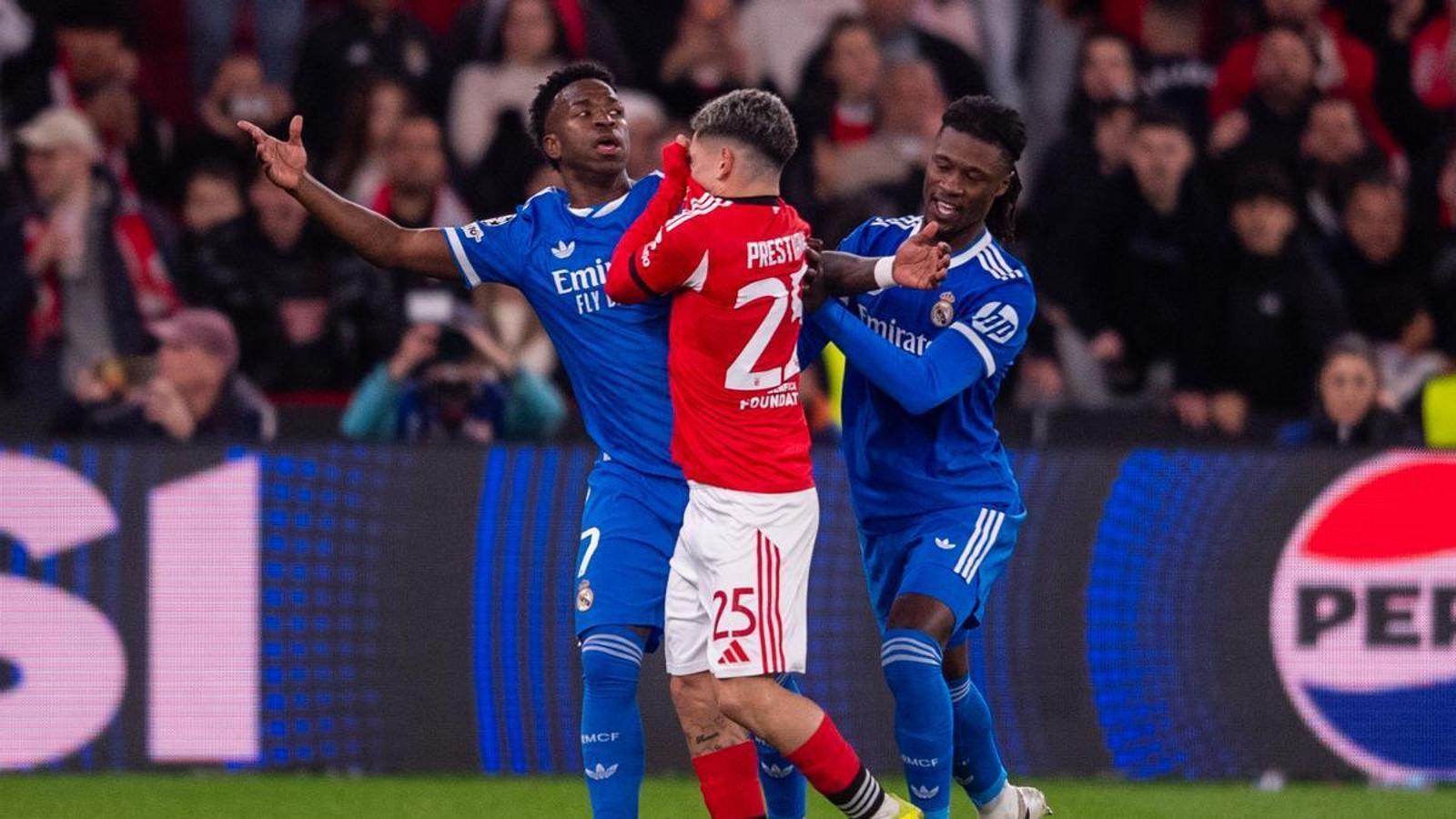
–This rule was created especially after the controversy generated by the alleged racist insult by the Argentine Gianluca Prestianni against Vinícius Júnior during a Benfica-Madrid match. The Brazilian reported a racist insult from Prestianni, but the latter had his hand in front of his mouth the whole time and it could not be proven. In order to avoid this, the referee will be able to warn or expel players who cover their mouths when arguing with opponents. It is left to the referee's discretion to interpret the actions. That is, if the feeling is that two rivals are talking in a friendly manner while covering their mouths, they should not be warned.
Forbidden to leave the field of play
–If a player leaves the field of play as a sign of protest against the referee, they may be sent off. Members of the bench who ask players to leave the field of play to protest against refereeing decisions can also be sent off. This rule was proposed after the final of the Africa Cup of Nations between Morocco and Senegal, when, outraged by the refereeing decisions, the Senegalese left the field of play as a form of protest. If the entire team leaves, they would automatically lose the match.
The VAR expands its functions
–Until now, VAR was used only in very specific cases related to goals, red cards, or mistaken player identifications. Now VAR is expanding its functions. In fact, if the VAR room quickly and clearly sees a refereeing error, they can rectify it instantly by notifying them. All new VAR developments will be analyzed once the World Cup ends to assess whether they need to be improved and maintained, or discontinued.
–VAR will now also be involved in cases of a second yellow card that results in an expulsion. Until now, if a player was sent off for accumulating two yellow cards, VAR would not intervene even if the referee had interpreted it incorrectly.
–VAR will also be able to intervene in corner kicks and free kicks. That is, if a corner kick is awarded and in the VAR they quickly observe, without delaying the game, that it should have been a goal kick, they can indicate it. With free kicks or throw-ins, it's more or less the same. As long as it doesn't delay the game. That is, it must be evident enough to be seen in a few seconds.
Ban "time-outs"
–Many teams took advantage of injuries, especially the goalkeeper's, to go to the bench area and receive instructions from their coach, as if it were a basketball "timeout". Many coaches complain, as opponents increasingly ask their goalkeepers to feign an injury to stop the game and give instructions. For now, it has not been decided what to do in these cases, but the referee is given the power to prohibit players from going to the bench. Now, in theory, they should not be cautioned, only warned. But at this point, IFAB has asked all federations and leagues to submit proposals on how to deal with it.

