Half a century of a cup so dreamed of, which was stolen
50 years ago, BM Granollers was the first state club to win an international title, the Cup Winners' Cup

-
CAT -
CAST
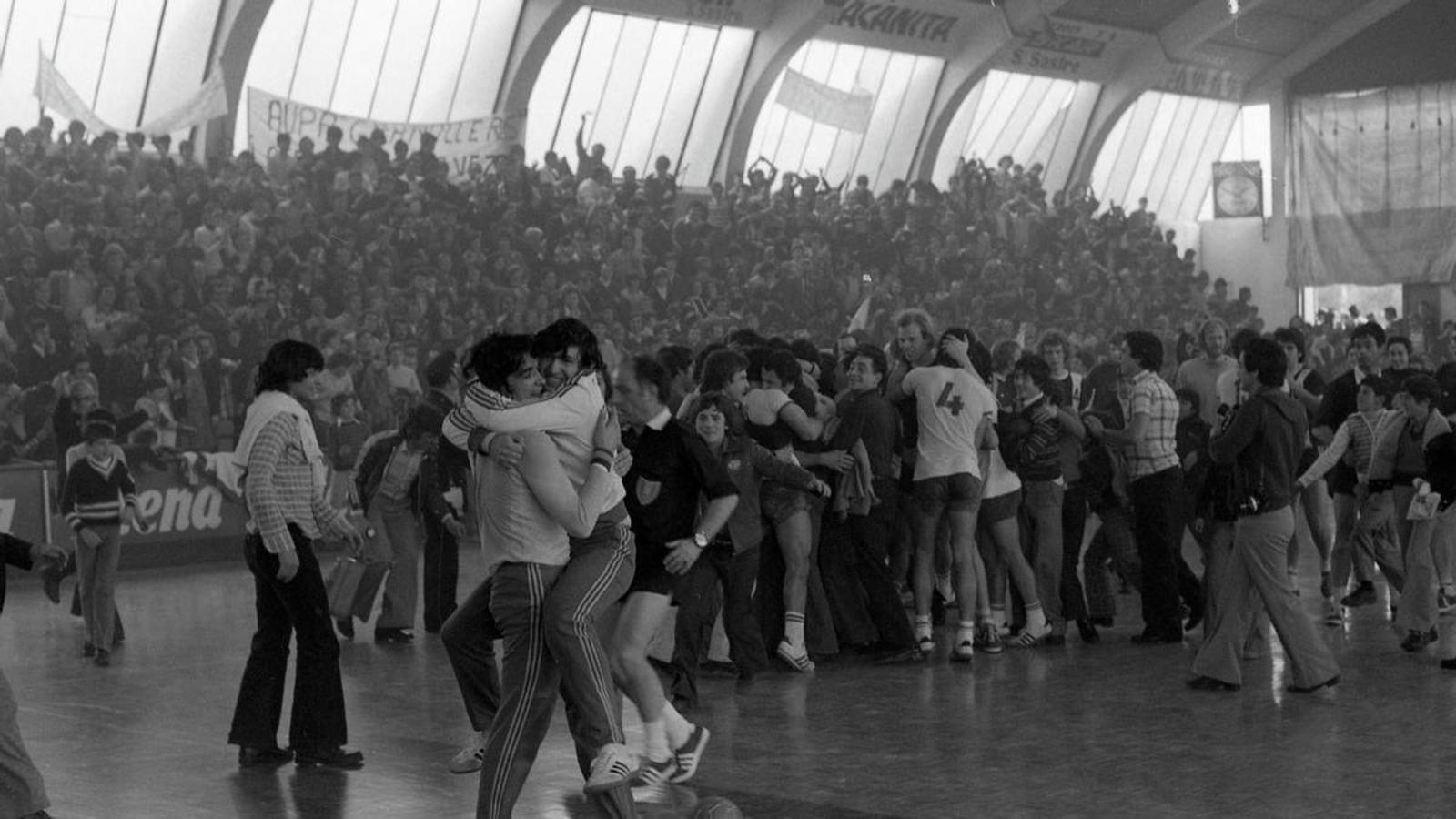
Granollers"I thought I would fall crying and I would fall. I was afraid of falling and seeing the Cup on the ground," recalls Miquel Prat, historic captain of BM Granollers. 50 years ago, the club from Valles became the first Catalan club and the first in the entire state to win a continental title, the Recopa, by defeating German Dankersen in extra time in the final by 26 to 24 in the old municipal sports hall, the popular Parquet. A historic milestone achieved by a bunch of home-grown players who weren't even professionals. A golden generation, an era of tight jerseys, long beards, and dreams of freedom, with senyeras in the stands and a city devoted to a team that paved the way.
These days, Granollers remembers that historic milestone, achieved on April 10. The City Council, the club, and the Fundació BM Granollers have organized a series of events to commemorate the triumph, such as an exhibition at the Municipal Archive with images that are now part of the history of Catalan sport, such as the one in which Prat, watched by club president Francesc Ventura, lifts the Cup. The fans who had invaded the parquet lifted him off the ground "even though I weighed about 100 kg," recalls Puig, a true Granollers native, born in the Plaça de l'Oli. At that time, German teams seemed unbeatable, but Granollers managed to win the title in one of those games that lasts for years. Everyone who was in the hall, packed to the rafters with more spectators than officially allowed, remembers the final minutes of the match, when in the last second goalkeeper Pagoaga prevented Dankersen's winning goal. Trying to score the winning goal, Granollers lost the ball and the Germans had one last attack. The Basque goalkeeper, however, prevented disaster and in extra time came ecstasy.

A time still remembered with black and white photographs, like those taken by Joan Mas García, who followed the team for the local press, images that belong to the Revista del Vallès archive; but also others taken by spectators whose authorship is not remembered. As if the author of those images were the entire town of Granollers, which also played its final, as El Parquet was a pavilion that could scare rivals "when everyone banged against the railings, making a lot of noise," recalls Prat. A pavilion where handball is still played and where this Saturday a gala dinner was held with the protagonists of that feat. On the same court where they sweated profusely to lift the title. Yesterday, a round table was also held, moderated by journalist Eloi Vila, with players from different eras of the club. Today, the institutional reception of the champion team was held at the City Hall and a tribute before the match against Recoletas Atlético Valladolid. All coinciding with the women's match on Saturday, and the men's on Sunday, because if anything has changed in this half-century, it has been the impact of women's handball in the city.
Founded in 1944, Granollers quickly became a benchmark for a sport, handball, which was very different back then. For decades, it was played with 11 players, like football, on outdoor courts. For example, the opponent in the 1976 final, Dankersen, had been three-time European outdoor handball champions with 11 players. It wasn't until the 1960s that a move towards handball with six field players and a goalkeeper began, until this format was adopted in the 1972 Olympic Games. Granollers had been among the pioneers in adopting the new format in Spain, and in the 1970s, it competed with Club Balonmano Calpisa from Alicante and Atlético de Madrid to dominate the league, won thirteen times by the Granollers team, for the last time in 1974. "You had your job, so you couldn't be a professional," admits Prat, the player with the most titles in the club's history.
In 1975, Calpisa achieved a double: League and Cup, defeating Granollers in the Martorell final. It was the year the Recopa was born, a continental tournament between the Cup winners of each League. And as runner-up, Granollers was entitled to participate. If in 1959 BM Granollers had been the first Spanish club to play in a continental competition, in 1976 it debuted in the Recopa under the name Granollers-Camp, as it received sponsorship from this soap brand. And it would win it with a team of many local players, but also others from outside, such as Valencian Vicent Calabuig, Basque goalkeeper Patxi Pagoaga, who died of cancer in 1995, or Andalusians Joaquín Borrego and Eugenio Castellví.

The new competition was played with a two-legged knockout format. And Granollers advanced by overcoming Västra Frölunda from Göteborg in the round of 16, AHC'31 from Amsterdam in the quarterfinals, and Oppsal Handball from Oslo, Norway, in the semifinals. They won all matches, except for a draw against the Norwegians. "The semifinal was sensational, as no one had ever won on the Norwegians' court and we did," says Prat. The final would be against the powerful Gruen-Weiss Dankersen, a team that came from a very small town of barely 6,000 inhabitants, but which had a lot of titles, international players, and was the favorite. And the final began to be won before stepping onto the court, as President Ventura managed to have it played in Granollers, paying a financial sum for the final. "Playing at home helped, the arena was very intense," says the captain of the time. The VIP box was full of authorities, such as Juan Antonio Samaranch, who was already campaigning to be elected president of the Olympic Committee. "By winning the title, I think we put Spanish handball on the map; until then, we weren't favorites," explains Prat, who retired right after winning the Cup Winners' Cup.
From suffering, they moved on to celebration, which included a reception in Madrid with King Juan Carlos I, proof of the importance of the milestone achieved by the Granollers team. And this reception allowed Granollers to cheat to keep the cup permanently. Officially, they had to return it to the authorities, as only the team that managed to win the tournament three times would keep it. But Miquel Prat had an idea: he secretly took the trophy home, and when the Federation asked, the club said it "had remained in the king's hands by mistake." "It was a prank," admits the captain. But they were so eager for the cup that they preferred to lie to keep the trophy.
A success in the final changed a lot of things. Spanish handball became more professional, and players left the club for rivals like Barça, Atlètic de Madrid, or Calpisa. Granollers would take a long time to win titles again, which they wouldn't do until the 90s, in the new Olympic arena, the venue for the 1992 Games.
