"We took Paula at least a hundred times to the emergency room before she committed suicide"
The testimonies of professionals and patients collected by ARA show the shortcomings of the public mental health system
Barcelona"We took Paula to the emergency room at least a hundred times," state Germán and Beatriz, the parents of Paula Baquedano Martínez, who fought for five years for someone to help her get out of the pit she was in. She suffered from borderline personality disorder, and self-harm became her daily reality.
The first time she committed a major act of self-harm, a cut to her abdomen, they closed the wound with eight staples in the emergency room and sent her home, her parents explain. They were advised from then on to be careful with sharp objects at home. Nothing more. That was all, as surprising as it may seem.“We went to the emergency room with severe self-harm and they told us they couldn't admit her because there were no beds available,” the indignant father continues to explain. "And if they did admit her, she would only be there for three weeks at most. That's the standard. Whether you are doing well or poorly, they discharge you," the mother adds. "If a person has metastasis, they might end up dying, but the public health system will not abandon them. Why is it not like that with mental health?" they ask.
The family was forced to resort to private healthcare. They spent up to 100,000 euros. Paula, exhausted from suffering and seeking help without success, ended up requesting euthanasia. But even that did not arrive in time. The girl died by suicide on April 15th of last year. She was only 23 years old.
Paula's case may seem exceptional, but there are many more. At the end of last year, professionals from 31 of the 55 child and adolescent mental health centers (CSMIJ) in Catalonia, which serve 62% of the reference population of minors, warned in a manifesto that the public care network is failing. Likewise, last June, the Catalan Society of Clinical Psychology (SCPC-ACAPIR) published a devastating study titled Mental health in Catalonia: between institutional discourse and actual practice. In contrast, the Department of Health continues to insist that mental health care is one of its priorities. In fact, it increased the budget allocated to this goal by 28.8% in the Generalitat's budget approved last July, and has launched new specialized services over the last five years. That is to say, just when there is more talk about mental health and it seems that there is more concern on the part of the administration, more voices claim that the public health system is not up to the task.
Without a clear health map
L'ARA has tried to delve into the public mental health care system for young people and adolescents to clarify what is happening. For months, it has interviewed professionals, families, and organizations, and the first thing that stands out is that no one knows for sure what resources are available. Not even the Department of Health has been able to provide this newspaper with a clear health map, despite our insistence. L'ARA also made a request to the Transparency Portal, but even then, it did not obtain some of the requested data. As an alternative, we called many mental health care centers one by one, but most replied that they could not provide us with information either because “the Department of Health centralizes the data”. On the CatSalut website, there are endless lists of existing resources, but when you dig deeper, you realize that there are not as many as they seem. Added to this is that some municipalities have local mental health services, which make it even harder to get a clear picture. Nevertheless, below we relate what we have been able to find out.
The public mental health care system in Catalonia is characterized by the fact that the administration does not usually provide this service directly, but rather contracts provider entities to do so (consortia, foundations, third-sector entities, companies…). There are dozens of provider entities, each of which has a different way of working and a specific computer system that prevents sharing the complete clinical history of patients between different provider centers. This, logically, is already an obstacle.
On the other hand, what all provider entities do have in common is that they try to sell their service as the best, with the goal of continuing to receive funding from the Generalitat. That is why self-criticism within the sector is so difficult, and why the manifesto of denunciation made by professionals months ago is so significant.
If you want to investigate the chart in more detail, open the high-resolution version in another tab.The first step
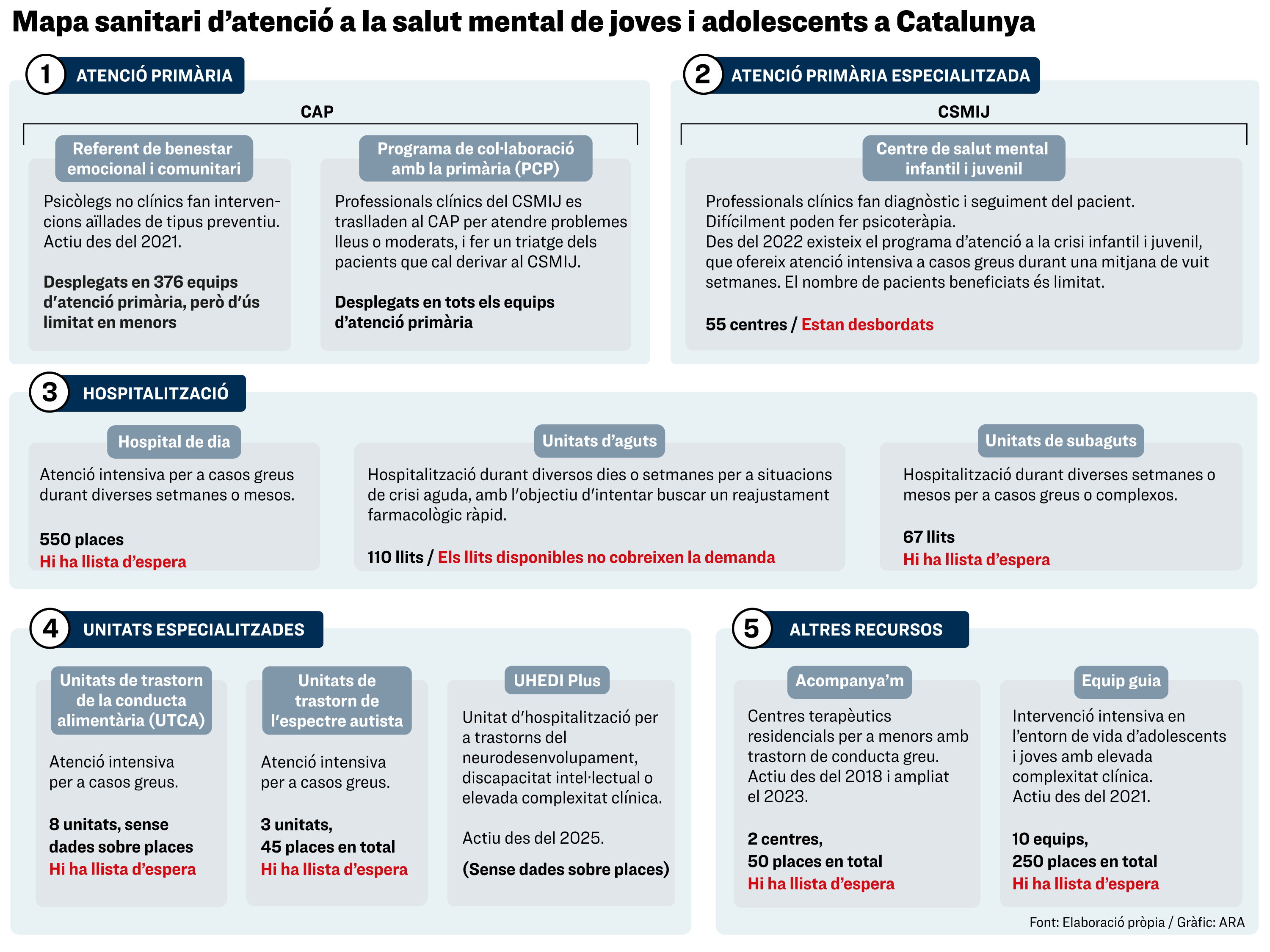
To begin with, the provider entities are in charge of the so-called child and adolescent mental health centers (CSMIJ), which are a type of outpatient clinic for the mental health of minors and which could be said to be the first tier of care. "Before, a person had anxiety and it wouldn't cross their mind to go to the doctor. Following the pandemic, campaigns were carried out on mental health and people were encouraged to seek help," highlights Laura Ramis, a clinical psychologist at the Parc Sanitari Sant Joan de Déu. This, obviously, caused demand to increase, but a whole series of social conditioning factors have also contributed to it, such as economic precariousness, migratory grief, difficulty accessing housing, social networks, or the lack of limits for minors. The result is that, currently, the CSMIJs are completely overwhelmed.
The Generalitat pays the provider entities a fixed part of money for the service they offer, and another variable part based on the fulfillment of a whole series of indicators and objectives. This year it has introduced as a new indicator that the maximum waiting time for a first visit at a CSMIJ must be 45 days. Before it was ninety. This has collapsed these centers even more. "The Government will be able to boast that it has reduced waiting lists, but, if the staffing of the CSMIJs does not grow and more patients are admitted, the only thing achieved is that later we have to visit them less frequently," complains the coordinator of the CSMIJ of Santa Coloma de Gramenet and one of the signatories of the protest manifesto, clinical psychologist Josep Checa. In fact, this is the crux of the matter: professionals denounce that the Generalitat prioritizes attending to many patients over the quality of care.
"A good therapeutic process requires a visit every week or every fortnight, but currently even a visit every three weeks is not feasible," asserts Roger Ballescà, who also supported the manifesto and is the coordinator of the child and adolescent mental health area at the Fundació Hospitalàries Martorell, one of the provider entities. According to data from the Department of Health provided this year in a parliamentary response to ERC, the average number of visits per year per patient at the CSMIJ was 8.2 in 2024. That is to say, each patient was visited every month and a half. This, however, does not mean that a psychiatrist or a clinical psychologist attended to them every six weeks, far from it, but rather that a professional from the CSMIJ attended to them, who could perfectly well be nursing staff, as the Generalitat itself acknowledges. The visits, moreover, are only half an hour long, except in exceptional cases. In private healthcare, they last a minimum of 45 minutes.
The conclusion is that, at the CSMIJ, with current demand and staffing levels, it is very difficult to follow a psychotherapeutic process. That is to say, to establish a relationship with the patient, understand their environment and what is happening to them, and foster change. This is corroborated by the president of the Catalan Society of Clinical Psychology (SCPC-ACAPIR), María José Miñano; the dean of the Official College of Psychology of Catalonia, Dolors Liria; or the director of the Institute for Teaching and Research of Pere Claver Grup, Berna Villarreal, who is dedicated precisely to the training of mental health professionals and the supervision of teams. In other words, to have psychotherapy one must go to the private healthcare sector, where a visit with a psychologist or psychiatrist costs between 50 and 120 euros.
The CSMIJ have the capacity to make a diagnosis or monitor medication, but they can hardly go any further. The Ombudsman warns in her latest Annual Report on Childhood, corresponding to 2024, that the prescription of antidepressants for children and adolescents under fifteen years of age has tripled in Catalonia over the last three years. Perhaps this is related to the limitations of the CSMIJ, but there is no evidence to prove it.
Little time with the psychologist
“I felt that I had to explain things to the psychologist in a very superficial way, and that made me feel bad because I thought that, even though I wasn't well, I wasn't unwell enough to receive help,” explains a nineteen-year-old girl who prefers to remain anonymous and who started going to a CSMIJ at fourteen. She was self-harming and also had an eating disorder. In the CSMIJ waiting room, she would try to summarize what she had to say to the psychologist because, since the visit was so short, she knew she had to get to the point. Logically, this caused her anxiety. Finally, she had a crisis and ended up in the psychiatric emergency department of the Vall d'Hebron Hospital. There, she asserts, they recommended that she seek help from the private healthcare system, because at the CSMIJ she would find it difficult to obtain proper psychotherapeutic treatment.
This, however, does not mean that it is not possible to receive adequate treatment in the public health system. In fact, for serious and complex cases, there are specialized services that work quite well, according to professionals. For example, day hospitals or medium and long-stay subacute units. Day hospitals, however, "are saturated," as acknowledged by the director of the Mental Health Master Plan of the Generalitat himself, Josep Tristany. And as for the subacute units, there are only 67 beds for all of Catalonia, according to data from the Department of Health. Consequently, there is also a waiting list to be admitted.
This is confirmed by doctors María Martín and Meritxell Centeno Casanovas, from the Fundació Hospitalàries Sant Boi, which has the largest subacute unit in Catalonia, with 25 beds. According to them, demand has skyrocketed following the pandemic: before, they barely had two or three patients on the waiting list. Now there are at least thirty. With all the suffering that this entails for these young people and their families. 40% engage in self-harm, according to last year's data.
Time-limited treatment
Lucía González Venegas is one of the privileged patients who has received treatment at a day hospital within the public healthcare network. She suffers from borderline personality disorder and had "an addiction to self-harm," as she herself acknowledges. She began to show the first symptoms at fifteen, but did not receive intensive treatment in the public healthcare system until she attempted suicide when she was already an adult. She is now 22 years old. In April, she was discharged from the adult day hospital at the Parc Sanitari Sant Joan de Déu where, she says, she received excellent care. The problem is that after one month, she was visited by a psychiatrist at a mental health center for adults (CSMA), and the next visit was scheduled for four months later, for this September. In other words, she has gone from receiving almost daily treatment to absolutely no one monitoring her for weeks. So she has been forced to turn to private healthcare: she goes to a psychologist every two weeks and pays 90 euros per visit.
Logically, for acute crisis situations, the public healthcare system does offer immediate attention. For this, there are psychiatric emergency services and so-called acute units, where patients can be hospitalized for days or weeks with the goal of seeking a rapid pharmacological readjustment. Specifically, for minors, there are a total of 110 beds, according to data from the Generalitat. Many families claim that they have spent entire days in an emergency cubicle of only a few square meters and without natural light, because there were no beds available at any hospital. Something that has made it even more desperate for both the families and their sons or daughters with a mental disorder.
Constant change of psychologist and psychiatrist
Montse Vergés's daughter has spent days in an emergency room cubicle, and has also been admitted at least three times to sub-acute units, and about thirty more to acute units.In six years, she has been treated by at least a dozen different psychologists and psychiatrists, the mother asserts, even though the bond with the professional is fundamental in psychotherapeutic treatment. The girl suffers from complex post-traumatic stress due to a traumatic experience lived during childhood. At only twelve years old she already tried to commit suicide, and at seventeen she tried again. She broke her pelvis, vertebrae, feet..., as she details herself with an impressive strength. Seeing photographs of her with her legs all bandaged after the attempt to take her own life is breath-taking.
Last April 28th she turned eighteen, and that same day, an ambulance transferred her from the acute unit for minors at the Hospital Clínic where she was admitted, to a subacute unit for adults: the one at Sant Joan de Déu Numància, also in Barcelona. That is to say, once again she has had to change psychologists and psychiatrists. Her mother has no complaints about the professionals who have treated her. Quite the opposite, she feels deeply grateful. But she does not understand the system that forces her daughter to jump from one center to another. "I feel rage," she states.
New specialized services
Over the last five years, the Generalitat has made an effort to launch new specialized mental health care services for minors. For example, the guiding teams or the so-called child and youth crisis care program. But they have the same problem: there is a waiting list to access them. Furthermore, the child and youth crisis care program, although it has been sold as a new resource, is in reality a service offered within the CSMIJ themselves: it consists of the same patient being visited several times a week by the center's psychiatrists or clinical psychologists, or by other additional professionals hired for it (such as social educators or workers), for an average of eight weeks. It is intended for the most complex cases and really gives good results. With this service, however, they have robbed Peter to pay Paul: if psychiatrists and clinical psychologists have to dedicate more time to these patients, they can dedicate even less to the rest, the CSMIJ professionals denounce.
The underlying problem is that, without a doubt, there is a shortage of clinical professionals in Catalonia. The existing ratio is lower than that of other European countries. Traditionally, the Ministry of Health has been blamed for this, but the Catalan Society of Clinical Psychology (SCPC-ACAPIR) asserts that the Generalitat also bears a great deal of responsibility for it.
Specifically, the ministry is in charge of accrediting the positions for resident intern psychologists (PIR). In other words, it assesses whether the existing teaching units in Catalonia meet the requirements to train these professionals. Since the mental health care network here depends on provider entities and is completely fragmented, it would be necessary for several entities to coordinate and ally themselves to create new teaching units, which is not being done. Therefore, if there are no new teaching units, more professionals cannot be trained. It is a vicious circle. According to SCPC-ACAPIR, the Department of Health is the one that should promote these alliances to break out of this cycle. That is to say, to take an active role instead of looking the other way.
But beyond that, professionals in the sector believe that the Generalitat must stop creating new resources. If there is not enough staff for those that already exist, how does it intend to staff the new ones? "We need to reinforce what we already have, do more preventive work," highlights Dr. Toni Coello, medical director of the Fundació Pere Mata Terres de l'Ebre –one of the provider entities– and one of the few who speaks publicly without restraint. He confesses that he no longer even tries to refer patients to certain public resources, because there are so few places that it is impossible for them to be admitted. “Obtaining a place at Acompanya'm is for us like reaching Mars,” he says as an example. The inequality of care between territories is also evident.
Acompanya'm is also a relatively new resource. They are residential therapeutic centers for minors with severe mental health disorders. There are two in all of Catalonia: one was inaugurated in 2018 in Barcelona, and the other in 2023 in Lleida. In total, they have 50 places, most of which are reserved for minors under the guardianship of the Generalitat. That is why it is almost impossible to access them, or achieving it is a whole odyssey.
Without admission centers
After more than five years of hospitalizations, going to the emergency room, the CSMIJ, and private psychologists every other day, and finding out that private therapeutic centers cost about 6,000 euros a month and were out of her reach, Margarita Viarnés agreed to give up custody of her son, Ash, so he could be admitted to an Acompanya'm center. It was a total sacrifice, but she no longer knew what to do or where to seek help. The teenager suffered from a highly complex emotional disorder.
"In the public service, they tell you that the more reports you have from the emergency room and the Mossos d'Esquadra, the better your chances of getting into a center. This is madness," complains Margarita, who admits she went as far as wishing her son would do something very serious just to accumulate reports and get him admitted. Her desperation reached that extreme.The boy stayed at Acompanya'm until he turned eighteen. Upon reaching adulthood, he was forced to leave the center. A little over three months later, he ended up committing suicide. He died on September 6, 2023.
The director of the Mental Health Master Plan of the Generalitat, Josep Tristany, admits that the system needs to be improved and has shown openness to dialogue. In fact, he has already held several meetings with the professionals who signed the protest manifesto. For its part, the Catalan Society of Clinical Psychology believes that the Government should "be honest with the population" and admit that, whether we like it or not, the public mental health system cannot currently cover everything with the resources it has available.