"They gave me twenty months to live eleven years ago": two decades of oncological revolution in Barcelona
The Vall d'Hebron Institute of Oncology (VHIO) celebrates twenty years of a model that integrates medical care and research in the same space

-
CAT -
CAST
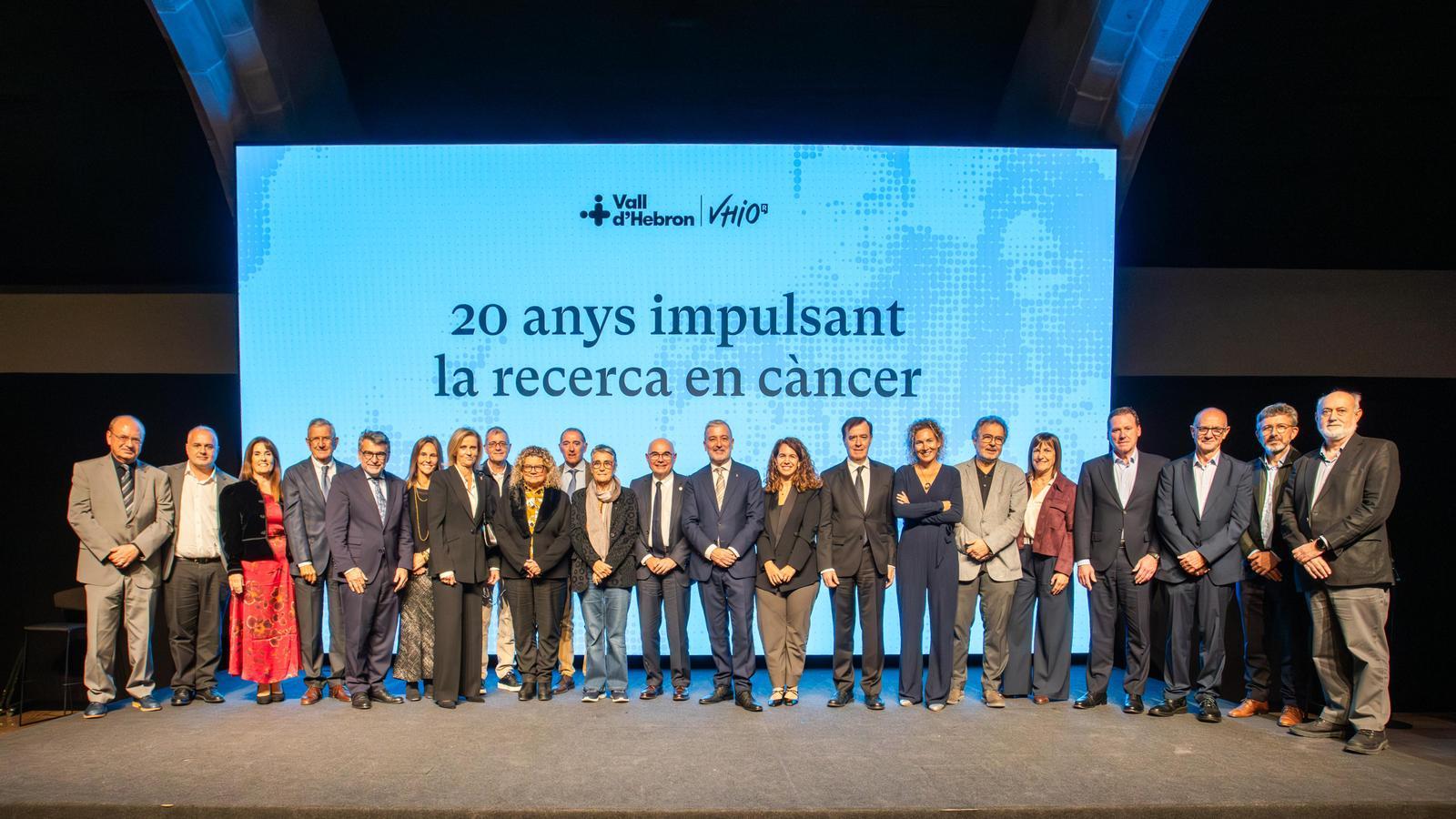
BarcelonaIsabel Lemus, Meritxell Jané, and Francesc Tarruella received, between ten and twenty years ago, a diagnosis of advanced cancer. Breast cancer with liver metastasis, colorectal cancer with liver metastasis, and melanoma with lung and brain metastasis... Treatments were scarce and the prognoses, not very hopeful. But on Tuesday, these three Catalans took the stage at the Llotja de Mar in Barcelona to explain how medical and scientific advances have allowed them to continue living for many more years. "I was diagnosed with cancer when I was 37 years old and now I am 54. I have been in remission for nine years thanks to immunotherapy," explained Jané. "When I started treatment, my oncologist told me: we will be seeing each other for a long time. And ten years have already passed," recalled Tarruella. The same thing happened to Lemus: "They gave me twenty months to live eleven years ago."
Their stories have one element in common: all three have received treatment at the Vall d'Hebron Institute of Oncology (VHIO). For two decades, this internationally renowned research center has been contributing from Barcelona to revolutionizing cancer therapies. "We opted for a model that integrated research and clinical practice. Today we know that this has allowed us to turn scientific discoveries into new opportunities for thousands of patients," stated Dr. Josep Tabernero, director of the VHIO and head of the Medical Oncology Service at the Vall d'Hebron Hospital, during the institutional event celebrating the center's anniversary. In 2006, Dr. Josep Baselga (1959-2021) began to make an ambitious idea a reality: to create a model that integrated care and research in the same environment; that is, for researchers and healthcare professionals to work together to find answers to the questions that arose in the clinics and to translate the discoveries to patients as soon as possible.
Twenty years later, the VHIO has gone from four laboratories distributed across 400 square meters to a community of more than 900 people from 45 countries, with 36 research groups and more than 12,000 square meters of workspace. Its activity has generated more than 5,000 scientific publications and has contributed to the approval of nearly 80 new drug indications. Tabernero, who has led the center after the death of Baselga, recalled that, when he was doing his residency, cancer survival was around 35% and, currently, it reaches 70%, according to the figures he shared during the event. But he also warned that this is not enough. "Cancer cannot wait, but patients even less," he recalled, citing one of the ideas that Baselga championed. Despite the advances, there are still many patients who do not find an answer to their illness.
"As if they were our own family members"
The VHIO has contributed to advancing the knowledge of tumor biology, the identification of biomarkers, and the selection of treatments based on the molecular characteristics of each cancer. It has also promoted tools such as liquid biopsy and pre-screening molecular, as well as innovative clinical trials or the development of new immunotherapies and cell therapies for tumors. And, during the event, the center wanted to acknowledge the trust and generosity of the patients who have participated: more than 21,800 people have been part of more than 9,700 clinical trials and studies.
The head of Cancer Genomics at VHIO, Ana Vivancos, recalled that the samples the laboratories work with come from people. Therefore, she defended the need to never lose sight of the goal of the research, beyond publications or academic results: "I always tell my team that we must work with the same rigor and commitment with which we would want research to be conducted if the patients were our own family members." And the focus on the future must also go beyond treatment. Between 30% and 40% of cancers could be avoided, a fact that places prevention and early diagnosis among the great priorities of the coming years. Artificial intelligence and new detection tools can also expand the possibilities of anticipating them. The challenge is to turn this knowledge into benefits for patients with rare tumors, diseases without treatment, or unfavorable prognoses.
The Minister of Health, Olga Pané, vindicated the importance of the management and scientific leadership and the governance model of the VHIO, in which the public and private sectors collaborate. For her part, the Barcelona councilor Marta Villanueva positioned the VHIO as a key piece in the consolidation of the Catalan capital as an international hub for biomedical research. "The drugs of the future are being designed there," she stated, and highlighted the relevant role of the center in attracting talent and funding, as well as in the redefinition of Barcelona as a city of science.
