"I saved mobile battery in case I needed to say goodbye": the residents of Oliva begin the reconstruction
Destroyed cars and unusable furniture and appliances are added to the toll of a storm that accumulates three victims in the Valencian Country
-
CAT -
CAST
OliveIt is eleven in the morning and under an almost summery sun and a warm westerly wind, Irene Miralles and Salvador Morató are taking a short break. They are taking advantage of the pleasant temperature, which is already over twenty degrees, to get some air and smoke a few cigarettes after a frantic and exhausting morning. For hours they have not stopped removing furniture and appliances damaged by the downpour that, between Sunday night and Monday morning, flooded several Valencian regions, especially La Safor and La Marina Alta, and caused four victims, one in Sagunt, two in Oliva, and the last one in Pego, a farmer found this Tuesday, whose death is still being investigated to see if it was caused by the heavy downpours. "We were very afraid. It is the third flood I have experienced and until now the water had never entered the house. We are not prepared for what is coming our way", laments Salvador.

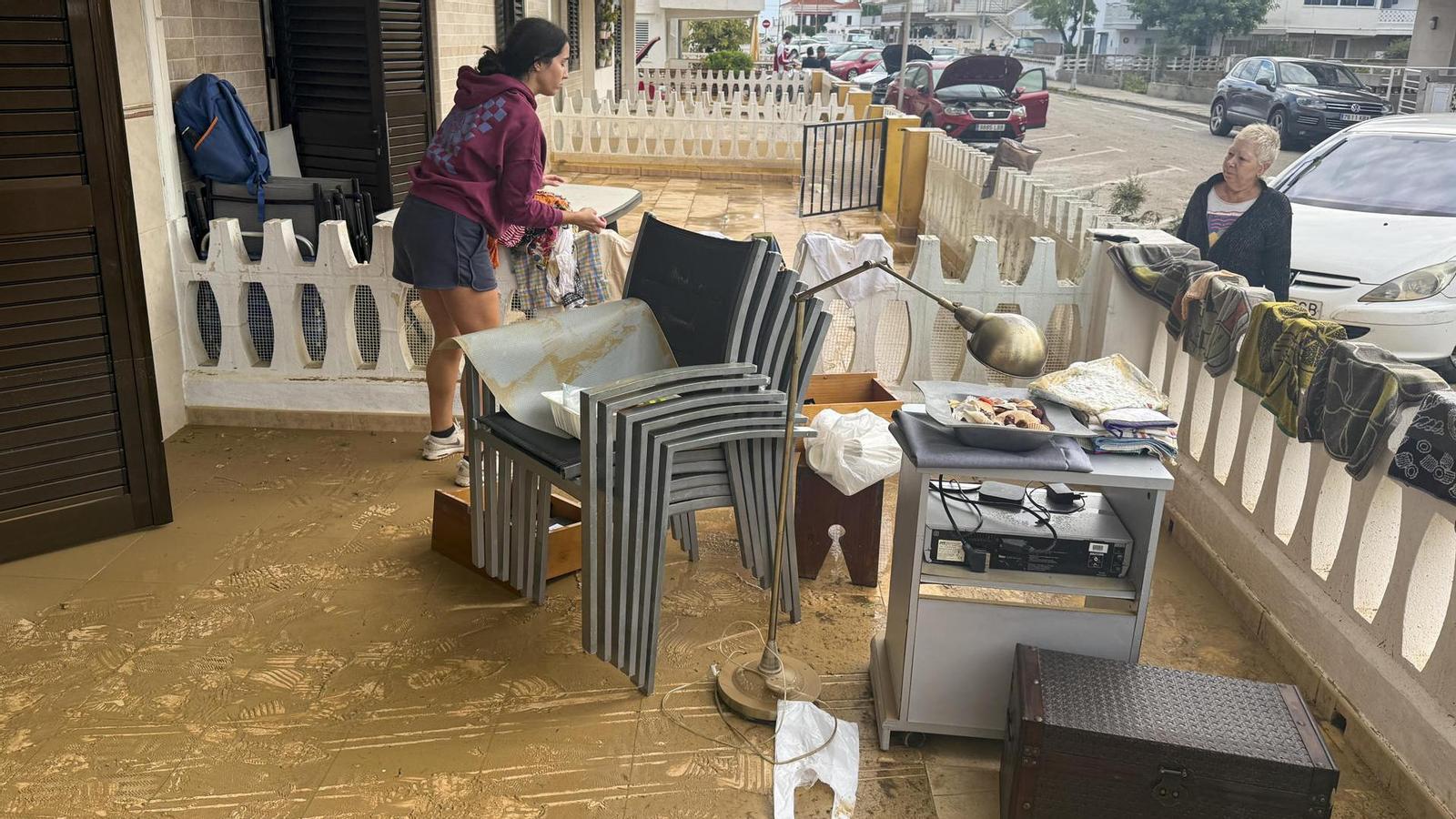
To sit down, both take advantage of what until Sunday was a nice and comfortable white sofa, which now only waits for the council workers to come and collect it to take it to the dump. They are emptying the house of Amalia Marí, Salvador's mother, who was rescued with a kayak by some neighbors from what is popularly known as the "Oliva beach," which is located next to the town's old fishing district and just two kilometers from the heart of the town. The 82-year-old woman looks on, confused. She does not want her children to throw everything away, but they explain to her that nothing is usable anymore, that everything is ruined or rotten, including two cars and a motorcycle. "It was horrible and agonizing, I still have the fear in my body," recalls Salvador, who lives in the nearby town of Pedreguer, and who spent the whole night and early morning calling his mother to see how she was, consumed by the helplessness of not being able to reach her, as all the roads were flooded.
However, the one who suffered the most was Cristina, his sister, who has just arrived at the house accompanied by her daughter. "We thought we would pull Mom out dead, she woke up when the water started to soak her mattress," she admits bluntly. "And mind you, I live in the house opposite, but I couldn't cross. The water had a lot of force. Imagine the frustration I felt," she emphasizes, while explaining that she was not at risk because her house, unlike her mother's, has two floors and is built on high ground. Mind you, she has lost her car and many objects and now she does not know how she will go to work.
The anguish that Amalia had was also suffered by Hortensia Aguilera, another resident of the area. "When the water started to enter, I climbed onto the table. Later, upon seeing that the level was rising [which exceeded half a meter], I placed a chair on top of the table and stayed there. I saw it so bleak that I stopped talking on the phone to save a bit of mobile battery in case I needed to say goodbye to my family". Hortensia explains her suffering to us accompanied by her two daughters who, helped by two friends, are emptying the humble home while they wait for the water to return so they can start cleaning. Like Salvador and Irene, they also could not access the neighborhood to save their mother and did not stop calling 112 in case the helicopters, which were rescuing other people at the time, could come immediately. Once again, the solution came from the same young people who helped Amalia and who took Hortensia out of the house in a kayak in images that have already gone viral, as the protagonist proudly shows us on her mobile. "I was very afraid. All that I have and more", she admits.
Looking towards the future
Once the nightmare of an "eternal" night and early morning has been overcome, doubts appear when Amalia or Hortensia look to the future. They know that torrential episodes are becoming more frequent, and that it will not be necessary to wait forty years –in the area the last equivalent storm was recorded in 1987– for it to rain so much again. "Now I have to go to my daughter's house in l'Alqueria de la Comtessa, but I am clear that when I return to live here I will not wait so long. The moment a few drops fall, I will take refuge in my daughters' apartments," she summarizes. Who does not know what she will do is Rosa Morell, another neighbor from the neighborhood who complains about the lack of urban planning. "Construction has been allowed where there used to be marshland or orchards. And what was illegal has been legalized. This has a difficult solution," she summarizes distressed.
Before leaving, we visit Amalia again, who is drying her old sewing tools with a cloth. Perhaps it is what has the least economic value in the house, but it is what this retired seamstress appreciates the most. She places the scissors and thimbles on the sofa where her sister-in-law and her son used to rest. She hangs the threads and ribbons on a rack so that the sun can dry them. "We have no other choice, to start over and look at the sky so that it doesn't rain like this again. We'll knock on wood," she concludes.
