In the heart of the DANA in the Valencian Country: "It was raining so much that the water was coming in through the windows of a third floor"
The storm has caused two mortal victims and has provoked serious floods on the south coast of the Valencia demarcation with some historic water accumulations
-
CAT -
CAST
Valencia"I woke up because it was raining so hard that water was entering our house through the windows, to the point that an inch of water had accumulated in the dining room. And I'm talking about a third floor." Sergi Morell, a resident of Oliva, will not easily forget the DANAAdam, which has left historic records in the Valencian regions of La Safor and La Marina Alta: up to 720 liters per square meter in nearly 36 hours. The episode also caused rivers to overflow, flooded six municipalities, and left hundreds of people trapped in their homes. A count to which the most tragic of balances must be added: as of now, there are three fatalities, a woman and a man from Oliva and another from Sagunto, who had disappeared on Sunday afternoon at the beach where she had been swimming, even though an orange alert for rain and coastal phenomena had been active all day.
"Despite yesterday's [Sunday] rains, which were already heavy, we were not aware of what was coming. When the ES-Alert sounded in the early hours, that is when we realized what was happening on the street and what was falling," explains Maria Tur, a 34-year-old resident of the Pau Pi urbanization, also in Oliva. Like so many citizens of the La Safor region, she woke up with the town flooded and unable to leave her home.
Beyond the ordeal, the link between Sergi and Maria is the trace of a catastrophe that did not cause them personal harm, but did cause material damage. "The whole family lives in the area, and my sister's car, her partner's car, and my parents' cars have been rendered useless. That is not the case for me, as I live in a slightly higher area," she explains. Sergi is less optimistic, given that the water level reached half the windows of his vehicle, in addition to flooding a ground floor where he keeps his motorcycle and other belongings.
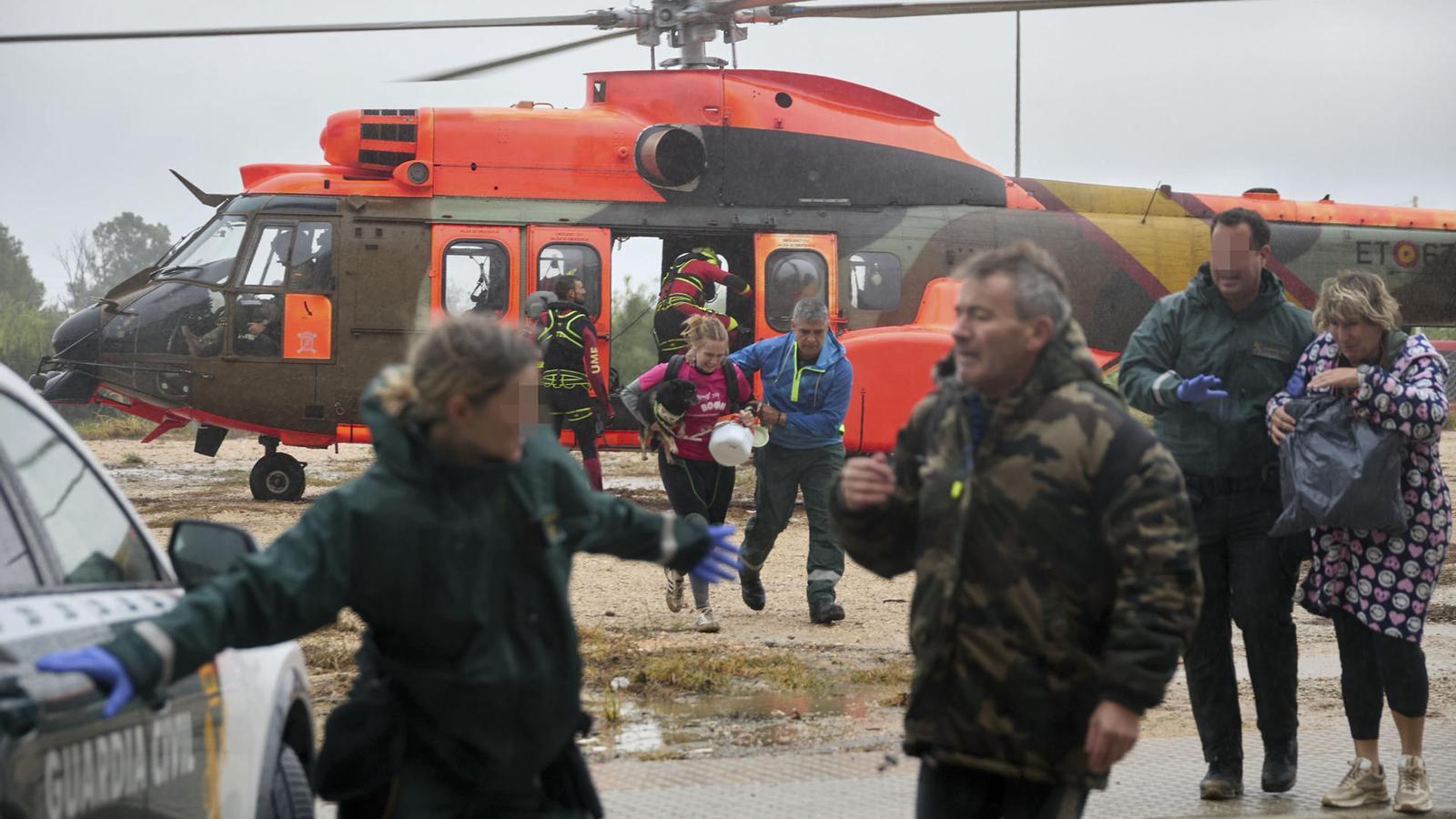
Both are talking over the phone with ARA at the same time that images are going viral of the 15 helicopters rescuing people from the numerous beach urbanizations in the area and the popular country houses. Videos of neighbors who have used surfboards to move through streets where, although the level is progressively dropping, a lot of water still accumulates, have also been massively shared.
The most tense moments were experienced in the towns crossed by rivers that, despite being short in length, have overflowed. This is the case of the Girona in Beniarbeig, Gorgos, the Algar and els Poblets or the Vernissa in Ròtova. However, where it rained the most was in the hamlet of Forna, which belongs to the municipality of l'Atzúbia, where 720 liters per square meter have accumulated, according to figures from the Valencian Association of Meteorology (Avamet), which highlighted that the data will go down in the "meteorological history" of the Valencians, since such a downpour had not occurred in the area since 1987. Also extraordinary were the 693 l/m² in Pego, the 643 l/m² in Oliva, the 615 l/m² in Real de Gandia or the 602 l/m² in Barx. The most notable aspect of the situation, however, is that many towns in the region have exceeded 500 liters in 36 hours.
Beyond the spectacular precipitation figures, the numerous damages to vehicles, damaged garages and flooded ground floors, or the traces left on agriculture and on mountains that are increasingly eroded, what the episode leaves behind is, according to Sergi Morell, a feeling of "impotence". "We are aware that Oliva is a low-lying area, right by the sea, an old wetland, and that every two years we have heavy rains, but this is something else," he emphasizes. And he concludes: "We can issue alerts, but if this becomes a recurring event, we have a serious problem. We will need measures of many types and be willing to make many changes".
Did the Valencian Generalitat take too long to order a lockdown?
"You yourselves prohibit the travel of working people; certain companies will not heed the city councils." The request was made at 5:41 a.m. this morning, on his X account, by Alexandre Ruiz Gadea, mayor of Bellreguard, one of the eight municipalities most affected by the downpour. He addressed it to the Emergency Coordination Center of the Valencian Government, a department that had decreed a red warning on Saturday and Sunday and had sent several ES-Alerts, and which this Monday repeated the operation on two occasions, asking citizens to avoid travel, not to cross floodable zones, and not to approach rivers, ravines, riverbeds, promenades, and coastal areas; also to look for elevated places or go up to higher floors, and not to go down to basements or garages or use elevators. The warning was added to the suspension of classes already decreed the day before by the town councils of the two regions and others nearby. In total, more than 103,000 students.
Ruiz's request raises the question of whether the Valencian Government took too long to decree a lockdown that did not come into effect until after 11:00 a.m. and that extended to the regions of Ribera Alta, Ribera Baixa, and Marina Baixa, thereby affecting more than 900,000 people in total. It also raises the question of whether this alleged slowness may have increased the number of people affected by the downpours, given that the mobility restriction was agreed upon later than the usual time for starting work.
In favor of the Valencian government, it could be argued that, with a red warning like the one in force in the area this Monday, employees can work remotely or take advantage of a paid leave of up to four days (supported by Article 37.3.g of the Workers' Statute). A possibility that, however, and as the mayor of Bellreguard pointed out, can sometimes generate reluctance in companies and, therefore, fear in workers of suffering possible reprisals.

Be that as it may, on this occasion the Generalitat has not received any criticism, at least not until now. Neither from the Spanish executive, which through its delegate in the Valencian Country, Pilar Bernabé, has applauded the work done because in the current DANA there has been "anticipation", the population has been warned and there has been institutional coordination, unlike that of October 29, 2024, which caused the death of 233 people and in which Carlos Mazón's chief of staff, José Manuel Cuenca, asked the former minister Salomé Pradas to rule out confinement with the now-famous message: “Salo. No confinement, please. Calm down”.
