The AVE high-speed train from Barcelona to Madrid will take less than two hours.
Minister Puente promises a change so that the service operates at 350 km/h, only "comparable" to the Chinese system


-
CAT -
CAST
BarcelonaTransport Minister Óscar Puente announced on Monday that the Spanish government will launch the AV350 project to accelerate the high-speed trains (AVE) connecting Barcelona and Madrid to 350 kilometers per hour. He indicated that the upgrade will shorten the journey between the two cities to two hours—currently almost three—although the minister did not rule out the possibility of an even shorter journey time. He emphasized that this speed is currently only found on China's rail network. The upgrade is expected to begin next year and is estimated to take three years to complete.
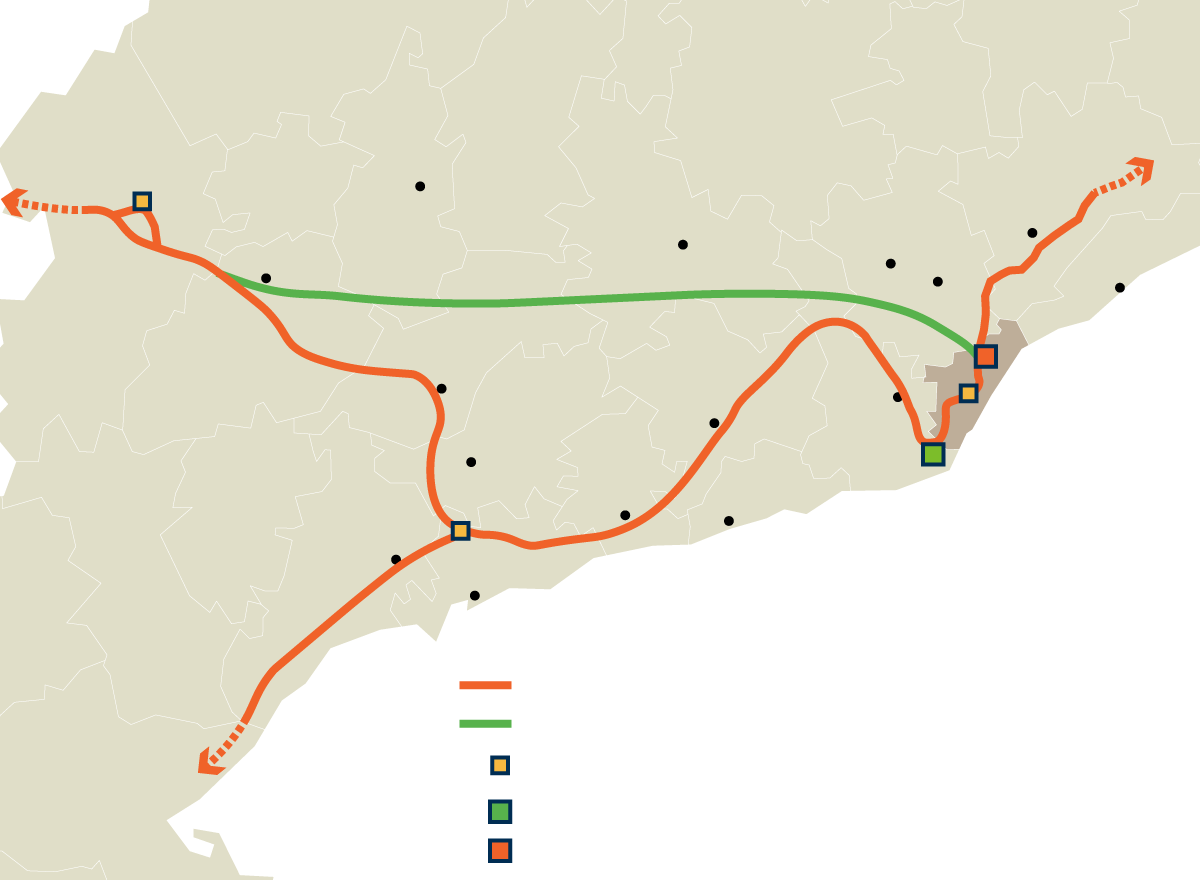
Canvis a la línia d’AVE entre Barcelona i Madrid
a Girona
LLEIDA-PIRINEUS
Tàrrega
Granollers
Igualada
Les Borges
Blanques
Terrassa
Mataró
a Saragossa
i Madrid
Sabadell
LA SAGRERA*
Montblanc
Vilafranca
del Penedès
SANTS
Sant Feliu
de Llobregat
Barcelona
Valls
AEROPORT
JOSEP
TARRADELLAS
EL PRAT
El Vendrell
CAMP DE TARRAGONA
Vilanova i
la Geltrú
Reus
Tarragona
Tram en servei
Tram en desenvolupament
Estacions existents
Nova estació
Nou accès
a València
LLEIDA-
PIRINEUS
a Girona
LA SAGRERA
a Saragossa
i Madrid
SANTS
Barcelona
AEROPORT
JOSEP
TARRADELLAS
EL PRAT
CAMP DE
TARRAGONA
a València
Tram en servei
Tram en desenvolupament
Estacions existents
Nova estació
Nou accès
LLEIDA-
PIRINEUS
a Girona
LA SAGRERA
a Saragossa
i Madrid
SANTS
Barcelona
AEROPORT
JOSEP
TARRADELLAS
EL PRAT
CAMP DE
TARRAGONA
a València
Tram en servei
Tram en desenvolupament
Estacions existents
Nova estació
Nou accès
Puente explained that the Barcelona-Madrid line captures 85% of the passenger share between the two capitals, but is "very saturated" and needs more capacity to meet demand. Currently, it is used by around 15 million passengers, compared to 2.2 million fifteen years ago. However, he argued that the current route between Barcelona and Madrid "still has significant growth potential" and already allows for higher speeds. "We will take advantage of the fact that we must renovate this line, which is almost twenty years old, to convert it into a 350 km/h line," he stated.
To increase the capacity of the AVE high-speed trains, as Puente detailed at a Europa Press breakfast, there are only two options: build more tracks—which would require tripling the number of tracks between Barcelona and Madrid with "all the associated costs, time, and procedures"—or increase the speed of the lines. With the second alternative, the minister argued, not only will passengers arrive at their destinations sooner, but more "tracks" (the term used to describe train schedules) will be made available to rail operators. According to Puente, the change—for which the necessary investment has not been broken down—will come from the installation of new aerodynamic crossings. These future elements, which support and secure the rails, will reduce the aerodynamic load generated by trains as they pass over the tracks by 21%, thus preventing the ballast from becoming lifted and impacting the underside of the trains at these speeds. "They allow for a 12% higher speed with the same aerodynamic load, meaning that a speed of 330 km/h with this aero crossing, in real terms, is equivalent to a speed of 370 km/h under current conditions," he explained.
In this regard, he said that there are countries in Europe taking steps to achieve a high-speed rail system, such as Poland and the United Kingdom, but he stressed that the former "is starting from scratch, it doesn't even have a single kilometer of high-speed rail yet," and the latter currently only has the London-Birmingham line, which is going to be completed. "We are going to become the only country in the world, along with China, that has a high-speed network at 350 kilometers per hour," Puente insisted. This is "a new starting point" for transportation in Spain, and he assured that the goal is for his ministry to be able to make a new investment of 60 billion euros over the next four years in trains, roads, ports, and airports.
New stations
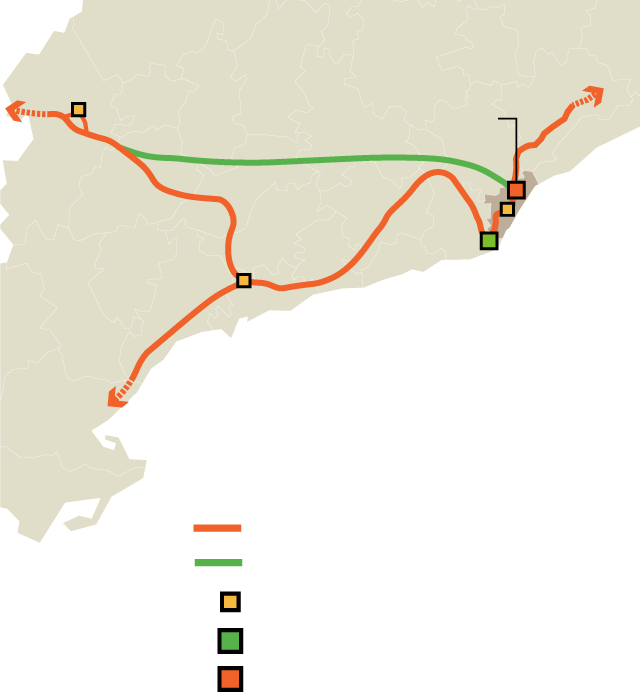
Puente also announced that new access points to the AVE high-speed rail network will be built in both Barcelona and Madrid to improve the operational efficiency of the Barcelona-Madrid line; that is, to increase traffic flow at stations and provide greater flexibility in the event of disruptions, he explained. In Catalonia, in addition to making La Sagrera a key high-speed rail hub, the Spanish government is studying the creation of another AVE line that would directly connect Lleida with Barcelona, bypassing the Camp de Tarragona region and instead passing through the center of the country. Furthermore, the El Prat station will be incorporated into the existing AVE line—the one that does pass through the Camp de Tarragona region. as announced last MayThus, Catalonia will have a total of three stations: La Sagrera, Sants, and El Prat. Regarding Madrid, Puente specified that Barajas Airport will be connected to Chamartín-Clara Campoamor Station, and a new AVE (high-speed rail) station will be built in Parla, in southern Madrid, so that travelers between Andalusia and Catalonia can change trains there and avoid entering the Spanish capital through Altos. These new connections are considered crucial due to the high volume of traffic that the full operation of the Mediterranean Corridor will generate, expected no later than 2027 or 2028.
