Lorenzo Salazar: "Organized crime is moving from killing people to infiltrating the economy"
Magistrate and president of the European Committee on Crime Problems of the Council of Europe

-
CAT -
CAST
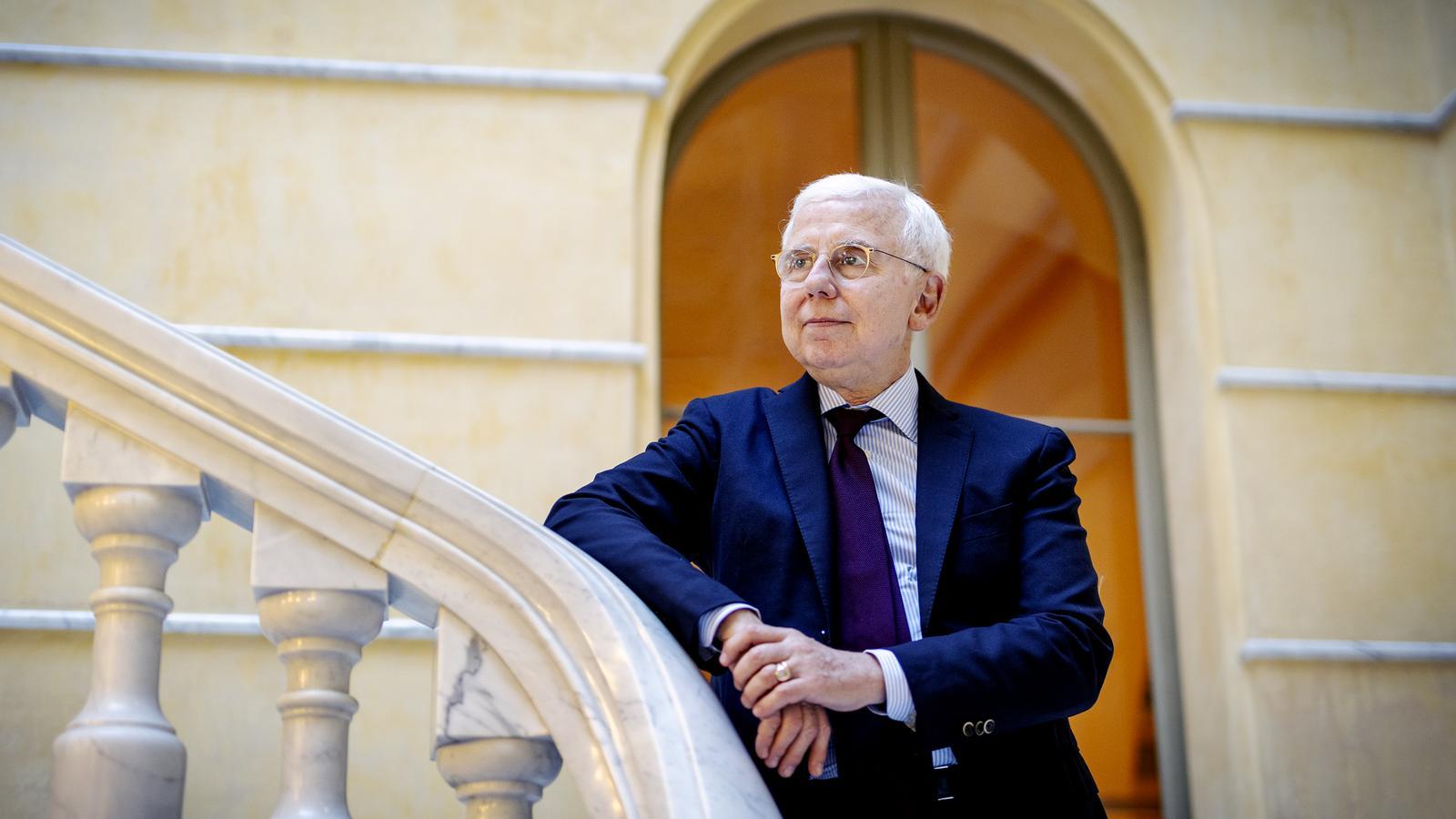
BarcelonaThe Italian magistrate Lorenzo Salazar has a long career in the Italian judiciary – he has been, for example, a prosecutor in Naples – and is also completing an extensive stint in European institutions, currently leading the European Committee on Crime Problems of the Council of Europe. He is in Barcelona these days for a conference of the European Notarial Academy on international crime, which is being held at the Notarial College of Catalonia.
What is the main threat in the field of organized crime?
— At the Council of Europe, we are working hard on financial crime; it is a priority. Two weeks ago, we agreed on an additional protocol to the Warsaw Convention on money laundering and the prevention of terrorist financing. It is a very good tool that is aligned—and this is important—with the instruments of the European Union. What has been achieved in the European Union can be extended to 21 more countries through the Council of Europe's instruments. We can even go beyond our borders, because our conventions are also open to third countries.
One of the problems with money laundering is that there are tax havens or economies with fewer regulations involved.
— We have large gaps in the world map. In Asia there is a problem, because there are countries that represent a very important part of international trade. They can resort to bribery in international exchanges and there is no way to avoid it. The United Nations convention, in theory, binds almost every country in the world, but there is no oversight system. It is very important to understand that having a legal instrument is not enough: it must be applied. There must be someone to seriously monitor compliance. Organized crime is moving from killing people in the streets and controlling drug trafficking –things that still happen, but have been reduced– to using dirty money to infiltrate the economy. The mafias have infiltrated economic activities and have acquired control of them.
If we talk about organized crime, mafias, terrorism, is it very difficult to find a way to achieve more coordination outside the EU borders?
— It is already difficult inside. We come from a golden age, that of the end of the last century. In September 2001, there was a great effort to react to the attacks in New York: we criminalized terrorism, we created Eurojust [the European Union agency in charge of strengthening judicial cooperation between member states]. Later, we eased off a bit. We have indeed achieved important milestones, such as the European Public Prosecutor's Office, but there is no longer the same willingness to go further. I do not perceive the same enthusiasm.

Organized crime attempts to infiltrate the formal structures of the State. Does this exist in Europe?
— To begin with, the situation in Europe cannot be compared with that of Latin America. In Europe, at times, we have local administrations that are infiltrated. In Italy, there have been dozens of local administrations with their governments suspended, and we have appointed commissioners from the Ministry of the Interior to govern them. But these are very specific situations. I could not say that today the mafia has infiltrated, for example, the Italian Parliament. Naturally, there may be politicians who maintain relationships with them. Some have even been prosecuted. But I would not say that there is evidence that organized crime has the capacity to directly influence the Italian government or any other European government, at least not that I am aware of.
Here in Catalonia we have recently had several executions in broad daylight.
— Spain has always been a very attractive place for trafficking. Naturally, no trafficker can feel safe in any European country. But I do not know the specific situation in Catalonia well enough. Obviously, the economy is developing and money always attracts this type of activity, along with the good life that one can have here.
In Barcelona we have another problem and it is the port. And not only here, also in Valencia, in Antwerp, in Rotterdam, in Genoa...
— Italian agencies say that discovering more illicit activities is not explained only because Italian ports are more infiltrated, but also because Italian agencies act more proactively. But, once again, this is just an impression. More specialized agencies are needed. It is evident that, with the volume of trade that exists, the control cannot exceed a certain level because, otherwise, the activity would be blocked. Therefore, artificial intelligence, modern technologies, X-ray systems... everything can be useful.
Let's talk about Italy. Since you landed in the judicial world until now, how has the mafia changed?
— In Italy you cannot speak of the mafia, you have to speak of the mafias. There are real differences between Sicily, Calabria, Campania, and Apulia. For example, in Naples, the Camorra is so atomized that there are many small families, to the point that when you act against one that lives in a certain area of the city, another one immediately arrives to take its place. In Sicily it was different. There, my colleagues were able to hit the mafia very hard because it had a more pyramidal structure. The 'Ndrangheta is also different. In Calabria we have discovered incredible things. For example, some phone taps showed that a man from Calabria who worked in Australia, in Perth, and who wanted to open a pizzeria there, made the whole trip to a small town in Calabria to ask for permission to do so. Just for a pizzeria! Therefore, if I had to summarize the general situation in a few words, I would say that there is a progressive shift: we have fewer and fewer deaths each time and they move more and more towards the control of the most profitable criminal activities: first drugs, but also smuggling, human trafficking, women trafficking... And they use this money to invest, reinvest, and earn money.
In Catalonia, criminal groups often launder money by buying and selling cars. In Italy as well?
— No, in Italy, as you can imagine, they are restaurants. And the problem is that this is combined with tourism. In Rome, the entire city center is turning into restaurants. And most are not good, from the point of view of quality, of course.
Doesn't the Italian mafia cook well?
— I am sure that within your family you cook very well. In Rome, from time to time, we see how businesses are confiscated, even ten pizzerias at once, because they belong to the mafia. But the mafia has a great capacity for resistance and adaptation. It is like a cat-and-mouse race. And sometimes they also acquire companies through extortion. In Naples, we had many activities that had been absorbed through usury.
And is there a significant presence of these Italian mafias in Spain?
— Without a doubt. Many people wanted by the Italian authorities are in Spain. Sometimes due to drug trafficking, other times because they are fugitives. But we cooperate a lot in matters of extradition with Spain. We have a liaison magistrate here because the cooperation is very intense.
At the Council of Europe, they are also analyzing terrorism. How would you define the current situation in Europe?
— I have the impression that, after a period in which Islamist terrorism was very active, security agencies are now quite prepared to respond to this threat, the one that kills people on the street, with the exception of the actions of lone wolves. But my impression is that we will now have to face a more sophisticated form of terrorism. All the activities with drones, the alerts about flights, show that there is an intention to destabilize.
Finally, let's talk about corruption.
— It is precisely what I am working on right now. I would like the Council of Europe's instruments in the field of corruption to be updated, because we were at the forefront in 1999. I am looking towards 2029, thirty years after the convention, as a target date to have our instruments updated, because there are certain crimes that are not covered there.
In Spain, there are legal cases affecting the main parties. Does this concern the Council?
— I could not say that there is any specific problem with Spain. The fact that there are investigations and criminal proceedings is always a good sign. It is clear that everything depends a lot on the independence of the judiciary. The system is different from the Italian one. You have prosecutors and judges separated, while in Italy the judiciary is a single body and they tend to react together to the reactions of politicians when there is a problem with corruption. In Spain, I have the impression, a very personal one, that, depending on which government is in power, the prosecutors are not independent. But I am speaking from a very Italian point of view, and I am not saying that our situation is better than that of Spain or another country.
